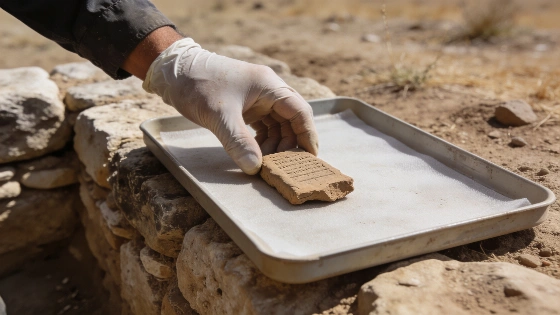
A newly identified cuneiform fragment from Hattusa belongs to the Hittite version of the Kadesh Peace Treaty and preserves clauses on fugitives who crossed between Egypt and Anatolia
A fragment of the Kadesh Peace Treaty has been identified among excavated remains at Hattusa, restoring part of a diplomatic record that once governed relations between the Hittite Empire and Egypt. The surviving text corresponds to articles 12 through 20 and concerns fugitives who left one kingdom for the other. The identification was publicly confirmed by Turkey's Minister of Culture and Tourism, Mehmet Nuri Ersoy, on 21 September 2026, the International Day of Peace.
The fragment at Hattusa
The piece was found near Building E in the Büyükkale area of Hattusa, the Hittite capital in modern-day Turkey's Boğazkale district in Çorum Province. It underwent scientific and textual analysis for about a year before researchers confirmed that it belonged to a Hittite copy of the treaty concluded between Hattusili III and Ramesses II during the 13th century BCE.
The object is not a complete tablet. Reports indicate that only one side of the small clay fragment survives, making it valuable primarily as a securely located textual witness. Its Akkadian cuneiform refers to fugitives from both Egyptian and Hittite territory and includes provisions intended to preserve the homes they had left behind. Those details do not provide a complete account of migration or resettlement in the Late Bronze Age; they document the legal terms that the two states agreed to apply when people crossed their borders.
That distinction matters in archaeology. A text can show what rulers claimed or required without proving how consistently officials enforced those rules or how fugitives experienced them. The Hattusa fragment is therefore evidence for the treaty's wording and transmission rather than a direct record of every movement between the two kingdoms.
A treaty in two scripts
The agreement followed a prolonged rivalry between the Hittite and Egyptian empires. Its provisions covered peace, mutual non-aggression, military assistance and the extradition of fugitives. Copies were produced by both powers: the Egyptian version survives in hieroglyphic inscriptions on temple walls, while the Hittite version was written in Akkadian using cuneiform. The Kadesh agreement is consequently important not only for its political content but also because parallel versions allow scholars to compare distinct writing systems and manuscript traditions.
Fragments of Hittite copies were recovered at Hattusa during excavations conducted between 1906 and 1912. They are now held in museum collections in Istanbul, Ankara, Berlin and St Petersburg. The newly identified piece adds to that dispersed manuscript record and may help researchers reconstruct more of the original clay tablets, although missing sections still limit what can be read.
The find also illustrates why excavation context remains central even when an object's text is historically famous. The fragment came from a defined area of Büyükkale rather than appearing as an isolated antiquities-market object. The excavation and documentation framework is consistent with the work of the German Archaeological Institute, whose Istanbul branch has conducted research at the site. As with the Galician find, the location and archaeological documentation are part of the evidence, not just background to the discovery.
What the text can establish
Hattusa was the political and administrative center of one of the Late Bronze Age's major powers. Archaeological investigations at the site began in 1906, and UNESCO designated it a World Heritage Site in 1986. The continuing importance of that protected context is reflected in the UNESCO Hattusa listing. Current work at Büyükkale is being conducted by the Istanbul branch of the German Archaeological Institute under the direction of Prof. Dr. Andreas Schachner.
The measurable historical core of the discovery is narrow but significant: the fragment preserves material corresponding to nine treaty articles, numbered 12 through 20, and was analyzed for approximately one year before its identification was announced. Its clauses concern people who crossed the border and the obligations of the authorities toward them and the property they had left behind.
The announcement date gave the discovery a modern symbolic frame, but the archaeological value lies elsewhere. The fragment joins copies and fragments held across several collections and supplies additional wording for scholars comparing the Hittite manuscript tradition with the Egyptian inscriptions. Excavations near Building E are continuing in the hope of finding more missing pieces.
The treaty is often described as an early peace agreement, but its clauses were practical as well as commemorative. They set out obligations between rival states, including how each side should respond to fugitives and protect property. The fragment's importance is consequently textual and institutional: it provides another piece of evidence for how two powerful governments formalized a settlement after conflict.
Its evidentiary standard is closer to philology, historical criticism and archaeological documentation than to the statistically powered experiments often reported in journals such as Nature or conducted by large research communities at MIT and the Max Planck Society. There are no meaningful p-values or confidence intervals for determining whether a damaged cuneiform sign belongs to a particular treaty clause. Instead, identification depends on the convergence of archaeological provenance, sign forms, language, parallel passages and comparison with other treaty witnesses.
Reading damaged evidence
Cuneiform tablets are durable but not indestructible. A fragment preserves only what survived breakage, burial and recovery, and interpretation depends on comparing the remaining signs with other copies and inscriptions. Missing passages can restrict translation and make it unsafe to treat one fragment as a complete statement of policy.
In this case, the evidence supports a careful conclusion. Researchers have identified the clay fragment as part of the Hittite version of the Kadesh Peace Treaty, and its preserved clauses concern cross-border fugitives and their homes. It does not by itself establish the number of people who fled, the frequency with which extradition occurred or the extent to which the treaty ended rivalry between Egypt and the Hittite Empire.
That restraint does not diminish the discovery. It is precisely because the fragment is tied to a known excavation area and can be compared with other treaty witnesses that it carries historical weight. Hattusa's continuing excavations may recover further pieces, but the fragment already strengthens the physical record for one of the ancient world's most consequential diplomatic agreements.
Cuneiform is a writing system made by pressing a shaped reed into wet clay, leaving wedge-like impressions that hardened as the tablet dried. A fragment's meaning is established through the surviving signs, language, parallels in other copies and the archaeological context in which it was recovered. Because the Hattusa piece is incomplete and preserves only one side, its value lies in adding securely located wording to a larger manuscript tradition rather than supplying an independent and complete version of the treaty. The discovery therefore signals progress in reconstructing the document while preserving the limits imposed by damage and missing text.