
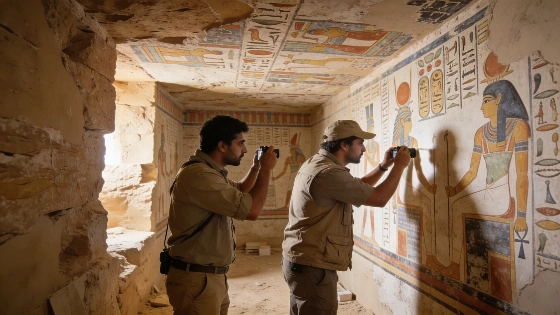
A Roman-era pyramid tomb at Bir al-Shaghala contains Egyptian funerary imagery, a 19-line Greek poem and a Constantine-era bronze coin, offering a rare view of cultural exchange in the Dakhla Oasis.
A pyramid-shaped Roman-period tomb at Bir al-Shaghala in Egypt's New Valley has produced an unusually concentrated record of cultural overlap: Egyptian funerary architecture and religious imagery stand alongside a 19-line poem written in ancient Greek. Egypt's Ministry of Tourism and Antiquities confirmed the discovery on 24 September 2026, placing it within the Roman period, conventionally dated in Egypt from 30 BCE to 395 CE.
The tomb was constructed from mudbrick and, according to the preliminary interpretation of the archaeological mission, was intended for a man and his wife. Its contents include a Greek-inscribed stone funerary stele, a sandstone offering table, a sandstone purification bowl, pottery and a bronze coin bearing the image or inscription of Emperor Constantine. The combination is important not because it proves a single, uniform cultural identity, but because it documents Egyptian and Greek practices within one funerary setting.
The discovery has been reported by several independent outlets, including Ahram Online's report. At the time of the available announcements, no separate official valuation, court proceeding or subsequent administrative decision had been published. The interpretations therefore remain preliminary and should not be treated as a completed archaeological assessment.
Fourteen steps descend toward an elaborate stone entrance designed in an Egyptian architectural style. The entrance includes a cornice, a winged sun disc and elements resembling bundled reeds. A stone panel carries deeply carved hieroglyphic inscriptions, protective spells and religious recitations, while the doorway was sealed with a stone closure showing a human figure surrounded by protective symbols.
Beyond the entrance is a hall made from plastered mudbrick and covered by a sloping roof. Part of its western side has collapsed. Two additional plastered burial structures were found on the right, and a further carved limestone slab above the main entrance suggests that the monument may have been altered or reused after its first construction. The distinction between mudbrick structural elements and limestone architectural fittings is significant because it helps archaeologists separate building materials, repair phases and later modifications.
The most unusual Egyptian religious image is associated with the Amduat, whose title means "That Which Is in the Afterworld." The composition describes the sun god's journey through the underworld across the 12 hours of night and his renewal at sunrise. Its appearance in a Roman-period tomb does not mean the burial followed an unchanged New Kingdom program, but it does show that established Egyptian ideas about death and regeneration remained available for later communities.
Interpreting such material requires the same separation of observation and inference used in other evidence-based disciplines. Institutions such as NASA and CERN routinely distinguish directly recorded measurements from model-dependent conclusions; archaeology applies an analogous principle when separating an inscription's content from assumptions about the deceased person's identity, office or date.
On the southern wall, archaeologists found a rectangular stone stele with a geometric upper section and a carved sun disc. Its surface preserves a 19-line funerary poem in ancient Greek commemorating a person named Pisichthes, also rendered Bisichthes in transliteration. Researchers tentatively suggest that Pisichthes may have been a judge, although the inscription alone does not establish the individual's precise office, legal jurisdiction or social position.
Preliminary analysis places the poem in the late third or early fourth century CE. That estimate is not the same as a direct date for the tomb's construction. The Constantine coin provides another chronological clue, but archaeologists must establish whether it belongs to the original burial or to later reuse before using it to date the monument more closely. Epigraphic dating is normally strengthened by comparing letter forms, language, carving technique and archaeological position rather than relying on a single object.
The find's importance lies in the combination rather than in any single artifact. Greek had served as a major administrative and cultural language in Egypt since Alexander the Great's conquest in 332 BCE and continued in use after Egypt became a Roman province in 30 BCE. A Greek literary inscription inside a monument decorated with hieroglyphic protections and Egyptian afterlife imagery records that coexistence at the level of one funerary complex.
That pattern resembles the mixed evidence documented in earlier research on ancient societies where texts and material contexts must be read together rather than treated as evidence of a single cultural identity. At Bir al-Shaghala, the architecture is Egyptian in its formal vocabulary while the poem points to the continued intellectual and commemorative use of Greek in the oasis.
Future study could improve the chronology through systematic epigraphic documentation, microscopic examination of pigments and mortars, ceramic comparison and laboratory analysis of the metal composition of the coin. Those methods would not automatically resolve every question: a scientific result must still be tied to the object's archaeological context. This emphasis on transparent documentation and reproducibility is consistent with the standards expected in leading research literature, including the journal Nature, although no peer-reviewed laboratory study of this tomb has yet been reported.
Bir al-Shaghala is associated with ancient Mothis, now known as Mut, in the Dakhla Oasis. Mothis was an important settlement during the Roman and Byzantine periods, and excavations at the site have been under way since 2002. Archaeologists have identified tombs with varied architectural and decorative programs, including upper shrines crowned by pyramid-shaped structures that may have marked burials connected with the oasis capital's elite.
The newly reported complex contains a compact but information-rich set of evidence: a 14-step approach, one 19-line Greek funerary poem, a bronze coin linked to Constantine, pottery, a sandstone offering table, a purification basin, two additional plastered burial structures and signs of possible later reuse. These counts describe recovered features rather than a complete inventory of the cemetery or a representative sample of its population.
Officials from the Supreme Council of Antiquities, including its head Hisham el-Leithy, have emphasized that the architecture and texts can help reconstruct burial practices as well as the cultural and religious life of the Dakhla Oasis during the Roman period. That interpretation is reasonable as a research direction, but the current evidence cannot identify the complete biographies of the buried people, establish the exact date of every construction phase or demonstrate that all objects were deposited during one ceremony.
The strongest conclusion is therefore specific. Bir al-Shaghala preserves a Roman-period funerary setting in which Egyptian religious forms and Greek literary expression were used together. It is not evidence that Roman rule erased Egyptian traditions, nor does it show that the community abandoned Greek cultural practices; instead, the tomb records a local society drawing on both within the practical setting of burial and commemoration.
Archaeological context is what makes that conclusion stronger than an isolated inscription or a coin from an unknown collection. The poem was found on a stele installed in the tomb, while the coin and other objects were recovered during excavation, but their precise relationships to the original burial still require analysis. For that reason, the discovery is best understood as evidence of cultural convergence and funerary continuity rather than a fully reconstructed account of the tomb's history.