
Neil deGrasse Tyson and Lindsey Nyx Walker introduce Lost in Space, a 400-page National Geographic encyclopedia packed with thousands of facts, images, and profiles of planets, telescopes, and cosmic phenomena.
When a new space telescope launches, it usually makes headlines. But for Neil deGrasse Tyson, the real event this season isn't in orbit-it's on the coffee table. Tyson's latest book, Lost in Space: 5,000 Facts For Navigating The Universe, is a visually rich encyclopedia that tries to capture the scale and variety of the cosmos in a single, accessible volume.
Encyclopedic ambition
Published by National Geographic, Lost in Space spans 400 pages and gathers thousands of facts about astronomy, planetary science, and the history of space exploration. Tyson co-wrote the book with Lindsey Nyx Walker, a science journalist and longtime StarTalk producer. Their approach mixes scientific detail with pop culture references, aiming to make each entry memorable and approachable for readers with any level of background.
The book is organized as a guide, with sections on planets, moons, telescopes, exoplanets, and the periodic table. Hundreds of illustrations, charts, and archival images run alongside the text, offering a visual tour of the universe. The design follows National Geographic's familiar style, with bold layouts and high-resolution images meant to draw in both casual readers and dedicated space fans. More than 300 maps, diagrams, and photographs provide visual context, in the tradition of scientific atlases from organizations like NASA and the European Space Agency.
Fact selection and presentation
Tyson and Walker focused on facts that are accurate but also likely to surprise or amuse. They worked with a small team of writers to finalize the selection, curating a mix that ranges from technical details about astronomical instruments to analogies borrowed from superhero movies. The idea was for readers to be able to flip to any page and find something unexpected-whether it's a planetary profile or a scientific explanation tied to everyday experience.
One example uses The Hulk's transformation to explain mass and density, showing how pop culture can help make scientific ideas more relatable. This style fits Tyson's usual way of communicating, which often combines humor, analogy, and technical detail. Similar methods are used in outreach by research centers like MIT and Stanford, where analogies and visuals help make complex astrophysics more understandable for students and the public.
Timing and context
The release of Lost in Space comes just ahead of NASA's planned launch of the Nancy Grace Roman Space Telescope on August 30, 2026. Tyson points out that public excitement for new observatories often builds even before the first data arrives. The Roman Space Telescope will study dark matter, dark energy, and exoplanets, using a set of interchangeable detectors for different research groups. The mission follows in the footsteps of the Hubble and James Webb Space Telescopes, both of which have led to major discoveries published in journals like Nature and Science.
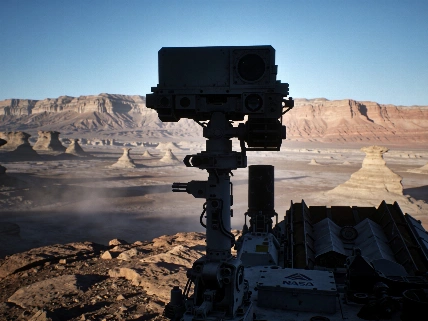
While the book isn't tied to any single mission, its publication comes at a time of growing interest in new astronomical instruments and discoveries. Recent milestones, such as the Curiosity rover's anniversary, highlight how far humanity's reach has expanded across the solar system and beyond. Institutions like the Max Planck Society and CERN have also added to our understanding of cosmic phenomena, from particle astrophysics to mapping the cosmic microwave background.
Scientific value and limitations
Lost in Space is meant as both a reference and an invitation to curiosity. Its encyclopedic format lets readers explore topics from the structure of the night sky to the classification of chemical elements. Because the book covers so much ground, it can't go into deep detail on every subject; it's not a replacement for specialized texts or peer-reviewed research. Instead, it's a starting point, encouraging readers to dig deeper into primary scientific sources.
Historical photographs and modern data visualizations show how astronomical knowledge has changed over time. By weaving in humor and cultural references, the authors try to make the material more approachable without losing accuracy. The result is a resource that reflects the current style of public science communication: broad, visually engaging, and designed to spark further interest.
To understand how encyclopedias like Lost in Space organize astronomical knowledge, it helps to look at the role of classification and visualization. These books distill large datasets into structured entries, often using diagrams, charts, and annotated images to show relationships between objects and phenomena. This method helps readers navigate complex topics by breaking them into manageable pieces. In astronomy, where scales and concepts can be abstract or counterintuitive, visual aids and analogies are especially useful for connecting technical details to everyday understanding.