Fairfax County Public Schools plans to place XeedQ's four-qubit diamond spin processor at Skyview High School in December 2026, giving students direct access to room-temperature quantum hardware through learning pathways beginning in spring 2027.
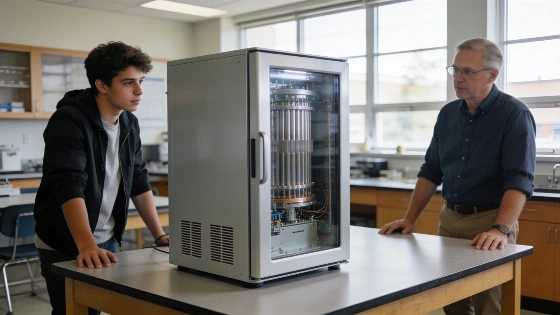
Skyview High School is scheduled to receive a working quantum computer in December 2026. If the deployment proceeds as announced, the Northern Virginia school will host the world's first reported physical quantum computer installed in a K-12 public high school and will begin student learning pathways in spring 2027. Fairfax County Public Schools has publicly confirmed the partnership with Connected DMV and the Fairfax County Economic Development Authority in an FCPS announcement.
The selected supplier is Leipzig-based XeedQ GmbH, which will provide its XQ1e system through the Potomac Quantum Innovation Center. The stated aim is not to give students only a remote demonstration of quantum computing, but to place operational hardware on site where they can program it and examine how control signals act on physical qubits. XeedQ founder and CEO Dr. Gopalakrishnan Balasubramanian has characterized the plan as a pioneering effort to put a real quantum computer in students' hands.
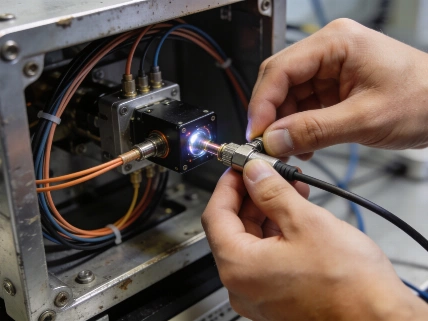
The XQ1e uses four spin qubits based on nitrogen-vacancy centers in diamond. An NV center is a defect in the diamond lattice formed when a nitrogen atom and a neighboring vacancy replace part of the regular carbon structure. Its electronic spin can be manipulated with microwave control and read through optical methods, allowing the defect to serve as a quantum system without the cryogenic refrigeration required by many superconducting processors.
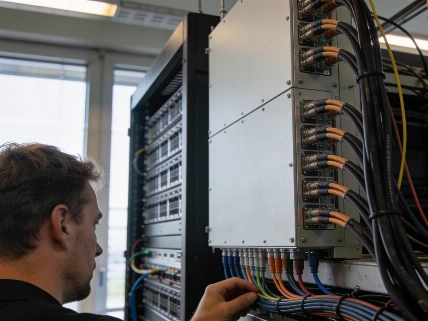
Unlike superconducting processors that require dilution refrigerators, the XQ1e is designed to operate at room temperature in a refrigerator-sized or mini file-cabinet chassis. The device is specified to draw 500 watts from a conventional wall outlet. That footprint does not eliminate the need for precision lasers, magnetic-field control, microwave electronics, shielding, calibration, or software; it changes how those requirements can be packaged and introduced in an instructional laboratory.
The system is described as providing automatic alignment and self-calibration, with Python and Jupyter notebook interfaces intended to expose students to both circuit-level programming and lower-level pulse control. At the circuit level, learners can prepare states, apply gates, and measure outcomes. At the pulse level, they can investigate how timed electromagnetic controls implement those abstract operations on a physical NV-center spin.
XeedQ reports single-qubit gate fidelities of up to 99.9% and two-qubit gate fidelities of up to 97% for the XQ1e. These figures are processor specifications rather than evidence in the announcement of a completed classroom benchmark. The disclosure does not provide coherence times, readout fidelities, circuit-depth results, calibration duration, uncertainty intervals, sample sizes, or a comparison with a classical computer performing a defined task.
Gate fidelity describes how closely an operation matches its intended quantum transformation under a stated measurement procedure. It does not mean that a four-qubit computation is 99.9% accurate, nor does it establish a logical qubit. The announced system contains four physical qubits, with no reported error-correction code, logical-qubit count, or fault-tolerant operating regime.
The distinction between physical and logical qubits is central to modern quantum engineering. A physical qubit is one controllable quantum system, while a logical qubit distributes information across multiple physical qubits so that errors can be detected or corrected. The terminology is consistent with the framework used in quantum-information research reported in Nature and developed at institutions such as MIT and CERN, although the XQ1e announcement does not claim to implement those large-scale error-correction schemes.
The device therefore represents an accessible experimental platform rather than a general-purpose machine with demonstrated quantum advantage. No useful algorithm benchmark or classical baseline is identified in the supplied announcement, and no independent replication is reported. The strongest supported claim is narrower: a compact NV-center processor is planned for direct educational use under ordinary room-temperature conditions.
Connected DMV's Potomac Quantum Innovation Center is coordinating the deployment as a regional talent-development hub. FCPS says the program will connect secondary-school coursework with universities, federal research laboratories, and commercial defense-technology firms across the Greater Washington region. The educational value will depend on what students can measure and control in practice, not simply on the presence of a quantum label on the equipment.
Fairfax-area training is also part of a wider workforce strategy. George Mason University has announced a Virginia quantum hub whose pipeline includes quantum literacy for grades 6-12 in Fairfax, Arlington, and Loudoun counties, along with community-college and university training tracks. The regional plan is summarized in a George Mason briefing. Together, the school installation and broader educational programs could connect introductory science lessons with engineering, laboratory, and software-development careers.
The small qubit count is part of the point. A four-qubit system cannot represent the scale associated with proposed large quantum processors, but it can expose students to state preparation, gate sequences, measurement, noise, and calibration within hardware they can access locally. That is a more concrete introduction to quantum engineering than treating qubits as purely abstract software objects.
The regional approach also sits alongside much larger national and industrial ambitions. A previous quantum project report described a German consortium seeking a five-year project targeting 1,000 physical qubits and 50 logical qubits. The comparison is not a performance ranking: the projects address different scales and purposes. It does show why a classroom processor should be judged by access and instructional value rather than by raw qubit count.
Room-temperature operation removes the need for cryogenic refrigeration at the processor, but it does not remove the central engineering questions. The supplied specifications do not state how long the qubits remain coherent, how stable the reported fidelities are over time, how often calibration is required, or how reliably the system performs across repeated workloads. They also do not establish whether the hardware can support circuits deep enough to demonstrate a useful computational task.
Those omissions are not a defect in an education announcement, but they set the boundary of what can be concluded. Automatic alignment and self-calibration may simplify operation, yet they do not by themselves demonstrate scalability, reproducibility, or fault tolerance. Nor does on-premises installation convert a prototype platform into a commercially useful quantum computer. As with other precision instruments, including those used in NASA and ESA research, meaningful evaluation requires defined protocols, repeated measurements, uncertainty analysis, and transparent reporting.
The planned curriculum is still a significant test of quantum education. Students will encounter the real distinction between a physical qubit and a logical qubit and between a high-fidelity gate and a reliable multi-step computation. They may also see why environmental noise, imperfect readout, drift, and control errors accumulate as circuits become deeper. That practical grounding is valuable precisely because it makes the limitations visible instead of hiding them behind large qubit counts or broad promises.
On the facts available, the project deserves attention as a serious public experiment in access and workforce preparation. Its technical significance should remain limited to what the machine can demonstrate under measured classroom conditions: a four-physical-qubit NV-center processor operating at room temperature, with published gate-fidelity figures but no reported logical qubits, fault-tolerant operation, or quantum-advantage benchmark.