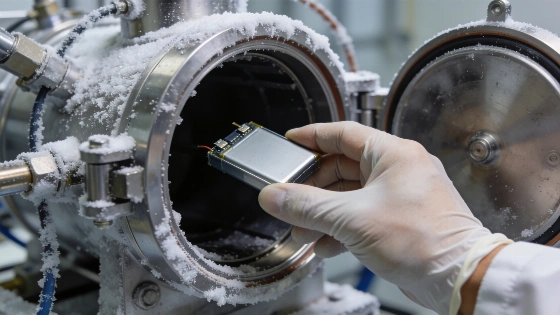
NASA's SPEARS team has tested solid-state battery cells in thermal-vacuum conditions, with prototypes operating at minus 80°C at reduced performance and surviving exposure to minus 170°C without damage
At the Moon's South Pole, a battery may have to endure a night colder than minus 200°C before it can power a rover or an astronaut's emergency equipment. A lunar night lasts about two Earth weeks, and temperatures in permanently shadowed polar craters can fall below minus 246°C, according to MIT Technology Review. NASA's SPEARS project is developing solid-state cells to withstand that environment, but its tests establish survival through extreme cold-not operation at the coldest temperatures reached in the chamber.
Conventional lithium-ion batteries use liquid electrolytes. In severe cold, that liquid can freeze and damage a cell; in the vacuum of space, it can evaporate. SPEARS replaces it with a solid ceramic- or polymer-based electrolyte, removing those particular vulnerabilities without making the battery work at any temperature.
During thermal-vacuum testing at NASA's Langley Research Center, prototype cells operated from 80°C down to minus 60°C. Performance was reduced at minus 80°C. The cells also sustained no damage after exposure across a wider range, from 100°C to minus 170°C, but NASA's account does not say they operated at minus 170°C.
That distinction matters for lunar hardware: a cell that survives the night still needs to be warmed before use. SPEARS researchers propose using small heaters to bring batteries to operating temperature when needed, rather than maintaining heat continuously. The project's reported tests do not establish how much energy those heaters would require in a mission system. In the near-vacuum of the lunar surface, heat cannot be transferred by convection; equipment must retain heat or release it through radiation, as described in an overview by Electronics Cooling.
The measurements provide an early demonstration that the solid-electrolyte cells can function at minus 80°C and tolerate exposure to substantially colder conditions. They do not establish battery performance across every condition on the lunar surface, nor do they demonstrate a flight-ready power system. The reported results focus on temperature tolerance; they do not provide figures for capacity, lifetime, charging speed or performance in a rover or habitat.
NASA Glenn Research Center in Cleveland leads SPEARS, while Langley in Hampton, Virginia, conducted the thermal-vacuum testing. Yi Lin, the project's testing and research lead at Langley, said the team sees room to improve performance and potentially widen the operating range. That is a development goal, not a result already demonstrated by the prototypes.
The project began in 2026 with funding from NASA's Advanced Research and Technology division. NASA Ames Research Center is developing flight hardware, including test boards and electronics, to prepare the cells for spaceflight and testing in space environments. The account describes preparation for those steps, not a battery already tested in space.
Possible applications include rovers, drills intended for permanently shadowed craters, emergency power packs for astronauts and long-duration scientific instruments. The battery chemistry can be adjusted by changing electrode materials, allowing designers to prioritize energy, power or durability for different uses. The source does not identify a selected lunar mission or specific device that will use SPEARS cells.
Ames' work on flight hardware is one part of NASA's wider effort to develop materials and equipment for lunar operations; a separate lunar materials project has explored composites made with simulated lunar dust. The projects address different engineering problems, and the battery work remains at the prototype stage.
SPEARS grew from an earlier NASA battery effort focused on aeronautics. Although its current target is space, NASA also identifies possible Earth uses including cars, phones, communication devices and drones. Those are potential applications, not products shown to be ready for commercial use.
Solid electrolytes may simplify one part of thermal management because they do not freeze like liquids. That does not remove the need to control battery temperature: the tested cells still required warming to operate below their demonstrated operating range. Reducing the need to keep a battery warm continuously could help limit the mass of thermal-management systems, but the project has not reported mission-level savings or longer operating lifetimes.
The near-term work is technology development, followed by the possibility of commercial collaboration. NASA's Ames team is preparing hardware for future spaceflight and environmental testing; the present evidence remains the laboratory thermal-vacuum results.
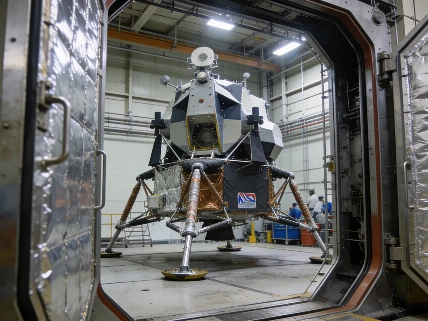
Thermal-vacuum testing evaluates hardware under controlled temperature and pressure conditions that approximate aspects of space. NASA's Jet Propulsion Laboratory, for example, reported that Voyager Technologies' Griffin-1 spacecraft spent about two weeks in the JPL Space Simulator, cycling between temperatures as high as 75°C and as low as minus 100°C. The campaign also included vibration, acoustic and electromagnetic checks. Those tests concerned Griffin-1, not SPEARS, and illustrate the broader environmental testing used to prepare spacecraft for a lunar mission.
In the SPEARS tests, the key distinction is between a cell's operating temperature and the colder conditions it can endure without damage. Exposure testing can show that a component survives a thermal extreme, but it cannot by itself show that the component will deliver useful power there.