Earlier experiments generally produced one skyrmion type at a time. A two-layer elastic-wave platform instead uses relative rotation to create patterns that can host several topological states
Earlier experiments generally produced one member of the skyrmion family at a time. In this elastic-wave experiment, rotating one of two stacked layers changes the interference pattern and allows different topological states to appear, disappear or coexist. The work, by Kuan He and colleagues, is reported in the 2026 paper "Moiré-driven skyrmion family" in Reports on Progress in Physics, volume 89, article 080502.
Twisting The Layers
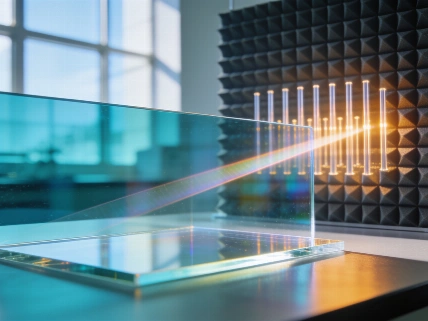
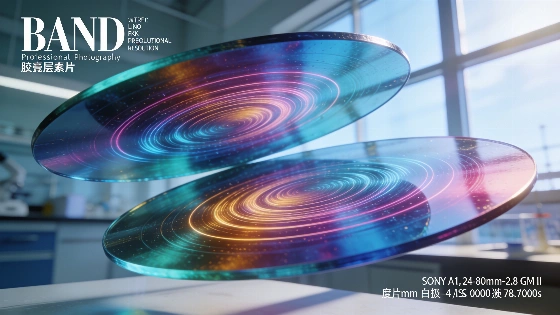
The researchers placed two elastic-wave layers on top of each other and rotated them relative to one another. Their overlapping waves form a moiré pattern: a larger-scale interference structure whose geometry depends on the angle between the layers. Changing that angle changes the topological wave patterns the platform can support. Unlike magnetic skyrmions or moiré patterns in electronic materials, these structures are formed in an elastic-wave field.
The setup provides an experimental way to control whole families of states rather than producing a single type. Its range includes skyrmions and merons, which are half-skyrmions. The researchers also produced meron-antimeron pairs, skyrmion bags containing multiple skyrmions within a larger structure, and skyrmioniums, which have a ring-like form and little or no net topological charge.
Patterns By Angle
With no twist, the layers produce regular lattices of skyrmions or merons. At intermediate angles, moiré superlattices support skyrmion bags. At larger twists of around 30° or 45°, the wave patterns become quasiperiodic: highly ordered, yet never repeating exactly. Different topological states can coexist in these larger-angle patterns.
These states are collective patterns in an underlying field, not tiny particles moving through the material. In a skyrmion, individual vectors rotate outward from the centre into a vortex-like arrangement. The pattern is difficult to destroy with small disturbances, a property described as topological protection. Merons and skyrmioniums have different arrangements and topological charges, giving the platform several structures to control through the layer geometry.
The elastic-wave platform builds on earlier work in phononics. In 2023, Lei Cao, S. Wan, Y. Zeng, Y. Zhu and B. Assouar reported "Observation of Phononic Skyrmions Based on Hybrid Spin of Elastic Waves" in Science Advances. The moiré approach extends this line of research from generating individual phononic skyrmions to controlling a wider family of wave patterns.
From Waves To Devices
Moiré patterns also arise in materials research, although the system here uses elastic waves. Related optical research has used plasmonic moiré superlattices to organize topological textures: "Skyrmion Bags of Light in Plasmonic Moiré Superlattices" appeared in Nature Physics in 2025, alongside work on moiré plasmonic skyrmion clusters in Science Advances. A separate superconductivity report described planned simulations of pairing in the Fermi-Hubbard model; that work concerns quantum simulation rather than this experimental wave platform.
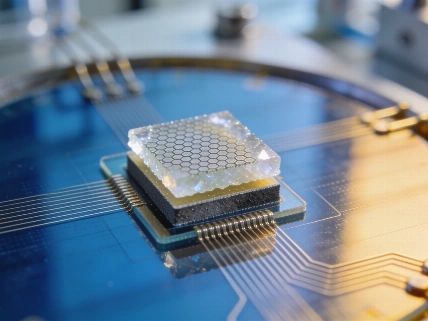
The result establishes a way to generate and control several topological wave states by adjusting the relative twist. It does not demonstrate an information-processing device. The researchers identify wave-based information processing, programmable metamaterials and topological devices as possible future applications; the experiment's demonstrated capability is control of the elastic-wave patterns.