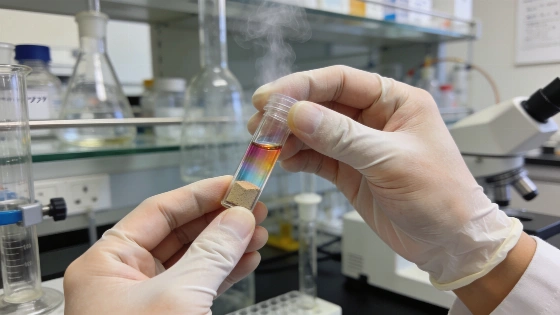
A team in Japan has built a reversible system that uses vapor to control the color, state, and phosphorescence of advanced functional fluids, offering a new approach to designing smart materials with tunable properties
Researchers at Nagoya University and Kyoto University have developed a laboratory system that enables reversible switching of both physical and optical properties in advanced functional fluids using vapor as an external trigger. The work, published in Chemical Science, demonstrates a method for toggling materials between solid and liquid states while simultaneously altering their color and phosphorescence, all without forming or breaking chemical bonds.
The system relies on host-guest chemistry, a field that studies how molecules can interact through non-covalent forces such as shape complementarity and weak electrostatic interactions. In this demonstration, the team combined a cyclic, tube-shaped host molecule with a guest known as a Functional Molecular Liquid (FML), which consists of long, flexible carbon chains. When mixed, the FML chains spontaneously thread into the host's cavity, forming a dumbbell-shaped complex. This process causes the material to harden from a liquid to a rigid solid, shift in color from yellow to deep red, and lose its room-temperature phosphorescence-the ability to emit a persistent glow in the dark.
To reverse the transformation, the researchers exposed the solid complex to hexane vapor. The hexane molecules compete for the host's cavity, displacing the FML and restoring the original liquid state, yellow color, and phosphorescent glow. Removing the hexane vapor by applying a vacuum causes the system to revert to its solid, non-glowing, red state. The team used microcrystal electron diffraction (MicroED) to capture the three-dimensional structure of the complex and directly observe the molecular rearrangements during switching.
Laboratory Evidence and Measured Effects
The reported system is a research prototype, not a commercial product. The switching process was demonstrated in controlled laboratory conditions using defined quantities of host and guest molecules. The transformation between states occurred rapidly upon exposure to hexane vapor or vacuum, with visible changes in color and phosphorescence. The researchers verified the structural changes at the molecular level using MicroED, a technique capable of resolving atomic arrangements in small crystals. No quantitative data on switching speed, cycle durability, or long-term stability under repeated operation were reported in the initial publication.
While the demonstration shows that vapor can serve as a reliable trigger for coordinated molecular and macroscopic changes, the system's performance outside the laboratory, including sensitivity to environmental contaminants, scalability, and robustness under real-world conditions, remains untested. The materials used are non-volatile and designed to minimize evaporation, but the practical limits of their stability and safety in larger-scale or open environments have not been established.
Potential Applications and Open Questions
The ability to control material properties such as color, state, and phosphorescence with a simple vapor trigger could enable new classes of smart materials. Potential applications suggested by the researchers include re-writable optical memory, gas-sensing security tags, and adaptive soft robotics where structural stiffness or optical properties must be tuned on demand. However, these uses remain speculative until the system is tested for durability, selectivity, and integration with existing devices or manufacturing processes.
Key limitations include the need for precise environmental control to avoid unintended switching, the specificity of the host-guest pairing, and the lack of data on how the system responds to other vapors or environmental factors. The demonstration does not address how the material would perform under mechanical stress, exposure to light, or in the presence of other chemicals. No safety incidents or adverse effects were reported, but the system's behavior under non-laboratory conditions is unknown.
Amplification and Coordination Challenges
One of the central technical challenges in supramolecular chemistry is achieving amplification-coordinating trillions of molecular-scale events to produce a visible, reliable change in a bulk material. In most cases, small molecular interactions are lost or averaged out at larger scales. The reported system demonstrates that, under controlled conditions, a vapor trigger can synchronize molecular rearrangements to produce an immediate, macroscopic transformation. However, the extent to which this approach can be generalized to other materials or scaled for industrial use is not yet clear.
The research highlights the importance of bridging the gap between molecular design and observable material properties. While the laboratory evidence supports the feasibility of vapor-controlled switching in this specific system, further work is needed to evaluate reproducibility, environmental robustness, and compatibility with real-world applications. Independent replication and systematic testing under varied conditions will be necessary before the technology can be considered for deployment beyond the laboratory.
Host-guest chemistry is a branch of supramolecular chemistry focused on the reversible binding of two or more molecules through non-covalent interactions. Unlike traditional chemical reactions, which involve the making or breaking of covalent bonds, host-guest systems rely on physical forces such as hydrogen bonding, van der Waals interactions, and geometric fit. This allows for reversible assembly and disassembly in response to external stimuli, such as changes in temperature, pressure, or the presence of specific vapors. The challenge lies in designing systems where these molecular events can be reliably amplified to produce useful, controllable changes in material properties at the macroscopic scale.