A polarization-sensitive metasurface grating has matched conventional instruments in mapping solar magnetic fields, offering a route to smaller, simpler, and potentially more robust hardware for future space-based solar telescopes
Researchers at the University of California San Diego have demonstrated that a polarization-sensitive metasurface grating can quantitatively map the Sun's magnetic field with performance comparable to established optical systems. The result, published in Science Advances in July 2026, suggests that metasurface-based devices could reduce the size, complexity, and power requirements of future solar telescopes designed to monitor solar magnetic activity and space weather.
Conventional solar polarimetry instruments typically rely on mechanically rotated waveplates or similar optical assemblies to analyze the polarization state of sunlight. This approach requires moving parts, external power, and careful synchronization, especially in space-based platforms where satellite motion can introduce image blur and additional engineering overhead. The need for mechanical remediation often increases the cost and complexity of such missions, and the sequential nature of polarization measurements can limit temporal resolution.
Metasurface Grating Design
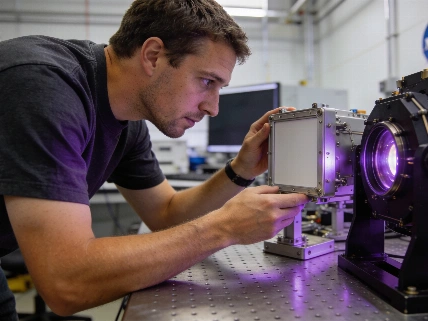
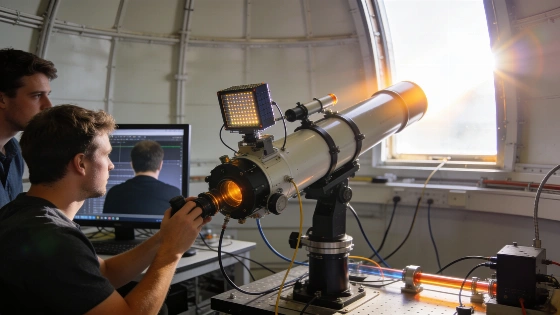
The UC San Diego team addressed these limitations by fabricating a polarization grating from a nanoscale-engineered metasurface. Unlike traditional bulk optics, a metasurface can manipulate the phase, amplitude, and polarization of light using subwavelength structures patterned onto a flat substrate. In this experiment, the metasurface grating was integrated into a custom-built telescope system, enabling the device to split incoming sunlight into multiple polarization components simultaneously. Each polarization-resolved image is captured in a single camera exposure, eliminating the need for moving parts or sequential measurements.
The metasurface grating was tested at the Dunn Solar Telescope in New Mexico, where sunlight was directed through the optical system and into the custom telescope. The device was used to observe sunspots-regions of intense magnetic activity on the solar surface-by capturing polarization-resolved images that reveal the Zeeman effect, a quantum mechanical phenomenon in which strong magnetic fields split and polarize atomic spectral lines. By analyzing these images, the researchers reconstructed maps of the magnetic field structure in and around sunspots.
Performance and Comparison
Quantitative analysis showed that the metasurface-based instrument produced magnetic field maps consistent with those obtained by the NASA Solar Dynamics Observatory, a state-of-the-art space-based solar observatory. The parallel, passive measurement approach enabled by the metasurface grating avoids the image blurring and synchronization challenges associated with mechanically rotated optics, and the compact, flat design reduces both mass and power requirements-key considerations for space missions.
While the demonstration was conducted using a ground-based telescope, the team collaborated with BAE Systems Space & Mission Systems to design the instrument for potential space deployment. The results indicate that metasurface polarization gratings could be integrated into future solar-observing satellites, provided that the devices can withstand the radiation, temperature, and mechanical stresses of launch and operation in orbit. The current study did not address long-term stability or radiation hardness, which remain critical engineering challenges for space qualification.
Engineering and Scientific Implications
The experiment used a single metasurface grating fabricated with established nanofabrication techniques, but the approach is compatible with scalable manufacturing methods. The device operated at visible wavelengths relevant for solar observation, and the polarization sensitivity was sufficient to resolve the Zeeman splitting in sunspot regions. The team reported that the metasurface grating enabled simultaneous measurement of multiple polarization states in a single frame, with spatial resolution and sensitivity comparable to conventional instruments. However, the absolute measurement precision, calibration stability, and device-to-device reproducibility were not fully characterized in this initial deployment.
According to a report from Physics World, the UC San Diego group is now exploring integration of metasurface-based polarimetry into future NASA solar missions. The transition from laboratory demonstration to operational space hardware will require further testing under simulated space conditions, as well as independent replication and long-term reliability studies. If successful, metasurface gratings could enable more compact, energy-efficient, and robust solar telescopes for monitoring solar magnetic activity and forecasting space weather events that affect satellites and terrestrial infrastructure.
Polarization measurement is central to solar magnetic field mapping because the Zeeman effect causes spectral lines to split and become polarized in the presence of strong magnetic fields. By analyzing the polarization state of sunlight from different regions of the solar surface, researchers can reconstruct the vector magnetic field and study the dynamics of sunspots and active regions. Traditional polarimeters use rotating waveplates or similar devices to sequentially measure different polarization components, but this approach is limited by mechanical complexity and temporal resolution. Metasurface gratings offer a route to simultaneous, passive polarization measurement in a compact form factor, but their long-term stability, calibration, and radiation tolerance must be established before they can replace conventional systems in demanding space environments.