Archaeologists have identified 7,000-year-old wooden fish traps in Norway's Jotunheimen mountains, providing evidence that Mesolithic hunter-gatherers deliberately introduced brown trout to high-altitude lakes using advanced ecological knowledge
Archaeological excavations at Lake Tesse, located 854 meters above sea level in Norway's Jotunheimen mountains, have uncovered a series of remarkably preserved wooden fish traps dating to the Mesolithic period. These finds, published in the journal Antiquity, suggest that hunter-gatherer groups were actively managing freshwater resources thousands of years before the widespread adoption of agriculture in Scandinavia.
Evidence from Lake Tesse
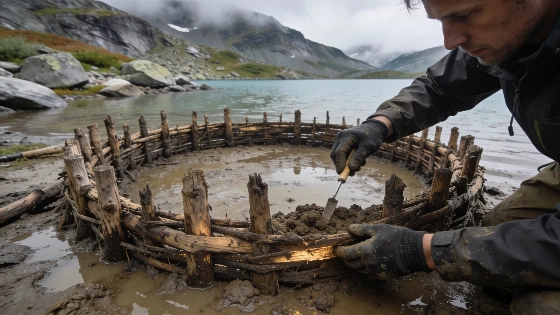
The site's high elevation and rugged terrain meant that, following the retreat of the Fennoscandian Ice Sheet around 8400 BCE, local river systems and steep waterfalls prevented freshwater fish from naturally colonizing the lake. Despite these barriers, four stationary fish traps were recovered from lakebed sediments exposed by seasonal water level changes after the area was converted into a hydropower reservoir in the 1940s. The best-preserved trap consists of a circular chamber approximately 3.5 meters in diameter, constructed from upright pine poles and a guiding fence designed to direct fish into the enclosure.
Radiocarbon dating, dendrochronology, and CT imaging were used to establish the chronology of the traps. The oldest examples date to around 5000 BCE, with later repairs and replacements extending the use of this fishing technology until at least 2700 BCE. This evidence demonstrates a technological tradition maintained and adapted over more than two millennia.
Interpreting the Introduction of Trout
The presence of brown trout in Lake Tesse presents an archaeological puzzle. Given the natural barriers, researchers argue that Mesolithic communities must have intentionally transported live trout from lower elevations to stock the previously fishless mountain lake. This interpretation is supported by the absence of alternative fish species, the intensive fishing infrastructure, and the recovery of burnt brown trout bones from multiple Stone Age settlements in the region.
Establishing a viable trout population would have required capturing live fish downstream and transporting them to the lake, a process demanding both ecological understanding and long-term planning. Trout populations would have taken decades to become established, indicating that these communities invested in future food security rather than relying solely on immediate resources. The introduction of trout likely altered the subsistence strategies of mountain hunting groups, providing a stable food source that reduced the risks associated with big game hunting in the region.
Regional Context and Broader Implications
Comparable evidence for early fish management has been identified at other mountain sites across southern Norway, where burnt trout bones dating to the fifth millennium BCE have been found. This pattern suggests a widespread tradition of mountain fishing rather than an isolated local innovation. The findings challenge the long-held view that environmental management in northern Europe began only with the advent of farming, instead highlighting the capacity of Mesolithic foragers for complex ecological interventions.
Recent discoveries elsewhere in Norway, such as the identification of a substantial medieval stone wall outside the Selja monastery, further illustrate the region's long history of resource management and landscape modification (see analysis of medieval construction at Selja).
Today, some mountain lakes in Norway still support trout populations descended from these prehistoric introductions, underscoring the long-term ecological consequences of early human interventions. While the evidence for deliberate fish translocation is strong, alternative explanations-such as accidental introduction-cannot be entirely excluded, though they are considered less likely given the archaeological and environmental context.
Dating and Analytical Methods
The chronology of the Lake Tesse fish traps was established using a combination of radiocarbon dating, dendrochronology (tree-ring analysis), and computed tomography (CT) imaging. Radiocarbon dating provided calibrated calendar dates for the wooden structures, while dendrochronology offered additional precision for the age of the pine poles. CT imaging allowed researchers to assess the internal preservation and construction techniques without destructive sampling. The integration of these methods enabled a robust chronological framework for interpreting the development and maintenance of fishing technology at the site.
In archaeological research, radiocarbon dating is a standard method for determining the age of organic materials by measuring the decay of radioactive carbon isotopes. Calibration is necessary to convert radiocarbon years into calendar dates, accounting for fluctuations in atmospheric carbon over time. Dendrochronology, or tree-ring dating, can provide annual resolution when suitable wood samples are available. Combining these approaches with non-destructive imaging techniques enhances the reliability of chronological and technological interpretations, especially in waterlogged or fragile contexts.