A captive carved at Ocomtún and a damaged stela at Minanbé connect two Maya centers through a probable place name and a ruler. Photogrammetry helped researchers read faint glyphs while the wider political relationship remains uncertain
On Monument 1 at Ocomtún, a carved captive lies face down with his wrists bound beside an animated mountain. Researchers read the accompanying inscription as identifying him as coming from Sakil, evidence of hostile relations between the two Maya centers. Mexico's Instituto Nacional de Antropología e Historia (INAH) described the connection in an announcement on November 9, 2026.
Ocomtún's ancient name was Maatz'. The conflict is dated to at least part of the Late Classic period, approximately AD 600 to 900. The inscription does not establish how long hostilities lasted. Ocomtún, discovered by the same archaeological project in 2023, is about 40 kilometers northwest of Minanbé and is the larger center.
Reading the Inscriptions
A comparison with Stela 7 at Minanbé points to Sakil as the settlement's probable ancient name. The site, north of the Calakmul Biosphere Reserve in Campeche, was discovered in May 2026 and named Minanbé by the archaeological team because of the difficulty of reaching it. The name means "there is no road"; Sakil is a Maya word associated with whiteness. INAH presented the identification as probable, rather than as a definitive reading.
Stela 7 survives in three broken sections, and researchers think its upper portion was moved elsewhere. The figure of Suutz' appears in elaborate regalia. Nearby hieroglyphic blocks record his name and a title containing the logograms sak and ajaw. Researchers recognized a similar construction on Monument 1 at Ocomtún, where an individual associated with Sakil is mentioned. INAH reports that the Ocomtún monument was originally part of an access lintel and was later reused as a step in Complex B6.
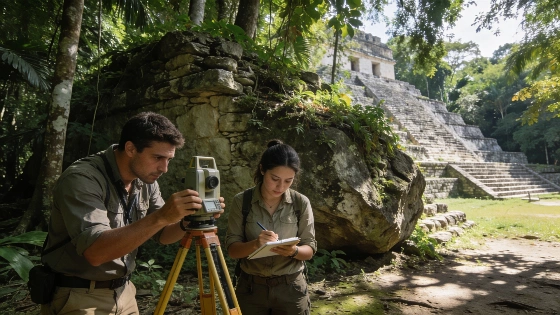
Photogrammetric models helped researchers examine faint carved features by manipulating virtual lighting on detailed three-dimensional representations. Nearly 20 monuments have been identified at Minanbé, with inscriptions or imagery recognized on at least five. Some monuments were deliberately broken or altered, and more than 1,000 years of abandonment further damaged their surfaces. The distinction between visible traces and interpretation also appears in a Buto site report, where survey anomalies were followed by targeted excavation.
The interpretation rests on comparing the two inscriptions, rather than on a single intact statement naming Minanbé. At Ocomtún, the captive's text identifies him as coming from Sakil; at Minanbé, the stela links Suutz' with a title containing sak and ajaw. INAH archaeologist Ivan Šprajc described the centers as unfriendly during at least part of the Late Classic period.
A Ruler and a Title
Researchers also identified Suutz', meaning Bat, on Altar 6 at Minanbé. His name is followed by the title kalo'mte'. During much of the Classic Maya period, that title was associated with powerful rulers whose authority extended beyond an individual city. It appeared at smaller centers toward the end of the period.
That context makes the title notable at Minanbé, which covers about 15 hectares. The findings were presented by epigrapher Octavio Esparza Olguín of the Centre for Maya Studies at the National Autonomous University of Mexico. He is part of a project on the Central Maya Lowlands led by Maya specialist Ivan Šprajc of the Research Centre of the Slovenian Academy of Sciences and Arts.
INAH's announcement of the decipherment also notes that Minanbé may have had connections with nearby centers including Chactún, Tamchén and Lagunita. The inscriptions support Sakil as a probable name for Minanbé and identify Suutz' as a ruler associated with the settlement. They indicate conflict with Ocomtún during at least part of the Late Classic period, while the wider political relationships remain uncertain.