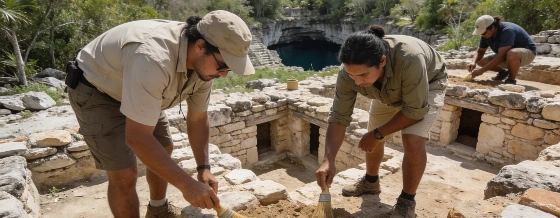
Archaeologists have identified and preserved a previously unknown Maya settlement in Yucatán, revealing 21 structures and evidence of water management. The site, excavated ahead of rail construction, offers new insight into non-elite Maya daily life.
Archaeological investigations conducted in advance of the Maya Freight Train infrastructure project in Yucatán have revealed a previously undocumented Maya settlement, now designated K'oxol Ja' II. The site, discovered during salvage excavations at the Progreso Multimodal Terminal, preserves 21 architectural features interpreted as domestic structures, providing a rare opportunity to examine the material conditions of non-elite households in the region.
Settlement Context and Chronology
K'oxol Ja' II covers approximately 2,257 square meters and is situated in a landscape characterized by both permanent and seasonal water sources. Ceramic analysis indicates the site was occupied from around 400 BCE to 900 CE, spanning the Preclassic through Late Classic periods of Maya history. The settlement's name, derived from the Maya words for "mosquito" and "water," references the local environment and the abundance of insects in the area.
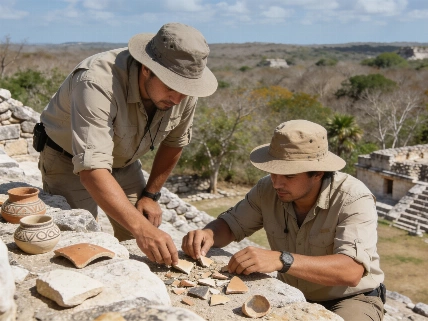
Excavators documented the foundations and architectural elements of ancient Maya houses, as well as features associated with water management. The principal cenote at the site retains evidence of a constructed wellhead, suggesting that inhabitants modified natural water sources to regulate access and consumption. The combination of residential and hydraulic features has led researchers to propose that K'oxol Ja' II may have functioned as a settlement of intermediate importance within the broader Maya landscape, potentially linked administratively to the nearby center of El Chiik.
Material Evidence and Preservation
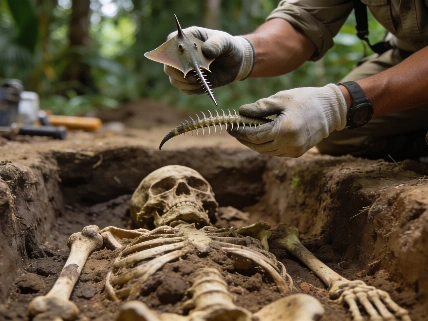
Archaeologists identified 21 structures at K'oxol Ja' II, all of which have been preserved in situ within a newly established protected zone. The site yielded relatively little pottery, which researchers interpret as a possible indication that many everyday objects were made from organic materials that have not survived. No human burials were recovered during the excavation, a pattern that may reflect the shallow soils and proximity to bedrock typical of coastal Yucatán settlements, limiting the potential for inhumation.
Only two offerings were found, both interpreted as foundation deposits associated with the construction or dedication of buildings. Following documentation, the structures were cleaned, partial wall sections restored, and protective fencing installed to safeguard the remains for future research. Laboratory analysis of ceramics, lithics, sediments, and other materials is ongoing, with the potential to refine the chronology and functional interpretation of the site.
Water Management and Settlement Organization
The evidence for deliberate modification of water sources at K'oxol Ja' II aligns with broader patterns of Maya adaptation to seasonal and environmental variability. Archaeologists identified both permanent and ephemeral bodies of water in the vicinity, with the principal cenote showing signs of engineered access. This suggests a community-level investment in water management, a theme echoed in recent research on Maya household strategies for agriculture and rainwater control in the Northern Lowlands. For example, analysis of soils and settlement patterns elsewhere in the region has demonstrated how domestic plots were organized to support food production and water storage, as discussed in a recent study on Maya household gardens and water management.
The absence of monumental architecture at K'oxol Ja' II distinguishes it from elite centers, focusing attention on the daily practices and environmental adaptations of ordinary inhabitants. The site's preservation as an archaeological reserve ensures that future research can address questions about household organization, resource management, and social structure in non-elite Maya communities.
Research Status and Limitations
Fieldwork at K'oxol Ja' II has concluded, with ongoing laboratory analysis expected to clarify aspects of chronology, material culture, and site function. The absence of burials and the limited artifact assemblage constrain certain lines of interpretation, particularly regarding demography and ritual practice. However, the in situ preservation of architectural features and water-management infrastructure provides a valuable dataset for understanding the lived experience of Maya households outside the monumental core.
The project highlights the potential for archaeological salvage in the context of large-scale infrastructure development to contribute to heritage preservation and research. The decision to protect the site rather than remove or destroy its features allows for future application of new analytical techniques and research questions as the field advances.
Understanding the archaeological significance of K'oxol Ja' II depends on careful contextual analysis. In settlement archaeology, the spatial relationship between structures, features, and environmental resources is critical for reconstructing patterns of daily life, social organization, and adaptation. The preservation of sites like K'oxol Ja' II, with their architectural and environmental context intact, enables researchers to move beyond elite narratives and examine the diversity of ancient Maya experiences. As laboratory work continues, the site will remain an important reference point for comparative studies of household archaeology and water management in the Maya Lowlands.