
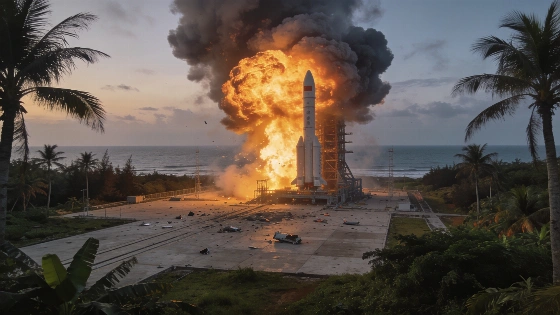
A Long March 7A rocket carrying the Zhongxing-4B satellite exploded less than two minutes after liftoff from Wenchang, raising questions about the reliability of China's medium-lift launch vehicles and the impact on future missions
China's attempt to launch a Long March 7A rocket from the Wenchang Space Launch Site on August 10 ended in failure when the vehicle exploded just 85 seconds after liftoff. The incident, which produced a large fireball and scattered debris over the launch area, resulted in the total loss of both the rocket and its payload, the Zhongxing-4B communications satellite. The cause of the failure remains under investigation, and the China Aerospace Science and Technology Corporation (CASC) had not released an official statement at the time of reporting.
Mission Profile and Failure Timeline
The Long March 7A, a medium-lift launch vehicle standing approximately 60 meters tall, was designed to deliver payloads of up to 7 metric tons to geostationary transfer orbit (GTO). The rocket lifted off from Wenchang in Hainan province at 8:02 p.m. local time (1200 GMT), with the Zhongxing-4B satellite intended to support telecommunications and broadband services. According to launch footage and social media reports, the vehicle exploded during the initial main stage burn, well before the scheduled first-stage separation, which typically occurs just under three minutes after launch. The failure occurred while the rocket was still within Earth's atmosphere, and no successful stage separation or payload deployment was achieved.
Technical Background and Historical Context
This launch marked the 18th flight of the Long March 7A since its introduction in 2020. Notably, the rocket's maiden flight also ended in failure due to an engine malfunction shortly after first-stage separation. The 7A variant combines the first two stages of the standard Long March 7 with a hydrolox-powered third stage, optimized for high-energy orbits. The Zhongxing-4B satellite, the mission's primary payload, was presumed bound for GTO and is part of a series of spacecraft supporting both civilian and military communications in China. The loss of the vehicle and satellite represents a significant setback for CASC's launch cadence and reliability record.
Implications for Future Launches
The immediate consequences of the explosion are likely to include a review of the Long March 7A's design and operational procedures. CASC also uses the standard Long March 7 for routine cargo deliveries to the Tiangong space station in low Earth orbit, with the most recent resupply mission launched in May. Depending on the outcome of the investigation, upcoming launches-including a Zhuque-3 rocket flight scheduled from Jiuquan Satellite Launch Center-could face delays or additional scrutiny. The incident recalls other high-profile launch failures, such as the deliberate deorbiting of the Salyut 6 space station after its operational life, which is discussed in detail in this historical analysis of Soviet-era mission endings.
Uncertainty and Investigation
As of publication, the specific technical cause of the explosion has not been confirmed. Early indications suggest a malfunction during the main stage burn, but further analysis of telemetry and debris will be required to identify the root failure. The lack of an official statement from CASC leaves open questions about the timeline for corrective action and the potential impact on China's broader space ambitions. The next scheduled Long March 7 cargo mission to Tiangong is not expected until early 2027, but any systemic issue could affect both commercial and government launches in the interim.
Rocket launches are complex sequences involving multiple stages, each with distinct propulsion and separation events. The main stage burn provides the initial thrust to escape Earth's lower atmosphere, while subsequent stages and boosters are jettisoned as fuel is expended. Failures during early ascent are particularly challenging to diagnose, as they may involve engine performance, structural integrity, or guidance systems. Investigations typically rely on telemetry data, recovered debris, and comparison with previous mission profiles to reconstruct the sequence of events and prevent recurrence.