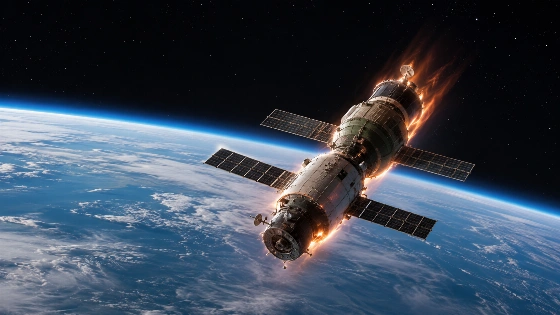
The Soviet Salyut 6 space station, operational since 1977, was deliberately deorbited on July 29, 1982, after supporting multiple long-duration missions and pioneering new space station technologies
On July 29, 1982, the Soviet Union's Salyut 6 space station was intentionally deorbited, ending nearly five years of continuous operation in low Earth orbit. The station, which had remained technically functional, was brought down due to persistent mold contamination in its crew quarters, a risk that outweighed the benefits of continued use. As Salyut 6 re-entered Earth's atmosphere, it burned up safely, with no debris reaching the surface.
Engineering Advances and Mission Operations
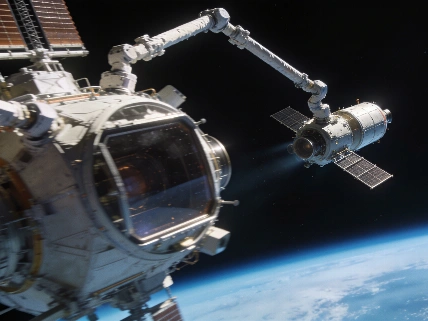
Launched in September 1977, Salyut 6 represented a significant step forward in space station design for the Soviet program. It was the first Soviet station equipped with two docking ports, enabling both resupply by uncrewed Progress cargo vehicles and the exchange of crewed Soyuz spacecraft. This dual-port configuration allowed for longer missions and more flexible crew rotations, a capability that would become standard in later stations.
During its operational life, Salyut 6 hosted five long-duration crewed expeditions and several visiting crews. Cosmonauts aboard the station conducted astronomical observations and biomedical studies, focusing on the effects of extended spaceflight on the human body. The station also featured an airlock for extravehicular activities, supporting a range of scientific and engineering tasks outside the pressurized modules.
Scientific Contributions and Records
Salyut 6's extended missions set new endurance records for human spaceflight at the time. The longest single stay aboard the station lasted 185 days, achieved in 1981. These missions provided valuable data on human adaptation to microgravity, as well as operational experience in maintaining life-support systems and managing supplies over extended periods. The station's ability to receive regular cargo deliveries from Progress vehicles was a key factor in sustaining these long missions.
The design and operational lessons from Salyut 6 directly influenced subsequent space stations, including Salyut 7 and Mir, and can be seen in the architecture of the International Space Station (ISS). The ISS, for example, employs multiple docking ports, automated cargo resupply, and overlapping crew rotations-features first demonstrated on Salyut 6. For comparison, the ISS now routinely supports missions exceeding six months, with the longest American stay reaching 371 days, as reported in recent years.
Deorbit Decision and Legacy
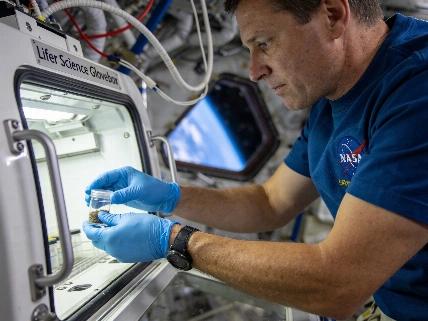
By 1982, Salyut 6 remained structurally sound, but the discovery of mold in the crew quarters posed a health risk that could not be mitigated with available technology. Soviet mission planners opted for a controlled deorbit, ensuring the station would disintegrate over an uninhabited region during atmospheric re-entry. This approach minimized the risk of debris reaching populated areas and set a precedent for the safe disposal of large orbital platforms.
The legacy of Salyut 6 is evident in the evolution of space station operations and international collaboration. Its technical innovations and operational milestones informed the design of later stations and contributed to the development of long-duration human spaceflight. The station's history also provides context for ongoing missions, such as the International Space Station, which continues to build on the foundation established by Salyut-era engineering. For readers interested in the progression of space station science, a recent article on the start of Expedition 74 aboard the ISS offers further insight into current research and operational practices: Expedition 74 crew begins science operations on the ISS.
Salyut 6's controlled re-entry remains a reference point for end-of-life planning in orbital infrastructure, highlighting the importance of safety and environmental considerations in mission design.
Understanding the process of controlled deorbiting is essential for appreciating how large spacecraft are safely removed from orbit. A controlled deorbit involves using a spacecraft's propulsion system or a dedicated deorbit module to lower its perigee-the closest point in its orbit to Earth-so that atmospheric drag rapidly increases. This causes the spacecraft to re-enter the atmosphere over a predetermined, uninhabited area, typically over the ocean. Most of the structure burns up due to intense heat and friction, with only small, dense fragments potentially surviving to reach the surface. This method reduces the risk to people and property on the ground and is now standard practice for retiring large space stations and satellites.