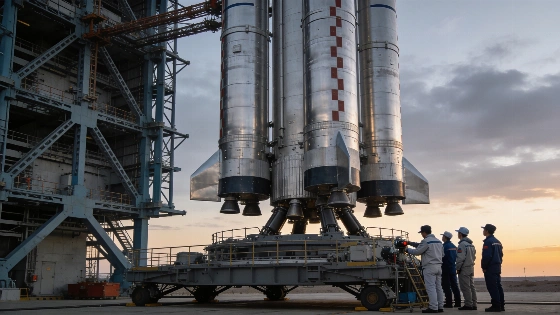
Chinese launch company Landspace plans a renewed attempt to recover its Zhuque-3 orbital rocket booster, targeting liftoff and powered landing from Jiuquan spaceport on August 10 following a previous failed recovery in 2025
Landspace, a commercial launch provider based in China, is preparing for a second attempt to recover the first stage of its Zhuque-3 orbital rocket. The mission is scheduled for liftoff from the Dongfeng commercial space innovation pilot zone at Jiuquan spaceport in northwest China, with launch targeted for August 10, 2026, at approximately 23:45 GMT (7:45 a.m. Beijing time, August 11). This effort follows a previous attempt in December 2025, when the Zhuque-3 first stage was lost during its final descent after reaching orbit.
Technical Milestones and Launch Details
The Zhuque-3 is a stainless steel launch vehicle standing 66 meters tall and powered by methane-liquid oxygen engines. It is designed to deliver up to 18,300 kilograms of payload to low Earth orbit (LEO), placing it in a similar performance class to SpaceX's Falcon 9. In preparation for the upcoming flight, Landspace completed a static fire test of the Zhuque-3 Y2 vehicle on June 29, 2026, at the same launch site. According to the company, all systems operated within expected parameters, and the test validated the coordination of the rocket's subsystems ahead of the planned mission.
The August 10 launch will mark China's fourth attempt to recover an orbital-class booster. The first such effort, also involving Zhuque-3, ended in a destructive fireball during landing. A subsequent attempt with the Long March 12A rocket days later also failed to achieve a safe recovery. However, on July 10, 2026, the Long March 10B mission succeeded in landing its booster using a net-capture system, making China the second nation to recover an orbital booster after the United States. Landspace's upcoming attempt will use a powered descent and deployable landing legs, a method comparable to that used by Falcon 9.
Recovery Methods and Engineering Challenges
Unlike the net-capture approach demonstrated by the Long March 10B, Landspace is pursuing a vertical powered landing for Zhuque-3. This technique requires precise control of the rocket's engines and guidance systems during descent, as well as robust landing legs to absorb the impact. The December 2025 failure highlighted the technical risks involved, with the booster exploding during its final approach. Engineers have since analyzed telemetry and test data to refine the descent profile and landing sequence.
Reusable launch vehicles are intended to reduce the cost of access to space by enabling multiple flights with the same hardware. Achieving reliable recovery and refurbishment remains a significant engineering challenge, as demonstrated by the mixed results of recent Chinese and international attempts. The Zhuque-3's stainless steel construction and methane propulsion are intended to balance structural strength, thermal resilience, and operational efficiency.
Scientific and Commercial Implications
If successful, the recovery of Zhuque-3 would represent a technical milestone for China's commercial space sector and could accelerate the adoption of reusable launch systems in the region. The ability to recover and reuse boosters has already transformed launch economics in the United States, as seen with Falcon 9 missions tracked by NASA and other agencies. For context, NASA and SpaceX have previously coordinated to monitor spent Falcon 9 stages, as described in a Science Report article on lunar impact tracking.
Landspace's approach, if proven viable, may offer new options for satellite deployment and commercial payload delivery. However, the company must demonstrate that its recovery system can operate reliably under real mission conditions. The outcome of the August 10 attempt will be closely watched by both domestic and international observers interested in the evolution of launch technology and commercial access to orbit.
As of this writing, the Zhuque-3 Y2 vehicle remains on schedule for launch, with final preparations underway at Jiuquan. Airspace closure notices and mission updates indicate that Landspace is proceeding with a cautious but ambitious plan to achieve a controlled landing and recovery of its orbital booster.
Rocket recovery is a complex process that involves guiding a spent booster back through the atmosphere and executing a controlled landing, often using engine burns to slow descent and landing legs to absorb impact. Powered descent requires precise real-time adjustments to trajectory and thrust, as well as robust structural engineering to withstand aerodynamic and thermal stresses. Successful recovery enables refurbishment and reuse, but each attempt carries significant risk due to the narrow margins for error and the harsh conditions encountered during reentry and landing.