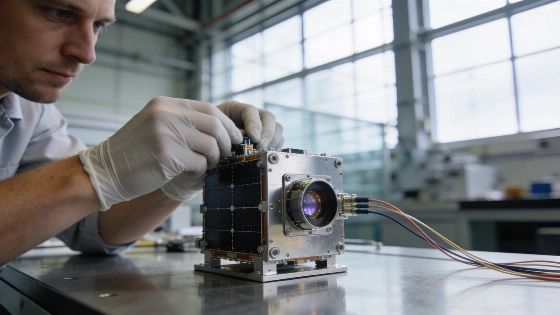
A University of Vienna payload has demonstrated two-photon interference and programmable matrix execution in orbit, showing that integrated photonic quantum hardware can operate beyond the laboratory.
A programmable photonic quantum processor has performed its defining experiment in low Earth orbit. The result, published on September 29, 2026, is presented by the University of Vienna team as the first in-orbit demonstration of a processor of this class. Over approximately eight months aboard a spacecraft payload, the system demonstrated two-photon Hong-Ou-Mandel interference and programmable linear-optical operations in space.
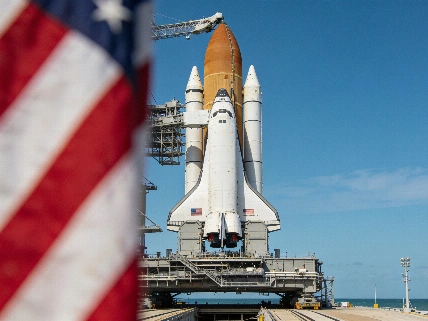
The experiment moved quantum hardware beyond the satellite role most commonly associated with distributing quantum states for applications such as quantum key distribution. The payload launched on June 23, 2025, aboard SpaceX Transporter-14 and was hosted by D-Orbit's ION SCV platform at an altitude of approximately 510 kilometers in low Earth orbit. Independent reporting describes the result as an operational demonstration of computational optical primitives, not as a universal or general-purpose quantum computer.
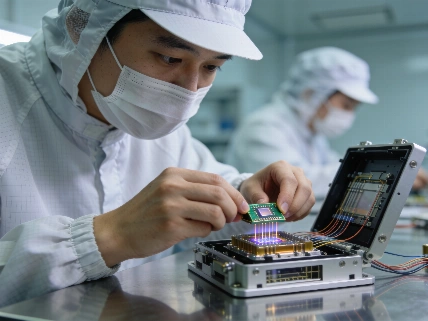
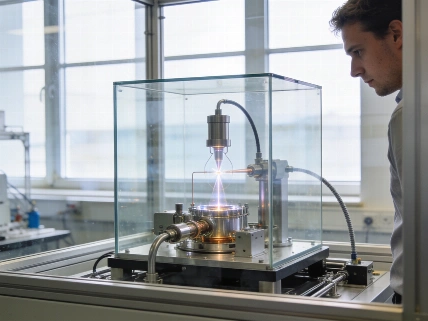
The hybrid instrument combined a 405-nanometer continuous-wave pumped spontaneous parametric down-conversion source with a six-mode universal photonic integrated circuit and a passively quenched single-photon avalanche-diode array. The circuit was written in glass with femtosecond lasers and contained 15 Mach-Zehnder interferometers. Thermo-optic microheaters changed the interferometer settings, allowing the processor to program arbitrary 3 × 3 subunitary matrices.
Its reported average classical fidelity for those programmed transformations was 0.949. The complete system weighed 9.8 kilograms, occupied a 15 × 15 × 45.3 centimeter volume and consumed 10 watts. Independent descriptions also classify it as a 3U-class satellite payload. Those numbers matter because space qualification is not simply a matter of placing a laboratory chip inside a satellite: optical alignment, thermal control, detector operation and electronic power budgets must all survive launch and orbital conditions.
The launch history and hardware specifications are summarized in independent mission reporting. The reported orbital operation also places the experiment in a broader engineering lineage that includes NASA and ESA work on radiation-tolerant spacecraft electronics, although this processor represents a different challenge: preserving nonclassical optical behavior while actively reconfiguring a photonic circuit.
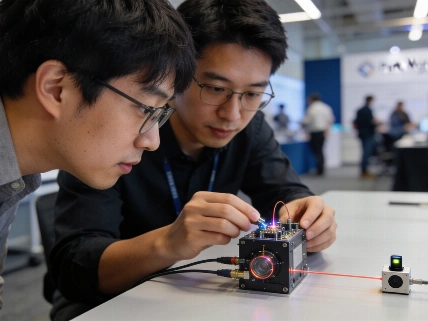
The most physically significant measurement was Hong-Ou-Mandel interference. When two indistinguishable photons enter a suitable optical arrangement, their probability of leaving through separate outputs is reduced, producing a characteristic coincidence dip. Observing that nonclassical pattern tests whether the source, integrated circuit and detection chain preserve the indistinguishability required for photonic quantum operations.
The payload recorded a HOM visibility of 0.908 ± 0.191 at a crystal degeneracy temperature of 32.5°C. The measurement was obtained after exposure to rocket-launch vibration, thermal cycling and the radiation environment of orbit, according to the reported account. It indicates that the relevant optical behavior remained measurable after launch and during orbital operation; it does not show that the processor performed a useful quantum algorithm or achieved a computational advantage over a classical machine.
The experiment also reported successful operation for eight months. That duration gives the demonstration more engineering weight than a single short measurement, although the available material does not provide a device-to-device study, an independent replication or a comparison with a competing orbital processor. The research is presented as a preprint on arXiv rather than as a peer-reviewed result, so its statistical and engineering claims should be interpreted within that limitation rather than as a completed qualification standard comparable to a mature NASA or ESA flight program.
The reported findings are consistent with the central physical requirement of integrated photonic quantum computing: photons must remain sufficiently indistinguishable for interference, while the circuit must be controllable and measurable with repeatable settings. In that respect, the result addresses a practical question that is also central to research reported in journals such as Nature: whether delicate quantum optical behavior can survive a nonlaboratory environment without being reduced to a passive demonstration.
Satellite quantum experiments have often emphasized sending quantum states or cryptographic resources between space and ground. This payload instead performed part of the optical processing onboard. The distinction is important: reducing or transforming data before downlink could eventually be valuable for Earth-observation systems because the operation would take place at the satellite rather than after raw measurements had crossed the communications link.
The researchers connect the hardware to possible onboard image analysis and remote-sensing data reduction. They also identify quantum machine-learning inference as a future use of such linear-optical transformations. That application remains a proposed direction. No image-analysis workload, compression ratio, latency reduction or comparison with a classical onboard processor is reported here, so the experiment establishes a hardware primitive rather than an operational Earth-observation advantage.
The broader architecture was developed with IFN-CNR Milano, DLR and Politecnico di Milano. It fits the evidence described in an earlier architecture analysis: quantum hardware must be judged by the interaction between its physical platform, control system and target workload rather than by a single headline metric.
Space operation removes several laboratory conveniences. The payload had to remain within a 10-watt power budget while maintaining a photon source, a programmable six-mode circuit and single-photon detection. Its reported interference measurement indicates that launch and orbital exposure did not destroy the optical conditions needed for the test, but it does not quantify detector dark counts, optical loss, calibration drift or the stability of each programmed matrix.
Nor does the demonstration establish fault tolerance. The processor uses photonic modes rather than a reported register of physical or logical qubits, and the available account describes neither quantum error correction nor a logical error rate. Matrix fidelity and HOM visibility are useful indicators of optical performance, but neither is equivalent to full algorithmic accuracy. The absence of a classical workload comparison also prevents a claim of quantum advantage.
The result is still consequential because it closes a specific technology gap. A programmable integrated photonic circuit and its detectors operated in orbit as an active processing payload instead of serving only as a passive communications component. That is a credible step toward spaceborne edge processing, but the evidence supports a narrower verdict than the promotional language often attached to quantum systems: this is a successful orbital physics and engineering demonstration, not yet a useful quantum computer in space.
For this experiment, quantum interference means that indistinguishable photon probability amplitudes combine in a way that changes measured coincidence rates. It is not the same as proving that the system can evaluate every possible answer at once. The 0.908 ± 0.191 visibility records the strength of the observed interference under the reported conditions, while the 0.949 matrix fidelity describes how closely programmed optical transformations matched their classical targets. Together they show preserved and controllable photonic behavior in orbit, but practical quantum processing will require workload-level validation, quantified losses and calibration stability, and evidence that the optical system delivers something beyond a well-engineered classical pipeline.