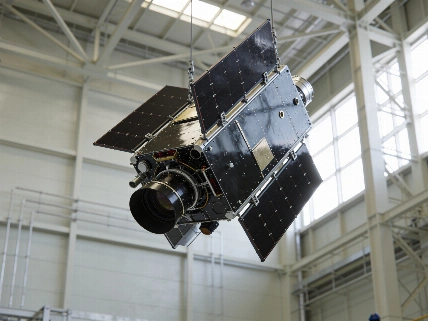
NASA's SSPICY mission has launched the 335-kilogram Otter 24C spacecraft to inspect up to four inoperable U.S.-origin objects in low Earth orbit and test autonomous technologies for future servicing and debris removal.
An autonomous spacecraft is heading toward a difficult orbital task: approaching satellites and rocket bodies that can no longer operate without touching or docking with them. NASA's Small Spacecraft Propulsion and Inspection Capability (SSPICY) mission launched on Oct. 1, 2026, from Vandenberg Space Force Base in California aboard a SpaceX Falcon 9 at 11:32 a.m. Pacific time. The mission's Otter 24C spacecraft reached low Earth orbit as part of the Transporter-18 rideshare mission, becoming the first full-size Starfish Space spacecraft to reach orbit.
Weighing about 335 kilograms, Otter 24C will first pass through an on-orbit commissioning phase. Inspections are planned to begin in 2027, and the mission is expected to operate for roughly two years. SSPICY was initiated by NASA in 2024 as a Phase III Small Business Innovation Research effort and is described as the first NASA-funded commercial project focused on inspecting orbital debris.
SSPICY is not a repair mission and it will not remove debris. Its Otter spacecraft will approach up to four inoperable space objects of U.S. origin in low Earth orbit, including satellites and rocket bodies, to collect information about their physical state. That distinction matters: the mission is testing the measurements and navigation needed for future servicing rather than claiming that servicing capability already exists.
Starfish Space built and operates the Otter 24C spacecraft, while Astro Digital supplied its satellite platform. The vehicle is designed to navigate to within hundreds of meters of each target and inspect it without contact. From that stand-off distance, the spacecraft is expected to assess surface condition, geometry, orientation, rotation, and orbital behavior-measurements that could help ground teams determine how an uncontrolled object is moving and what a later servicing mission might encounter.
Four technology elements are integrated into the spacecraft: Manta, Nautilus, CETACEAN, and CEPHALOPOD. Their combined flight demonstration is significant because close-range inspection requires several systems to work as one: perception must estimate the target's motion, guidance must plan a safe approach, propulsion must execute the maneuver, and onboard control must respond to changing geometry and attitude.
The mission's central challenge is close-range navigation around an object whose behavior and condition are not being managed by an active operator. Unlike a cooperative spacecraft, an inactive satellite may not transmit navigation data, maintain a stable attitude, or present a predictable surface to an approaching vehicle.
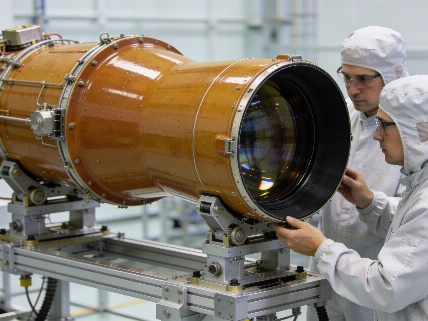
During the planned inspections in 2027, autonomous guidance and control software will use computer vision and onboard sensors to make real-time navigation decisions as Otter approaches each target. Ground controllers will provide limited input, leaving the spacecraft to interpret sensor information and adjust its trajectory near objects whose rotation and orientation must be characterized in flight.
The spacecraft also carries an electric propulsion system to travel between targets. An articulating robotic boom will test how the thrusters can be pointed for more precise maneuvering between different orbits. These systems are being evaluated together as an integrated system, so the demonstration concerns the interaction of navigation, sensing, propulsion, and maneuver control rather than a single isolated component.
The available mission description does not report inspection results yet. Until Otter reaches its targets and completes those operations, the technology remains a flight demonstration with a planned set of tests rather than proof that autonomous servicing can reliably repair or dispose of spacecraft.
Inactive satellites and rocket bodies can break apart or collide with other objects, producing debris that ranges from large fragments to small particles. The risk is tied to the physical condition and motion of individual objects, but those details can be difficult to establish when a spacecraft is no longer communicating with operators. Close-range observations could provide information that cannot be obtained from routine distant tracking alone. The broader orbital-debris challenge is also monitored through international programs such as the ESA debris program.
That need is becoming more consequential as thousands of satellites are launched for communications, weather forecasting, navigation, and other services. A spacecraft that can inspect an object before a later repair or removal attempt could help mission planners distinguish a stable target from one that is spinning unpredictably or showing surface damage. SSPICY itself will not make that decision for the wider orbital environment, but it is aimed at testing several of the physical capabilities such decisions would require.
The engineering logic also appears in NASA lunar fabrication work where mission hardware is evaluated against the constraints of operating away from Earth, although SSPICY applies that problem to autonomous movement around existing orbital objects rather than construction on a planetary surface.
Future missions could use inspection data to support repairs or to remove selected objects by pulling them into Earth's atmosphere for disposal. SSPICY, however, will not touch or dock with any satellite. Its value will come from showing whether a spacecraft can safely approach, characterize, and move between multiple targets while combining autonomous perception with electric propulsion and precise thruster pointing.
NASA's Small Spacecraft and Distributed Systems program within the agency's Research and Technology Mission Directorate funds and manages the demonstration. NASA's Small Business Innovation Research / Small Business Technology Transfer program previously funded awards to Starfish Space that supported early development of key spacecraft technologies and capabilities. The mission therefore sits within a broader technology pipeline in which NASA-backed hardware is tested in orbit before it is considered for operational servicing.
The scientific and engineering questions are narrower than the overall debris problem. Researchers and mission planners must determine how accurately Otter can estimate a target's position, attitude, rotation, and surface features; how much ground intervention is needed; and whether electric propulsion can support movement between several orbital objects. As in other autonomous-spacecraft demonstrations, results will depend on measured flight performance rather than on laboratory claims alone.
Those arrangements explain the mission's place in the technology pipeline: public funding is being used to test capabilities before they are relied on for operational servicing. The evidence SSPICY can provide is therefore practical and bounded. A successful approach would validate a set of techniques in orbit, but it would not by itself establish that repairs, debris removal, or autonomous operations are ready for routine use.
In close-range spacecraft operations, computer vision converts camera observations into estimates of a target's position and motion, while sensors provide additional information for navigation. Those estimates are then used by guidance software to select maneuvers. SSPICY's importance lies in testing that chain under real orbital conditions; its clearest contribution will be a measured demonstration of what the spacecraft can observe and control, not a promise that the debris problem has already been solved. NASA and Starfish Space are taking the correct engineering route by testing inspection before attempting contact, repair, or removal.