A Falcon 9 rocket and Dragon spacecraft stand vertical at Space Launch Complex 40 ahead of NASA's Crew-13 mission, which is scheduled to carry four international crew members to the International Space Station.
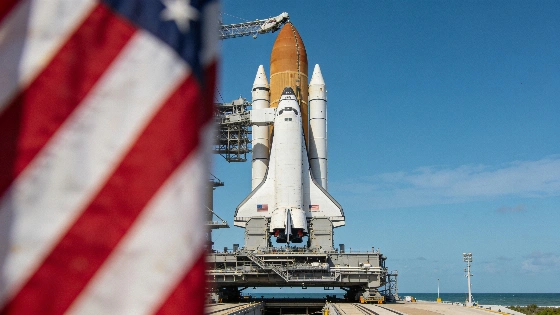
A SpaceX Falcon 9 rocket carrying the Crew Dragon spacecraft stands vertical at Space Launch Complex 40 at Cape Canaveral Space Force Station in Florida ahead of NASA's Crew-13 mission. The photograph records a prelaunch state rather than a completed flight milestone: NASA currently targets liftoff no earlier than 11:10 a.m. EDT on Thursday, Oct. 1, 2026, followed by Dragon's arrival and docking with the International Space Station and the Expedition 75 crew.
The image shows the Dragon spacecraft mounted above the Falcon 9 with ground-support connections still attached. NASA and mission insignia are visible on the vehicle's exterior, while an American flag appears in the foreground. The photograph was taken on Sept. 27, 2026, at Cape Canaveral Space Force Station, one day before NASA reported that the rocket had arrived at the launch complex and was being prepared for flight.
That distinction matters scientifically and operationally. A rocket standing upright demonstrates that the launch vehicle and spacecraft have reached a visible stage of ground preparation, but it does not establish that liftoff, ascent, stage separation, orbital insertion, or station rendezvous has occurred. Contemporary launch coverage likewise describes the scene as preparation for the planned mission rather than evidence of a completed spaceflight.
NASA lists Jessica Watkins as commander and Luke Delaney as pilot, alongside Canadian Space Agency astronaut Joshua Kutryk and Roscosmos cosmonaut Sergey Teteryatnikov. The four-person international crew is scheduled to travel to the International Space Station aboard Dragon, the spacecraft NASA identifies as Grace, launched by a Falcon 9.
The crew's arrival in Florida on Sept. 26 followed a formal Flight Readiness Review that NASA conducted on Sept. 25. After that review, NASA said the mission remained targeted for Oct. 1. These milestones place Crew-13 in the final prelaunch phase, not in an already completed orbital mission. The crew had completed its preparation and was reported ready for launch.
The four-person crew also places the flight within the continuing operational use of commercial crew hardware. NASA's earlier planning for additional SpaceX crew flights through 2030 is discussed in an earlier report, while the present photograph concerns the immediate preparation of Crew-13.
NASA describes Crew-13 as a long-duration mission supporting scientific investigations, technology demonstrations, and maintenance work aboard the orbital laboratory. The International Space Station provides a microgravity environment in which researchers can examine processes that are altered by the near absence of gravitational settling, while astronauts also maintain life-support, power, communications, and experiment systems needed for continued research.
The mission's scientific value therefore extends beyond the launch image. The Falcon 9 and Dragon are the transportation element of a broader program involving human operations, station infrastructure, and experiments conducted over an extended stay. NASA's mission description distinguishes those future activities from the hardware-readiness evidence visible at the pad.
The evidence here is visual and limited: a Falcon 9 and Dragon are vertical at their launch pad, with the spacecraft connected to launch infrastructure. The image does not provide measurements of engine performance, confirm that weather and range conditions are favorable, or demonstrate that the vehicle has completed every technical requirement for flight.
The key dates are specific. The photograph is dated Sept. 27, 2026; NASA reported the crew's arrival in Florida on Sept. 26 and the rocket's arrival at the launch complex on Sept. 28; and the planned launch remains no earlier than Oct. 1 at 11:10 a.m. EDT. The destination is the International Space Station, where Crew-13 is expected to dock with Expedition 75.
Launch coverage often compresses several separate milestones into one image. Pad positioning is not liftoff; liftoff is not orbital insertion; and reaching orbit is not the same as beginning routine work aboard the station. For Crew-13, the supplied facts support the visible stage of hardware preparation and the stated plan for the Oct. 1 launch, but not a claim that the vehicle has already flown.
The image therefore works best as a record of mission readiness in the narrow sense of hardware position and preparation. It is not evidence that the crew has launched, reached orbit, docked with the station, or begun its long-duration science program. That careful reading is more informative than treating a striking pad photograph as proof of a completed spaceflight.
In this context, the photograph's scientific importance is indirect but clear: it records the vehicle assigned to carry four international crew members toward a station-based research mission. Until launch and later mission milestones occur, the defensible conclusion is that Crew-13 is prepared for its next step rather than already in space.
A launch-pad photograph is a static record of hardware at one moment. It can show the rocket's position, the spacecraft's presence, and visible connections to ground equipment, but it cannot reveal trajectory, engine performance, orbital insertion, docking status, or the results of experiments that have not yet taken place. Those claims require later operational evidence from NASA and mission telemetry rather than the image alone.