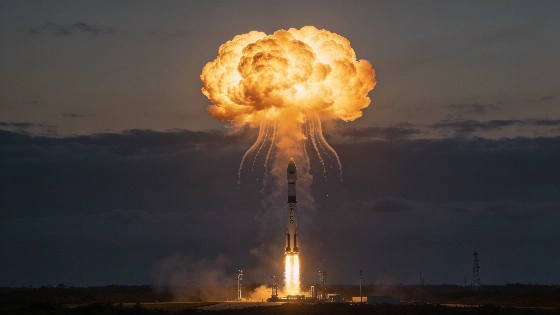
At 6:33 a.m. EDT on Oct. 13, a Falcon 9 sent SpaceX's Dragon toward the International Space Station as sunlight caught its exhaust plume and made the predawn launch look like a glowing jellyfish
A rocket's exhaust became the standout spectacle of SpaceX's CRS-35 launch: sunlight lit the Falcon 9's plume against the predawn sky, forming a shape known as a jellyfish. The effect appeared during a working cargo mission, not a separate atmospheric event.
The visual effect occurs when a rocket launches near sunrise or sunset: sunlight can illuminate exhaust high above the ground while the launch site remains in darkness. The plume's brightness and shape depend on its expansion, the rocket's altitude, the Sun's position and atmospheric conditions. On Oct. 13, 2026, the illuminated plume was visible across the eastern United States. NASA credited the image to photographer John Kraus.
The image records the plume's appearance; it does not provide measurements of the exhaust or details about the rocket's performance. Jellyfish describes the glowing shape, not a separate object, fuel type or technical classification.
SpaceX's Falcon 9 lifted off at 6:33 a.m. EDT from Space Launch Complex 40 at Cape Canaveral Space Force Station in Florida, carrying a Dragon cargo spacecraft to the International Space Station. NASA said the CRS-35 mission was sending more than 6,300 pounds, about 2,858 kilograms, of scientific investigations, supplies and equipment to the orbiting laboratory. It was the 35th SpaceX mission under NASA's Commercial Resupply Services program.
About nine minutes after liftoff, Dragon separated from the rocket's second stage, opened its nose cone and began a series of maneuvers toward the station. The cargo included NASA investigations into human and plant health and drug-resistant organisms, as NASA Science describes.
NASA scheduled Dragon's autonomous rendezvous and docking at the space-facing side of the station's Harmony module for approximately 11 a.m. EDT on Oct. 15. The agency planned to begin live coverage of the approach and docking at 9:15 a.m. EDT. The launch image captures the spacecraft's departure, while docking was a later planned milestone.
NASA's earlier lunar observation documented faint flashes on the Moon, while the CRS-35 image shows a launch plume lit by sunlight. The scenes involve different events and evidence: one records flashes seen near the eclipsed Moon, the other captures the visible appearance of rocket exhaust.
The CRS-35 image is a record of a specific lighting effect during a resupply launch. It shows how a predawn rocket plume can stand out across a wide region, while the mission itself carried cargo and investigations toward the International Space Station.