A Falcon 9 upper stage abandoned in a high Earth orbit is expected to hit the Moon on August 5, 2026, after gravity and solar activity gradually altered its trajectory
A spent Falcon 9 upper stage is scheduled to strike the Moon at about 2:35 a.m. EDT (0635 GMT) on August 5, 2026. The impact is expected to excavate a crater roughly 27 meters wide, turning an ordinary piece of launch hardware into an unplanned planetary-science experiment.
An unusual disposal orbit
The stage has spent more than 18 months in a high Earth orbit that crosses the Moon's orbital region. It was not placed on a deliberate collision course, and the event is better understood as the long-term evolution of an orbit than as a controlled impact.
The Falcon 9 launched in January 2025 with two private lunar landers: Firefly Aerospace's Blue Ghost and Resilience, built by the Tokyo-based company ispace. Blue Ghost completed a successful lunar landing and mission, while Resilience was lost during its landing attempt.
Falcon 9 first stages are designed for reuse, but the upper stage normally flies only once. For many Earth-orbit missions, SpaceX can use leftover propellant to guide an upper stage into the atmosphere, where it breaks apart and burns. That option was largely unavailable after the January launch because the stage used most of its fuel sending the landers toward the Moon.
Gravity finished the job
The approximately 4,000-kilogram stage was therefore left in what researchers describe as a Moon-crossing high-Earth orbit. SpaceX carried out a safety maneuver rather than a conventional atmospheric disposal, but the maneuver did not place the vehicle in an indefinitely stable orbit.
Once the stage was abandoned, its path continued to respond to the gravity of Earth and the Moon. Solar activity also affected the vehicle indirectly by changing the small forces acting on its large exposed surfaces, including pressure from sunlight and the influence of the upper atmosphere at portions of its orbit. Over many revolutions, those effects altered the timing and geometry of its lunar encounters.
Orbital predictions are especially sensitive when an object repeatedly passes through the gravitational neighborhoods of two bodies. A small change in speed or position during one encounter can produce a much larger change in the timing of a later encounter. In this case, the combined evolution has made a lunar impact the expected outcome, although the exact impact location and crater dimensions remain model-dependent.
What the impact can reveal
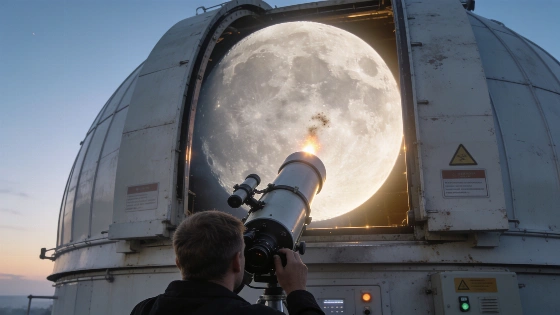
The collision will probably occur on the sunlit side of the Moon, limiting its visibility from Earth. Observers with sufficiently large telescopes might detect a brief flash or an expanding plume of excavated material, but the event is not expected to produce a conspicuous naked-eye display.
The more valuable measurements may come from instruments that record the impact indirectly. Cameras can constrain the flash and ejecta plume, while lunar spacecraft or Earth-based observing networks may help determine where the collision occurred. If seismic instruments detect the disturbance, researchers can test methods for locating impacts and estimating how energy moved through the lunar ground.
A recent study led by Benjamin Fernando of Los Alamos National Laboratory estimates that the event could help researchers test observation pipelines and improve estimates of the hazards created when discarded spacecraft strike the Moon. The result would not be a controlled laboratory experiment: the impactor's exact condition, approach angle and surface properties will limit how precisely scientists can reconstruct the event.
The episode also follows an earlier lunar collision that created a double crater. The March 2022 impact was ultimately linked to the upper stage of China's Long March 3C rocket, which had launched the Chang'e 5-T1 mission in October 2014. The paired crater shape helped researchers infer that the object had an unusual mass distribution, illustrating how an impact can reveal details about hardware that can no longer be examined directly.
Safety beyond Earth orbit
As lunar activity increases, disposal practices designed mainly for Earth orbit may no longer be sufficient. NASA's Artemis program aims to support sustained activity near the lunar south pole during the coming decade, including infrastructure and crewed operations. A spent upper stage landing near an occupied site would be a safety problem even if the probability of a particular impact were low.
SpaceX has said it is examining disposal options for future high-energy missions operating in the Sun-Earth-Moon system. Possible strategies would have to balance propellant limits, trajectory design, collision risk and the rules governing lunar and deep-space operations. The engineering challenge is not simply to avoid one known impact; it is to ensure that a vehicle remains predictable after it can no longer be commanded.
The issue is part of a broader shift in spaceflight. As seen in the recent report on a Starship upper stage surviving splashdown, launch hardware can remain physically recognizable long after its primary mission ends. In lunar space, however, an intact stage is not just debris: it can become a high-speed impactor, a source of contamination and a complication for future scientific measurements.
The Falcon 9 impact will therefore be both a predictable orbital event and a warning about the limits of conventional disposal planning. It may produce useful data on lunar impact physics, but its scientific value does not remove the underlying operational lesson: future missions must account for the full trajectory of spent hardware, not only the phase when it is actively controlled.
Orbital prediction works by propagating an object's measured position and velocity through a gravitational model. For a spacecraft near Earth and the Moon, the calculation also includes perturbations such as solar gravity, atmospheric drag and radiation pressure. Uncertainty grows when observations are sparse or when a small force is difficult to model, so impact forecasts are updated as new tracking data become available. A predicted collision is therefore a calculated outcome with an uncertainty range, not evidence that every detail of the impact has already been measured.