
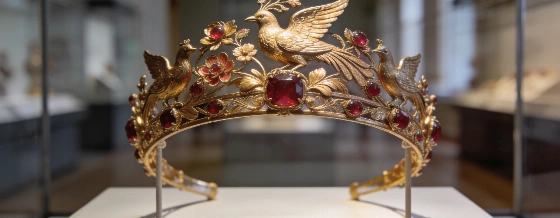
Archaeologists have examined a gold and garnet diadem from a fifth-century burial in Crimea, revealing details about Hun material culture, mortuary customs, and the artifact's symbolic motifs
A gold diadem known as the Crown of Kerch, recovered from a fifth-century CE burial on the Kerch Peninsula in Crimea, offers rare insight into the mortuary practices and social symbolism of the Huns during a period of significant cultural transition. The artifact, now held in the Neues Museum in Berlin, was originally discovered in the grave of a high-status woman at the ancient city of Pantikapaion, a site with a complex history of Greek colonization, Hun conquest, and later Byzantine incorporation.
Archaeological Context and Recovery
The Crown of Kerch was unearthed during early twentieth-century excavations led by Russian archaeologists at Pantikapaion, a settlement founded as a Greek colony in the sixth century BCE and later overtaken by the Huns in the late fourth century CE. The burial context included the remains of a woman, whose skeleton displayed evidence of artificial cranial modification-a practice documented among several steppe populations. The grave was part of a large necropolis, with as many as 2,000 burials excavated, though only a limited number of artifacts and skeletal remains were preserved and documented before the collection was dispersed.
The diadem itself is constructed from three gold-plated bronze plaques, each set with numerous garnets and other gemstones. Measuring approximately 4.4 centimeters in height, the band features two stylized birds of prey, likely eagles, flanking a central floral motif. The birds' eyes are marked by round green stones, and the overall design is consistent with motifs found in other high-status jewelry from the period. The artifact's association with a female burial and its elaborate craftsmanship suggest it was worn by a member of the Hun elite, though not necessarily a royal figure.
Material Evidence and Interpretation
Analysis of the diadem's construction reveals over 250 gem-set cells, with the gold plating applied to a bronze core. The use of garnet inlay and the depiction of birds of prey are features shared with contemporary jewelry from other regions, including Visigothic finds in Spain. The symbolic meaning of the birds is interpreted as representing power and authority, a motif that appears across multiple steppe and post-Roman societies. However, the precise social or ritual significance of the diadem within Hun society remains uncertain, as direct written records are lacking and the archaeological sample is limited.
German archaeologist Joachim Werner, writing in the mid-twentieth century, argued that such diadems were not exclusively funerary objects but were likely worn in life by high-status women, possibly attached to a cloth cap or veil. The presence of artificial cranial modification in the associated skeleton further supports the interpretation of elite status, as this practice was often linked to social identity among steppe groups. To date, approximately two dozen similar gold diadems have been identified from the broader region, indicating that the Crown of Kerch represents a rare but not unique example of Hun elite adornment.
Chronology and Cultural Change
The dating of the Crown of Kerch is based on contextual association with the late fourth to early fifth centuries CE, a period marked by the westward movement of the Huns from the Don River region and their subsequent dominance over former Greek and Scythian settlements in the Black Sea area. Pantikapaion itself was later incorporated into the Byzantine Empire in the sixth century CE. The diadem's style and materials reflect both local traditions and broader patterns of cultural exchange across Eurasia during this era of migration and political transformation.
While the artifact's provenance is relatively secure, the broader context of its recovery highlights the challenges of early twentieth-century excavation and collection practices. Many burials from Pantikapaion were incompletely documented, and the dispersal of finds has complicated efforts to reconstruct the full mortuary landscape. Nevertheless, the Crown of Kerch remains a key piece of evidence for understanding the intersection of material culture, social identity, and mortuary practice among the Huns and their neighbors.
Comparative Evidence and Limitations
The Crown of Kerch is one of a small number of elaborate gold diadems attributed to the Hun period in the Black Sea region. Comparative analysis with similar finds, such as Visigothic jewelry from Spain, suggests that motifs like birds of prey were widely adopted as symbols of status and authority. However, the limited number of securely provenanced examples and the incomplete documentation of many burials restrict the ability to generalize about their function or meaning. The absence of direct written sources from the Huns further complicates interpretation, leaving researchers to rely on material and skeletal evidence.
Recent research on elite women's burials in other ancient societies, such as the Maya, has also emphasized the importance of integrating iconography, burial context, and skeletal analysis to reconstruct social roles. For example, the study of a monumental limestone stela depicting Lady K'abel in Guatemala has provided new perspectives on female authority in the ancient world (see analysis of Maya queenly power). Such comparative approaches highlight both the potential and the limitations of interpreting status and identity from mortuary evidence alone.
Understanding the significance of the Crown of Kerch requires careful attention to archaeological provenance. Provenance refers to the documented origin and recovery context of an artifact, including its excavation, collection history, and subsequent movement between institutions. Secure provenance strengthens the interpretive value of an object by linking it to a specific site, layer, and cultural context. When provenance is incomplete or uncertain, as is often the case with early twentieth-century finds, the ability to draw firm conclusions about function, status, or cultural affiliation is reduced. For artifacts like the Crown of Kerch, ongoing research and comparative analysis remain essential for refining interpretations and situating individual finds within broader patterns of ancient social life.