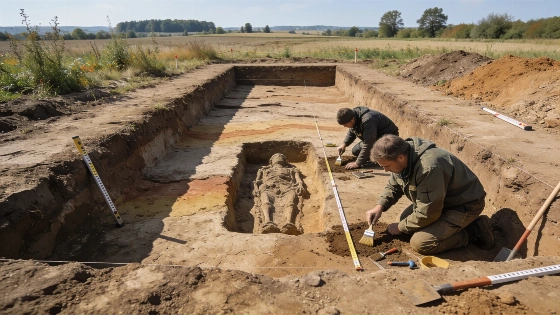
Archaeologists in Saxony have excavated a 5,500-year-old trapezoidal enclosure containing a single human burial, offering new evidence for selective mortuary architecture and social differentiation among Neolithic Baalberge communities in Central Germany
A newly excavated Neolithic monument near Döhlen in Saxony has brought the selective and labor-intensive burial practices of the Baalberge culture into sharper focus. The site, discovered during pipeline construction works, consists of a trapezoidal earthwork measuring approximately 20 by 25 meters, with a surrounding ditch that remains clearly visible in aerial and drone imagery due to the contrast between dark fill and lighter subsoil.
Monumental Construction and Selective Burial
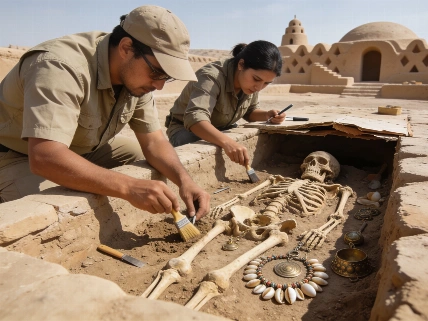
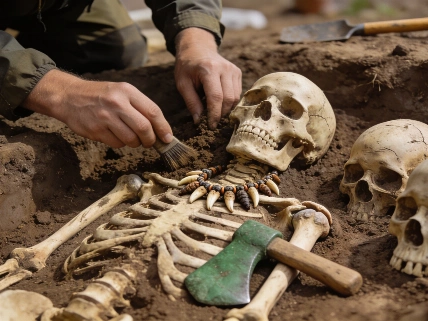
Excavations revealed seven circular pits within the enclosure, but only one contained a human burial. The individual was interred in a flexed position on their side, with the head oriented south and the face turned west. No grave goods were recovered, and most of the larger pits were similarly devoid of artifacts, with only two smaller pits yielding pottery fragments. The absence of material offerings, combined with the monument's scale and careful construction, suggests that the enclosure was not a communal cemetery but a highly selective funerary space.
Dating based on archaeological context places the monument between 3800 and 3400 BCE, within the fourth millennium BCE, and attributes it to the Baalberge culture-a Neolithic society recognized for distinctive pottery and monumental burial architecture in Central Germany. The orientation of the trapezoidal ditch, running northeast to southwest, and the effort required to excavate and construct the mound, point to significant investment in commemorating a single or very limited number of individuals.
Social Status and Regional Patterns
Comparable trapezoidal burial monuments have been documented at several sites in the Leipzig district, including Altranstädt, Zwenkau, and Kieritzsch. Most are centered on a single burial, with rare instances of a second individual. The scale and exclusivity of these monuments have led archaeologists to propose that they were reserved for people of particular social importance, indicating that pronounced social distinctions may have emerged in some Neolithic communities of Central Germany more than five millennia ago.
While the absence of grave goods limits direct inference about the buried individual's identity or role, the monument's construction itself serves as evidence of selective commemoration. The Baalberge culture's mortuary architecture stands in contrast to more egalitarian burial traditions seen elsewhere in Neolithic Europe, where collective or less monumental graves are more common. This pattern is echoed in other recent discoveries, such as the reported earlier Neolithic grave in Poland with distinctive burial treatment and grave goods, highlighting the diversity of mortuary practices across the region.
Evidence and Interpretation
The Döhlen enclosure's archaeological context is well documented, with the monument's outline and internal features clearly visible during the July 2026 excavation. The human remains were found in situ, and the burial posture is consistent with other prehistoric European traditions. However, the lack of associated artifacts and the limited number of burials complicate efforts to reconstruct the full social or ritual significance of the site. The monument's function as a potential burial mound is supported by its size and layout, but direct evidence for a superstructure or above-ground marker is absent.
Excavations along the pipeline route are ongoing, raising the possibility that additional prehistoric remains or monuments may be identified in the area. Public access to the site is planned for Germany's Open Monument Day in September 2026, offering an opportunity for broader engagement with the excavation process and the interpretation of Neolithic mortuary evidence.
Monumental Graves and Neolithic Memory
The Baalberge culture flourished during a period of significant transformation in Central European landscapes and mortuary customs. Monumental graves such as the Döhlen enclosure likely served not only as burial places but also as enduring landmarks, reinforcing connections between communities and their territories. The selective nature of these monuments, their architectural investment, and their spatial concentration in the Leipzig region provide a window into the emergence of social differentiation and the negotiation of memory in Neolithic society.
Despite the absence of grave goods and the limited number of burials, the physical evidence from Döhlen and comparable sites challenges assumptions about uniformity in Neolithic funerary practice. Instead, it points to a complex landscape of mortuary behavior, where monumental architecture could signal both social status and collective memory. The current evidence does not allow for definitive conclusions about the identity or role of the individuals commemorated, but it does underscore the importance of context, construction, and selective burial in understanding the social dynamics of early agricultural communities.
In mortuary archaeology, the distinction between primary and secondary burial, the presence or absence of grave goods, and the scale of monument construction are all critical for interpreting past social organization. Primary burials are those in which the body is interred soon after death, often with deliberate positioning and associated artifacts. Secondary burials involve the reburial or rearrangement of remains, sometimes after initial decomposition elsewhere. Monumental enclosures like the one at Döhlen, with their selective use and architectural investment, highlight the need for careful contextual analysis before inferring social hierarchy or ritual meaning from burial evidence alone.