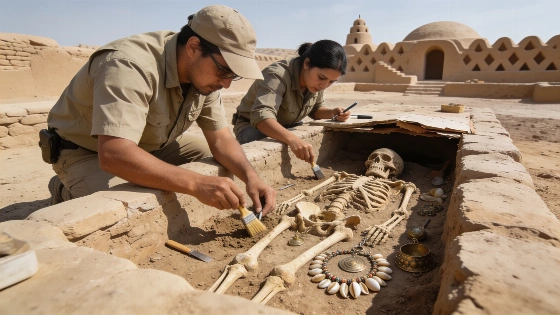
Archaeologists have excavated a remarkably preserved funerary platform at Chan Chan, Peru, containing 38 individuals and elaborate grave goods. The find offers new evidence for Chimú elite burial customs and raises questions about ritual and status
Archaeological teams working at the ancient city of Chan Chan on Peru's northern coast have exposed a funerary platform containing the remains of 38 individuals, many accompanied by ornate metal ornaments, headdresses, and shell necklaces. The preservation of both human remains and grave goods is exceptional for the region, providing a rare opportunity to examine Chimú elite mortuary practices in situ after centuries of looting and disturbance elsewhere at the site.
Unusual Burial Positions and Possible Sacrifice
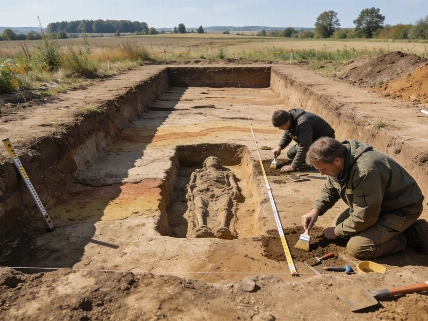
Among the recovered skeletons, one individual was found fully extended, diverging from the flexed or seated-flexed positions typically associated with Chimú funerary tradition. This atypical arrangement has prompted researchers to consider whether the burial represents a case of ritual sacrifice or reflects a distinct social status within the group. The absence of clear perimortem trauma or direct evidence of cause of death means that both interpretations remain plausible, pending further osteological and contextual analysis.
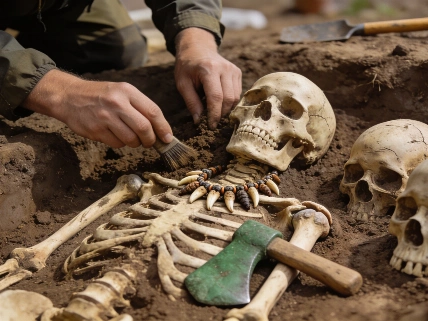
Other individuals on the platform displayed traces of red pigment on their heads, a treatment historically reserved for high-ranking burials in Andean societies. The presence of fine metal ear ornaments, carved wooden boxes with metal appliqués, and necklaces of shell and quartz further supports the interpretation that those interred belonged to the Chimú elite. However, the diversity of burial positions and associated objects complicates any simple reading of status or ritual.
Funerary Platform Architecture and Preservation
The funerary platform, located within the Utzh An walled complex (formerly the Gran Chimú Palace), consists of a central chamber flanked by two larger side chambers. The central chamber measures approximately 1.2 meters wide and 5 meters deep, accessed by a staircase descending 2.5 meters. Here, a single individual was found with numerous shell and metal objects. The side chambers, each about 1.5 meters wide and 8 meters long, extend 3.5 meters below the surface. One side chamber contained weapons and metal emblems but no human remains, while the other yielded 20 individuals. The remaining 18 individuals were distributed elsewhere on the platform.
In total, the platform held 38 individuals, a sample size that allows for meaningful comparison with other elite burials in the region. The largely undisturbed context is a marked contrast to previous finds at Chan Chan, where colonial-era looting and later disturbances have left most elite tombs incomplete or contextually compromised. The current project's use of high-precision photogrammetry to document the burials before removal ensures that the original spatial relationships are preserved for future study.
Material Evidence and Analytical Challenges
Grave goods recovered from the platform include elaborate metalwork, shell and quartz jewelry, carved wooden boxes, weapons, and ceremonial objects. The application of red pigment to both human remains and ceramics is consistent with high-status funerary treatment, but the specific social or ritual meanings remain uncertain. The fragile condition of the bones and organic materials, a result of centuries of exposure to coastal humidity, has required careful conservation and digital documentation before any physical removal.
Researchers have emphasized that much of what is known about Chimú elite burials has previously come from looted or disturbed contexts, limiting the reliability of earlier interpretations. The intact nature of this platform offers a rare chance to reconstruct original mortuary arrangements and to test hypotheses about status, identity, and ritual within the Chimú polity. The project's approach echoes the importance of context highlighted in other recent discoveries, such as those reported earlier from prehistoric Poland, where undisturbed burials have transformed understanding of mortuary customs.
Historical Implications and Remaining Questions
The funerary platform dates to the final centuries before the Inca conquest of the Moche Valley, a period when Chan Chan served as the political center of the Chimú state. Researchers hope that further analysis of the human remains, grave goods, and architectural context will clarify how elite status was constructed and maintained, and whether the unusual burial positions reflect changing social or ritual dynamics during this transitional era.
Key uncertainties remain. Without direct evidence of trauma or ritual activity, the interpretation of the extended burial as a sacrifice is provisional. The relationship between individuals within the platform-whether kin, retainers, or members of a broader elite group-has yet to be established. Planned laboratory analysis, including osteological examination and potentially ancient DNA or isotope studies, may help resolve these questions, but the limits of preservation and sample size will constrain the scope of possible conclusions.
The discovery at Chan Chan underscores the value of undisturbed archaeological contexts for reconstructing ancient lifeways. While the evidence from this funerary platform is unusually rich, it also highlights the interpretive challenges that arise when mortuary practices are complex, variable, and only partially preserved. The temptation to read every unusual burial as evidence of sacrifice or hierarchy must be balanced by careful attention to context, preservation, and alternative explanations. As with other recent finds, the most responsible interpretation is one that foregrounds the limits of the evidence as well as its potential.
Understanding the significance of this discovery requires attention to the concept of archaeological context. Context refers to the original position and association of artifacts, human remains, and architectural features within a site. When a burial or object is recovered in situ, with its spatial relationships intact, archaeologists can reconstruct the sequence of events, social meanings, and cultural practices with greater confidence. Disturbance, looting, or removal from context reduces the interpretive value of the evidence, making it harder to distinguish between primary deposition, later reuse, or post-depositional change. The Chan Chan funerary platform's preservation offers a rare opportunity to study elite mortuary behavior in its original setting, but even here, the limits of preservation and the complexity of ancient practice demand caution in drawing conclusions.