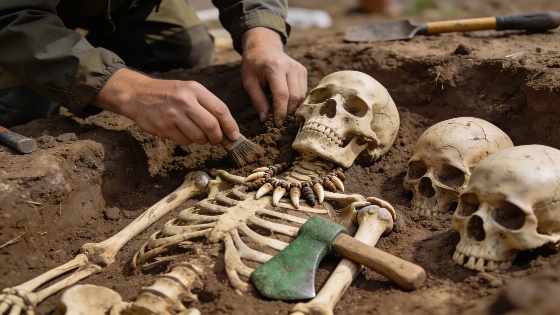
Archaeologists in southwest Poland have uncovered a Neolithic grave containing an adult skeleton, two additional human skulls, a necklace of 42 drilled animal teeth, and a serpentinite battle ax, raising new questions about burial practices and social identity around 2900 BCE
When archaeologists excavating a Roman-period cemetery near Wrocław in southwest Poland reached the end of their planned fieldwork, they encountered a burial that did not fit the expected chronology or customs. Beneath later graves, a circular feature in the soil led to the discovery of a nearly complete adult skeleton accompanied by a necklace of 42 drilled animal teeth, two additional human skulls, amber beads, a flint blade, and a battle ax made from serpentinite. The style and material of the ax, along with the associated artifacts, indicated a burial date around 2900 BCE-three millennia older than the surrounding cemetery.
Unusual Grave Goods
The necklace, composed of incisors and canines from large mammals such as wolves, deer, and bears, was arranged with precision around the skeleton. Each tooth had a hole drilled through its root, suggesting deliberate manufacture for personal adornment or symbolic display. While most teeth were identified as animal, the possibility that some may be human remains under investigation. The presence of two additional human skulls, not articulated with the main skeleton, further complicates the interpretation. These skulls may represent decapitated heads placed as grave offerings, but further analysis is required to determine whether decapitation occurred around the time of death or as part of a later funerary act.
In total, the grave contained the adult skeleton, two separate skulls, the tooth necklace, amber beads, a flint blade, and the serpentinite ax. The completeness of the skeleton and the preservation of the teeth and beads provide a rare opportunity to study mortuary practices and social signaling in the Middle Neolithic of Central Europe. The burial's location beneath a Roman cemetery highlights the long-term use and re-use of the site, complicating stratigraphic interpretation but offering a unique window into changing funerary landscapes.
Context and Cultural Attribution
Archaeologists have compared this burial to a similar find in the same region, where another individual was interred with axes, flint tools, amber beads, and the remains of a sacrificed calf. Both graves are tentatively attributed to the Corded Ware culture, a widespread archaeological horizon associated with the spread of Indo-European languages and distinctive burial customs across Europe and western Asia during the late Neolithic and early Bronze Age. However, the presence of multiple human skulls and the elaborate tooth necklace set this burial apart from most Corded Ware graves, which typically feature single individuals and more standardized grave goods.
Dating of the burial relies on typological analysis of the serpentinite ax and associated artifacts, placing the grave around 2900 BCE. No direct radiocarbon dates have yet been reported for the human remains or associated materials. The stratigraphic position beneath the Roman cemetery provides a clear terminus ante quem, but the possibility of later disturbance or re-use cannot be excluded. The preservation of the skeleton and associated objects is unusually good for the region, allowing for detailed osteological and material analysis.
Interpreting the Evidence
Researchers have proposed that the individual buried with the necklace and skulls may have held a special social role, possibly as a leader, hunter, or person of ritual significance. The combination of animal and possibly human teeth, the presence of a battle ax, and the inclusion of additional skulls suggest complex mortuary symbolism. However, without direct evidence of status or occupation, such interpretations remain provisional. The burial's uniqueness in the local archaeological record raises questions about the diversity of funerary practices within the Corded Ware culture and the extent to which individual identity was expressed through grave goods.
Further laboratory analysis is planned, including osteological examination of the skeleton and skulls, isotopic studies to assess diet and mobility, and ancient DNA analysis to investigate possible biological relationships between the individuals. The results may clarify whether the additional skulls belonged to relatives or unrelated individuals, and whether the necklace incorporated human teeth. Comparable cases of elaborate burial treatment and grave goods have been documented elsewhere in prehistoric Europe, but the combination of features in this grave is rare. For context, the analysis of elite burial objects such as the gold diadem from Crimea, as reported earlier, demonstrates how mortuary evidence can illuminate social hierarchy and cultural interaction, though each case must be interpreted within its own archaeological context.
Limitations and Ongoing Questions
Several uncertainties remain. The precise function and meaning of the tooth necklace are not established, and the identification of some teeth as possibly human requires further morphological and biomolecular analysis. The circumstances under which the additional skulls were deposited-whether as part of a single funerary event, later reopening, or secondary burial-are not yet resolved. The absence of direct radiocarbon dates limits chronological precision, and the potential for post-depositional disturbance complicates interpretation of the burial sequence.
Ethical considerations also arise in the study and display of human remains, particularly when unusual mortuary treatment is involved. Researchers have indicated that results from ongoing analyses, including possible kinship and dietary reconstruction, are expected later this year. Until then, the burial stands as a striking example of the variability and complexity of Neolithic funerary customs in Central Europe, challenging assumptions about uniformity within archaeological cultures and highlighting the need for careful, context-sensitive interpretation of the material record.
Osteological age estimation is a key method in bioarchaeology for determining the age at death of skeletal remains. In adults, this process typically relies on morphological changes in the pelvis, cranial sutures, and dental wear, though precision decreases with age. For juveniles, dental development and epiphyseal fusion provide more accurate age ranges. Preservation, taphonomic alteration, and population-specific variation can affect the reliability of age estimates, making it essential to combine multiple indicators and acknowledge uncertainty in reporting results.