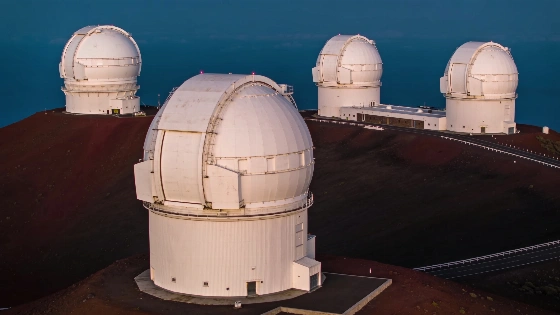
Four 23 m telescopes at La Palma will work together to detect faint atmospheric flashes from high-energy gamma rays, with sensitivity that could extend observations to bursts at redshifts near z∼4
At Roque de los Muchachos Observatory, four completed Large-Sized Telescopes each have a 23 m-diameter reflector built to collect faint flashes of Cherenkov light. Very high-energy gamma rays produce this light when they interact with Earth's atmosphere; the telescopes detect the secondary signal, not the gamma rays themselves. The array's sensitivity could extend observations of bright gamma-ray bursts to redshifts around z∼4, potentially giving astronomers access to events from the early universe.
Atmospheric light
The four instruments form the Large-Sized Telescope (LST) array, the low-energy component of the Cherenkov Telescope Array Observatory (CTAO). LSTs are designed to observe gamma rays from approximately 20 GeV to 3 TeV. The collaboration describes them as the world's most sensitive instruments within that range.
The first telescope, LST-1, was built in 2020. It has already observed pulsars and studied active galactic nuclei at cosmological distances. It has also made rapid follow-up observations of transient events, including novae and gamma-ray bursts. Now the three newly completed telescopes join it.
Four viewing angles
When several telescopes observe the same atmospheric shower from different directions, astronomers can combine their views to estimate the incoming gamma ray's properties. The array is intended to improve sensitivity. Its multiple viewpoints should also sharpen angular resolution and improve energy reconstruction.
The array's reach at low energies matters for studying bright gamma-ray bursts at high redshift. The collaboration says it could extend observations to sources at redshifts around z∼4, potentially allowing astronomers to examine events from the early universe. This remains a potential capability, not a guarantee that every such burst will be detectable.
Masahiro Teshima, the Japanese astrophysicist who leads the LST collaboration as principal investigator, said the completed sub-array follows more than 15 years of international collaboration and technological work. He has described its scientific aims as including the study of supermassive black holes and neutron stars. The collaboration also plans to investigate dark matter's nature.
Coordinating observations across the array poses an instrumentation challenge distinct from quantum-computing work such as Science Report's decoder calibration report. Here, light generated in the atmosphere carries the signal, and the array is designed to reconstruct the gamma-ray event that produced it.
Part of CTAO
The four LSTs belong to a larger observatory expected to operate in 2028. The CTAO is designed to cover energies from 20 GeV to 300 TeV and is set to become the world's most powerful gamma-ray astronomy observatory.
The planned 66 telescopes will be split between CTAO-North at La Palma and CTAO-South at the Paranal Observatory in Chile's Atacama Desert. The design includes six LSTs. A separate group of 23 Medium-Sized Telescopes will cover 80 GeV to 50 TeV, while 37 Small-Sized Telescopes are intended for the 2-300 TeV range. The completed La Palma instruments form the northern site's low-energy core; commissioning and integration into CTAO operations are still ahead.
The energy ranges overlap because each telescope type contributes to a different part of the observatory's coverage. Gamma-ray energy is commonly expressed in electronvolts: GeV means a billion electronvolts, and TeV means a trillion. Cherenkov light is a brief optical signal created in the atmosphere by a particle shower, so astronomers infer the original gamma ray's properties from the shower's observed light, not from a direct optical image of the gamma ray.