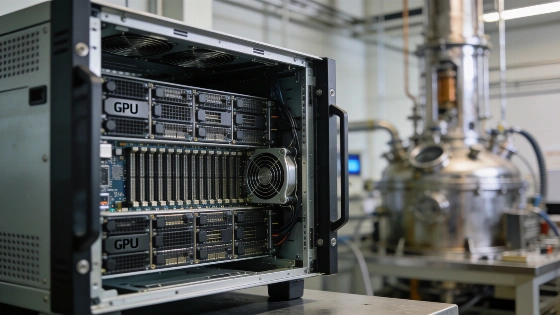
Riverlane and NVIDIA report that an H100 GPU cuts surface-code decoder-training epochs from minutes to seconds, while recalibrated priors lower logical error rates by several percent to as much as twofold against uncalibrated starting weights
Recalibrating a quantum error-correction decoder can take a surface-code training epoch from about 180 seconds on a single CPU core to 2.8 seconds on one NVIDIA H100 GPU, Riverlane and NVIDIA reported on October 14, 2026. That is roughly a 65-fold speedup. The reported throughput rose from about 59,000 to more than 4.2 million syndromes per second. For a repetition code, the training cycle was 43 times faster, with throughput reaching 155 million syndromes per second.
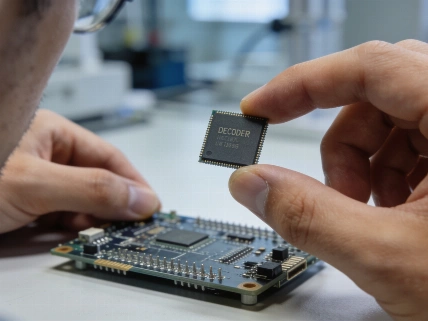
A decoder uses numerical weights to represent estimated physical error probabilities. It combines those weights with syndrome data-the signals generated during error checks-to infer which faults may have affected encoded quantum information. These estimates can drift as qubit frequencies change, defects become active or gate fidelity declines, making recalibration useful as device behavior evolves.
Riverlane and NVIDIA adapted Riverlane's Local Clustering Decoder (LCD) for high-throughput processing on GPUs. The optimization loop evaluates batches of candidate weights against experimental data and shifts toward the settings that produce the lowest logical error rate. The approach is described as using machine-learning methods, including multi-agent reinforcement learning; small-distance sensor codes, including distance-5 codes, provide logical-error-rate measurements that guide the search.
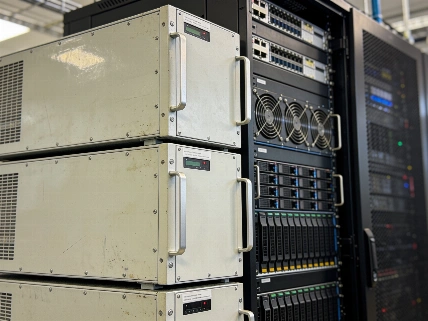
The H100 benchmark also illustrates the role of parallel processing. A 32-core CPU achieved about a 23-fold speedup over a single core, while the H100 remained roughly three times faster than that configuration. The reported comparison is for decoder calibration workloads: GPU batches candidate-weight evaluations rather than performing each low-latency error-correction step during execution of a quantum circuit.
The logical error-rate improvement varied with code structure and the initial decoder weights. Riverlane and NVIDIA reported reductions of several percent in some configurations and up to a factor of two in others, relative to uncalibrated starting priors. These results describe the tested configurations, not a single improvement applicable to every quantum code.
The work is part of a broader effort to combine AI, accelerated computing and quantum error-correction technologies, as described in NVIDIA's announcement. Riverlane, a Cambridge-based quantum error-correction company, positions GPU calibration within a broader hardware and software stack that also includes Deltaflow, its real-time decoding technology.
The proposed division of labor separates computationally intensive calibration from decoding during circuit execution: GPUs handle batches of calibration workloads, while real-time decoding systems address low-latency operation. Faster calibration can shorten the time needed to update decoder weights, but it does not by itself demonstrate faster quantum computations or a fault-tolerant machine. The reported benchmark concerns calibration performance and the effect of updated weights on logical error rates.
The workflow also differs from software that turns a high-level task into quantum circuits, as described in an earlier workflow report. Here, the target is narrower: optimize decoder priors against observed hardware data.
A logical error rate describes failures of information encoded across physical qubits, rather than the error rate of one physical qubit or gate. A decoder estimates likely faults from error-check signals and uses that estimate to recover the encoded information. Recalibrating its weights can update those estimates as device behavior shifts; it does not remove physical errors.