A motor issue stopped NICER's observations in 2025. NASA says the X-ray telescope has now ended science work as teams prepare its archive and plan its removal from the International Space Station
A motor problem that halted NICER's observations in June 2025 left the X-ray telescope unable to swivel side to side and track cosmic objects. NASA says science operations ended Nov. 17, 2026, as teams turn to archiving the mission's observations and planning the telescope's removal.
The motor problem
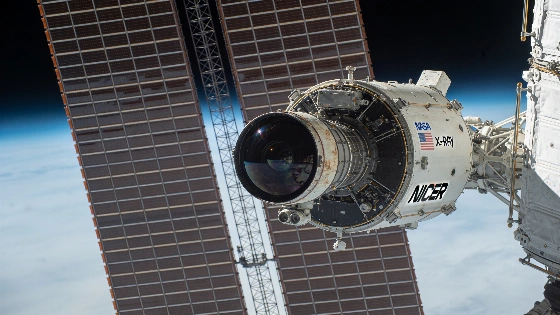
Performance degradation in one motor began affecting observations, and the team paused operations on June 17, 2025. Photos taken by robotic cameras outside the International Space Station helped engineers rule out external causes. After investigating, they concluded that an internal motor had likely failed.
In August 2025, the team said it had no timeline for restarting science operations. The telescope's limited motion also meant it could not track targets as before.
Years beyond its prime
Launched in June 2017 aboard SpaceX's CRS-11 cargo-resupply mission, NICER was installed externally on the International Space Station. It was designed for an initial 18-month prime mission and continued studying the universe for six and a half years beyond that plan. Its main focus was neutron stars, including pulsars: rapidly rotating stars whose X-ray beams sweep past Earth in regular pulses. NASA Goddard Space Flight Center astrophysicist Keith Gendreau, NICER's principal investigator, described the nature of matter inside neutron stars as "a decades-old unsolved problem." NICER used precise X-ray timing and spectroscopy to test theories about matter at densities approaching the threshold of black-hole collapse.
The observatory also carried the Station Explorer for X-ray Timing and Navigation Technology experiment. Pulsars' regular signals can act as natural clocks: spacecraft can compare the arrival times of observed pulses with predicted times to estimate their position and motion. The experiment was designed to demonstrate pulsar-based navigation in space, though the technology's operational use on interplanetary spacecraft is a separate step.
NICER also investigated active galaxies and other energetic phenomena. NASA has described how NICER observations, combined with data from other missions, helped astronomers study recurring X-ray outbursts near supermassive black holes. The observatory's X-ray measurements complement work at other wavelengths, including a Carina Nebula telescope view that paired visible-light and infrared observations. NASA's LISA mission stories also describe NICER's role in investigations of activity around these "monster black holes."
Archive and removal plans
The mission and station teams are preparing NICER's eight-year archive of X-ray science observations. They also plan to decommission and detach the telescope from its perch near the station's starboard solar array.
NICER's measurements helped characterize neutron stars, which contain the densest matter in the universe that scientists can measure. Its science extended beyond neutron-star structure: NASA has highlighted NICER data as part of multi-mission studies of repeating X-ray outbursts around black holes.
NICER detects X-rays when they strike its detectors and generate electrical charge. Measurement and power units sense that charge, allowing the instrument to register individual X-ray events.