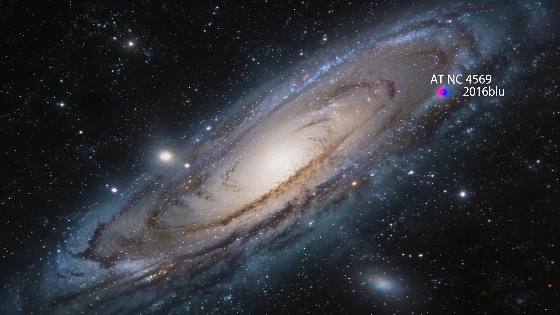
Chandra observations point to a hidden neutron star or stellar-mass black hole drawing material from AT 2016blu on a 113-day orbit and heating the captured matter until it shines in X-rays
At least 33 times the Sun's mass, AT 2016blu is a luminous blue variable (LBV) in NGC 4559, a galaxy about 30 million light-years from Earth. Classified as a "supernova impostor," it has undergone repeated eruptions without being destroyed. For more than 15 years, astronomers have tracked its brightening and fading in optical light.
The 113-day cycle
A peer-reviewed study in The Astrophysical Journal counts 27 detected, roughly 113-day outbursts between 2012 and June 2026. The researchers interpret the recurring events as signs of an eccentric binary orbit: the compact companion passes closest to the LBV at periastron, where it can capture material from the star. The study presents the first X-ray detection of AT 2016blu and identifies the system as a high-mass X-ray binary.
The study's X-ray measurements indicate a luminosity of about 1038.64 erg per second and an inferred accretion rate of at least 8 × 10⁻⁸ solar masses per year. Its authors say the outbursts are most likely triggered by periastron encounters, as matter drawn from the LBV heats up while falling toward the compact object. The team describes AT 2016blu as the first known LBV supernova impostor for which X-ray observations clearly favor intermittent accretion as the cause of the eruptions. The findings are reported in the journal study.
A compact companion
The captured material becomes so hot that it shines brightly in X-rays. The unseen object could be either a stellar-mass black hole or a neutron star; the observations do not identify which one. Both are compact remnants capable of producing X-rays as gas falls onto them. NASA's Chandra team describes the companion as one of these two possibilities in its account of the findings.
Distant points of light
In the image of NGC 4559, a small group of pink and blue dots near the spiral's outer edge is outlined and enlarged in supporting images. The smallest pink dot is AT 2016blu. A separate Webb account of star formation in N159 in the Large Magellanic Cloud appears in this earlier image report.
The other dots in the outlined area are unresolved stars or star clusters. They are too distant to be connected to the movement of material between AT 2016blu and its companion.