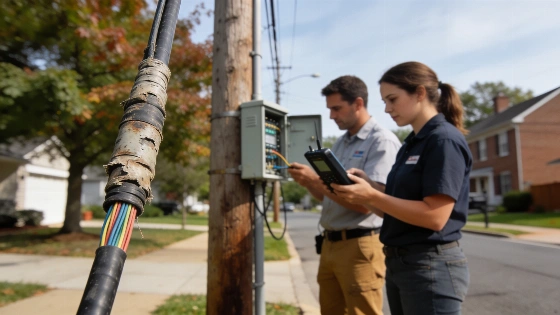
A team from NIST, the University of Maryland, and Qunnect has distributed polarization-entangled photons across 62 kilometers of commercial aerial fiber, testing quantum communication under real-world environmental noise
Researchers from the National Institute of Standards and Technology (NIST), the Joint Quantum Institute at the University of Maryland, and quantum networking company Qunnect have experimentally distributed polarization-entangled photons over 62 kilometers of commercial fiber-optic cable suspended above ground between Gaithersburg and College Park, Maryland. The demonstration, published in the peer-reviewed Journal of Optical Communications and Networking, tested the stability of quantum entanglement transmission across a live, partially aerial telecommunications link exposed to wind, temperature fluctuations, and mechanical vibrations-conditions that are far less controlled than those in buried or laboratory fiber systems.
Environmental Noise and Polarization Drift
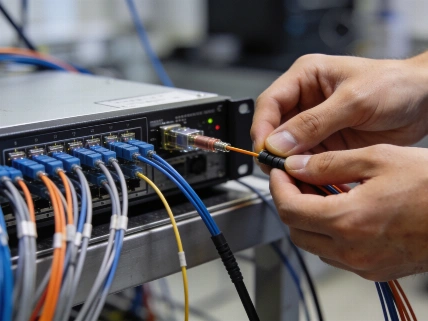
Unlike underground fiber, aerial cables are directly affected by environmental changes, leading to rapid and unpredictable polarization drift. This drift can degrade or destroy the quantum correlations needed for entanglement-based protocols. To address this, the team integrated automated polarization compensation (APC) modules developed by Qunnect. These devices inject reference light into the fiber to continuously monitor time-varying birefringence, then apply real-time corrections to maintain the quantum polarization state of transmitted photons. The system operated continuously for 24 hours, with the APC modules recalibrating polarization for only 7.2% of the total link time, resulting in an operational uptime of 92.8%.
Measured Entanglement and Fidelity
During the trial, the entangled photon source achieved a distribution rate of approximately 1,500 pairs per second across the 62 km link. The researchers measured the strength of quantum correlations using the Clauser-Horne-Shimony-Holt (CHSH) Bell inequality, obtaining a time-averaged S parameter of 2.45 ± 0.08. This value exceeds the classical physics threshold (S ≤ 2) for more than 20 consecutive hours, confirming that high-fidelity entanglement was preserved despite the challenging conditions of aerial fiber. The experiment demonstrates that entanglement distribution is feasible over existing commercial infrastructure without the need for custom underground installations or extensive shielding.
Implications for Quantum Networks
The ability to maintain entanglement over metropolitan-scale distances in real-world fiber is a critical step toward practical quantum networks, quantum key distribution (QKD), and distributed quantum computing. The result suggests that future quantum communication systems could leverage existing telecom infrastructure, reducing deployment costs and complexity. However, the experiment did not include quantum repeaters or memory nodes, which are necessary for extending entanglement beyond metropolitan distances or for building scalable quantum internet architectures. The demonstration focused on two-node entanglement distribution, and further engineering will be required to address loss, synchronization, and integration with quantum memories.
Comparison With Other Quantum Communication Efforts
This field test complements recent advances in quantum networking, such as laboratory-based entanglement distribution and hybrid quantum-classical testbeds. For example, efforts to integrate quantum processors with high-performance computing infrastructure, as described in a recent Science Report article on hybrid quantum-classical testbeds, highlight the broader push to bridge laboratory demonstrations and operational quantum networks. The Maryland experiment stands out for its use of unshielded, commercially deployed aerial fiber, providing a realistic assessment of the engineering challenges and environmental noise that future quantum networks must overcome.
Entanglement is a uniquely quantum phenomenon in which the measurement outcomes of two or more particles are correlated beyond what is possible in classical physics, even when the particles are separated by large distances. In photonic quantum communication, entanglement is typically generated in pairs of photons and distributed through optical fiber. Preserving entanglement over long distances requires careful control of polarization, phase, and loss, as environmental disturbances can rapidly degrade quantum correlations. The CHSH Bell inequality provides a quantitative test for entanglement, with values above the classical limit indicating nonlocal quantum correlations. Demonstrations like this one are essential for validating the feasibility of quantum networks under real-world conditions and for identifying the engineering advances still needed for scalable deployment.