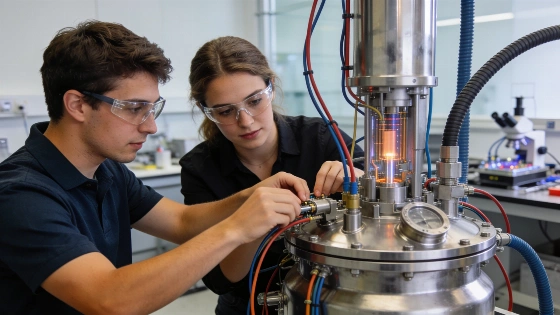
Florida State University will build a campus-scale quantum communication testbed linking engineering and high-field facilities to study entangled photons under turbulence, magnetic fields and cryogenic cycling.
Florida State University announced on September 28, 2026, that it had secured $2.1 million in federal funding through the National Institute of Standards and Technology for a campus-scale quantum communication testbed. The planned facility is intended to expose networking hardware to conditions that ordinary laboratory links rarely combine. Rather than confining the experiment to a single optical table, the project will connect quantum optics equipment across FSU's Tallahassee campus and evaluate performance in what the university describes as real-world conditions.
The award comes through federal Community Project Funding administered by NIST. U.S. Representative Daniel Webster of Florida's 11th District supported the investment in Congress. In descriptions of the project, the facility is presented as the first dedicated real-world quantum communications and optical networking testbed of its kind in the southeastern United States, although the announcement does not establish a construction schedule, completion date or quantitative performance target.
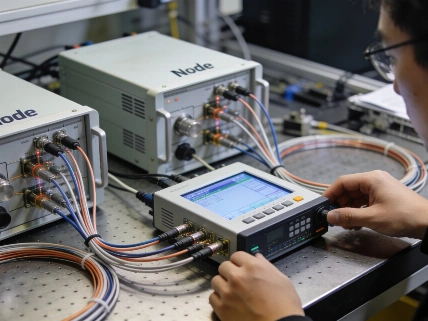
FSU has identified three network locations. A central quantum-optics hub will be installed in the Interdisciplinary Research and Commercialization Building, while receiver nodes will be placed at the FAMU-FSU College of Engineering and the National High Magnetic Field Laboratory in Tallahassee. The system will use existing campus fiber connections and is also intended to support reconfigurable free-space optical channels, allowing researchers to compare controlled and atmosphere-dependent links.
The network is intended to generate and distribute entangled photon pairs between separated nodes. Entanglement is a measurable quantum correlation between systems, not a channel for sending usable messages faster than light. In this project, it is the resource researchers plan to use when examining quantum key distribution, link reliability and other indicators of quantum-communication quality across connected hardware.
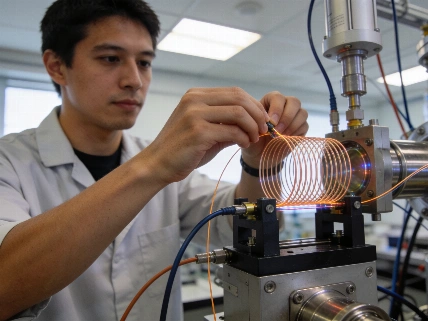
The MagLab connection gives the testbed an unusual operating regime. The university describes experiments involving high magnetic fields, strong atmospheric turbulence and cryogenic thermal cycling. These conditions can be relevant to optical polarization, detector behavior, alignment stability and calibration. In high-field environments, researchers may need to consider magneto-optic effects such as Faraday rotation, while cryogenic operation can alter the behavior of optical components, cables and single-photon detectors.
Superconducting nanowire single-photon detectors illustrate why environmental testing matters. A quantum network must identify individual-photon events with high reliability, yet detector performance can depend on temperature, bias conditions, optical coupling and background events. The project announcement does not report detector efficiencies, key rates, entanglement-generation rates, optical losses or measured polarization changes from the new facility. The $2.1 million award therefore supports an experimental capability rather than announcing a completed performance result.
The planned stress tests also include cryogenic thermal cycling. A link can operate in a carefully stabilized laboratory and still lose performance when components repeatedly move between operating temperatures. Thermal expansion, contraction, connector drift and changes in alignment can introduce errors that are difficult to observe in a static setup. A campus-scale platform can characterize those effects across connected nodes rather than treating each instrument as an isolated device.
At the College of Engineering node, researchers are expected to examine adaptive optics and related control methods for stabilizing free-space channels. Atmospheric turbulence can distort an optical beam, change its wavefront and alter the conditions seen by a receiver. Adaptive optics attempts to compensate for some of that disturbance, while full-stack protocol validation asks whether hardware, timing systems and control software continue to operate as attenuation and alignment change.
This combination gives the project a more demanding target than simply demonstrating photon transmission through a fixed link. Fiber provides a controlled route already available on campus; free space introduces environmental variability; and the MagLab node adds magnetic and cryogenic conditions. The testbed is meant to compare these regimes within one connected experimental setting. Similar distinctions between laboratory proof-of-principle and field-ready instrumentation are central to engineering work at institutions such as MIT and to the measurement standards developed across the wider quantum-information community.
The facility will not by itself establish a scalable quantum internet or prove that quantum key distribution is immune to implementation flaws. No quantum repeaters, trusted-node architecture, secret-key rate or security certification is reported in the announcement. Those omissions define the difference between building a useful research platform and demonstrating an operational secure network. As the broader literature in Nature has repeatedly illustrated, a physical demonstration and a validated system-level capability require different kinds of evidence.
FSU's project fits into a wider state effort that includes the 45-faculty FSU Quantum Initiative and the Florida Alliance for Quantum Technology workforce pipeline. The infrastructure emphasis also connects with Florida's quantum expansion through university-based technology programs, although the FSU award concerns communication and optical networking rather than a quantum processor.
The most consequential feature of the award is not a record transmission distance or a new detector specification. It is the decision to build a test environment where magnetic fields, temperature changes and atmospheric turbulence can be treated as experimental variables. Researchers can use such a platform to identify which components fail first and which control strategies preserve the quantum signal, but the announcement does not yet provide the measurements needed to rank those effects.
The planned work also has a clear methodological boundary. The public announcement specifies the network architecture, target stressors and intended use of entangled photons, but it does not report a sample size, number of experimental runs, statistical confidence intervals, p-values or peer-reviewed findings. Those details would be needed to distinguish an exploratory engineering characterization from a reproducible performance study. Until they are published, the appropriate interpretation is that FSU is establishing the apparatus for later measurements.
That distinction matters in quantum engineering. Entangled photons can be generated in a laboratory without solving the losses, detector imperfections, calibration drift and environmental instability that determine whether a network can operate outside ideal conditions. A campus testbed can close part of that gap by linking hardware and exposing it to realistic disturbances, while leaving the harder questions of rate, reliability, security and reproducibility for later experiments. The project should therefore be evaluated by transparent calibration procedures and repeated measurements, not by the grant announcement alone.
FSU's award is a concrete infrastructure decision rather than evidence that a regional quantum network is already operational. Its value will be judged by the data produced under stress: how polarization changes are measured, how detector performance shifts in high fields and at low temperatures, and whether adaptive optics can maintain a usable free-space channel. For now, the strongest conclusion is restrained but important: the project puts the engineering problems of quantum communication in the same experimental environment as the underlying physics, which is where credible progress has to begin.
Entanglement links the testbed's nodes through correlations between photon measurements, but it does not remove ordinary engineering constraints. Loss can erase photons, detectors can miss events, and environmental disturbances can reduce the quality of the shared quantum state. A quantum communication testbed is valuable precisely because it measures those failures under controlled conditions. The award funds that measurement infrastructure, not a finished network or a demonstrated security guarantee. Further technical details and standards relevant to quantum information are available through NIST's quantum-information program.