Cisco has released research prototypes that let quantum software request entanglement across networked QPUs while a compiler accounts for optical loss, switching delays and distributed error-correction constraints
Cisco is moving quantum networking work up the software stack with two research prototypes designed to coordinate operations across multiple quantum processing units. The Cisco Quantum Network Controller and Network-Aware Quantum Compiler v0.2.0 treat entanglement as a managed network resource rather than a sequence of optical paths and hardware triggers that every application must configure itself. Cisco presents the pair as a transition from managing isolated quantum devices to coordinating a network-level service.
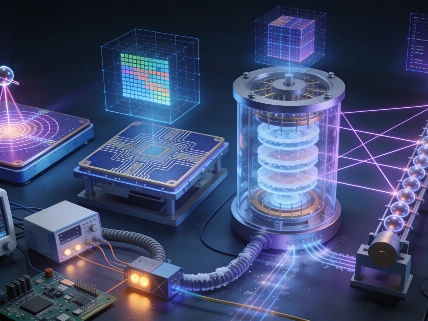
Developed through Cisco's Outshift division and built on the architecture of the Cisco Universal Quantum Switch, the controller introduces an Entanglement-as-a-Service abstraction layer. Its hardware-independent layer separates interfaces for photon sources, optical switches, detectors and synchronization systems, allowing equipment from different manufacturers to be represented through a common model. Compilers, application routines and security protocols can request entanglement between network nodes without directly specifying optical routing, physical device triggers or timing parameters.
The architecture divides responsibility between software layers. The compiler determines how a distributed computation should be partitioned across processors, how much entanglement is needed, which nodes should participate and what quality is required. The controller then translates that request into actions on the available network equipment. This separation resembles the role of a classical control plane, but the underlying resource remains probabilistic and vulnerable to loss.
That abstraction addresses a problem specific to quantum systems: a network cannot simply inspect a travelling quantum state to determine whether it remains healthy. Measurement can collapse the state being used. Instead, the controller is designed around closed-loop statistical telemetry. It monitors link performance and can initiate predefined tuning or re-initialization when measured behavior deteriorates. Similar distinctions between device control, calibration and application-level performance are central to research programs at MIT and CERN, although Cisco's announcement describes prototypes rather than a completed interoperable standard.
The distinction matters. This is not a claim that Cisco has created a general-purpose quantum internet or removed the physical constraints of entanglement distribution. It is a control-plane design intended to hide some of those constraints from higher-level software while leaving the underlying optical links and quantum processors responsible for producing usable states. The basic communication principle is unchanged: entanglement cannot be used to send controllable messages faster than light, and classical communication remains necessary for coordinating many protocols.
Version 0.2.0 of the Network-Aware Quantum Compiler brings network conditions into circuit compilation. It combines circuit compilation and qubit partitioning with distributed quantum error correction, using parameters that ordinarily sit outside a conventional compiler's view of the processor. Cisco also describes a single network model used throughout the workflow: the same representation informs partitioning and execution simulation, including realistic network limitations.
The listed inputs include optical-switch delay, attenuation in fiber, limits on communication qubits and the requirements of surface-code lattice surgery between quantum processing units. In practice, that means a distributed circuit is not treated as if its qubits occupied one ideal machine. The compiler must account for the time and loss involved when information crosses a physical link and for the extra qubits and operations needed to manage errors across separate processors.
The release adds a distributed error-correction package covering fault-tolerant encoding, network decoding, logical-error estimation and workflows based on the surface code. Other code families are described as future development. Surface-code methods are attractive because they use repeated stabilizer measurements to infer error syndromes without directly measuring the encoded quantum information, but their practical overhead can be substantial when operations must cross a network boundary.
This is a more credible engineering direction than simply adding network language to a local circuit compiler. Communication latency and photon loss can change which circuit partition is viable, while distributed error correction can impose operations that alter scheduling and resource requirements. The release describes those capabilities as part of a prototype compiler rather than as evidence of fault-tolerant distributed computation. The broader field, including work discussed in Nature's quantum-information coverage, distinguishes carefully between physical-link demonstrations, logical-qubit benchmarks and useful algorithms executed across nodes.
Cisco points to an earlier multi-node deployment over 17.6 kilometers of commercial telecommunications fiber in New York City as evidence for the broader software stack. Using third-party hardware at room temperature, the deployment demonstrated polarization fidelity above 99 percent, according to the supplied release material.
Those figures establish a concrete network result, but they do not by themselves specify an entanglement rate, a secret-key rate, a logical error rate or the performance of a distributed algorithm. Polarization fidelity is also not interchangeable with gate fidelity, readout fidelity or the fidelity of an entire network protocol. The measurement therefore supports a narrower conclusion: the stack was used in a multi-node fiber deployment where the reported polarization quality exceeded 99 percent.
The release does not provide a physical-qubit count, logical-qubit count, code distance, number of correction cycles, communication rate or independent replication. It also does not establish whether the reported deployment performed real-time decoding or a useful distributed computation. Those omissions prevent the result from being read as a demonstration of a complete fault-tolerant quantum network. As in laboratory work reported by major research institutions such as CERN, a systems claim must be separated from the individual performance metric used to support it.
The distinction has been important in earlier error tests as well, where the relevant question is not simply whether a quantum device can be controlled but whether the operations needed to detect and manage errors remain reliable under realistic conditions.
The controller's central challenge is statistical rather than visual. Because quantum states cannot be inspected without disturbance, network health must be inferred from repeated behavior and classical telemetry. That approach can reveal degradation and trigger corrective routines, but it does not eliminate fiber attenuation, imperfect hardware, synchronization requirements or the probabilistic nature of entanglement generation.
The compiler faces a related trade-off. A circuit partition that minimizes communication may increase local hardware demands, while a partition that balances QPU workloads may send more quantum information through lossy links. Surface-code lattice surgery can connect logical operations across nodes, but the input does not report logical performance or show that increasing the error-correction resources reduced the logical error rate.
There is also a distinction between a network model and a network measurement. A realistic simulator can expose the consequences of attenuation, switching delay and limited communication qubits, but only an experiment can establish whether the resulting schedule works with a particular combination of sources, detectors, processors and synchronization hardware. That makes the controller's hardware-independent interfaces potentially important for interoperability, while leaving performance validation dependent on future multi-vendor tests.
Cisco says the compiler is available as a product with a free 30-day trial, while access to the controller is offered to interested teams on request. This availability makes the software more testable by external users, but it does not by itself establish a standardized commercial quantum-network service or independent validation of the reported metrics.
Cisco's prototypes are therefore significant as an attempt to make network conditions first-class inputs to quantum software. They do not yet demonstrate a scalable quantum internet, a commercial quantum service or a useful distributed algorithm. The strongest evidence is narrower and more valuable for being narrow: a control architecture, a network-aware compiler release and a reported 17.6-kilometer deployment with polarization fidelity above 99 percent. In quantum networking, that is meaningful infrastructure work, but infrastructure is not the same as fault-tolerant capability.
Entanglement is a shared quantum state between systems, not a channel for sending controllable messages faster than light. A network can distribute entanglement and use classical communication to coordinate a protocol, but losses and imperfect measurements still determine whether the resource is useful. Quantum error correction adds another layer by encoding information across physical qubits so that errors can be detected or corrected; it does not make individual operations error-free. Cisco's release matters because it addresses how those resources might be requested and scheduled across hardware, while the reported data still leaves the logical-network performance unmeasured.