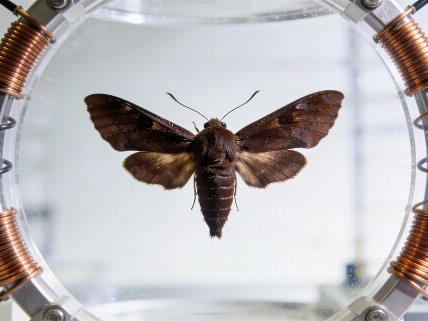
EeroQ aims to hold electron spins above superfluid helium on a semiconductor chip. The company reports charge-qubit work so far; its 10,000-qubit system remains a target rather than a demonstrated machine
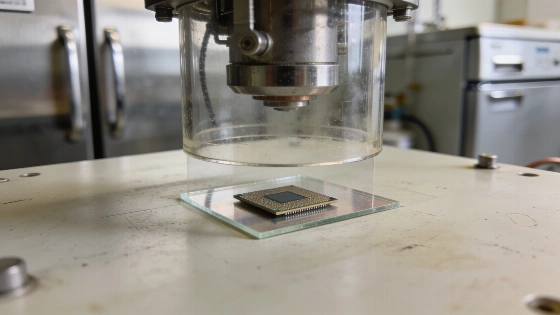
A chip roughly 3 by 5 millimeters across is central to EeroQ's scaling argument: the company wants to combine semiconductor manufacturing with electrons held above a superfluid helium surface. EeroQ was founded in 2016, building on a research idea studied for more than 20 years. The small footprint is an architectural proposal, not proof of a large working processor. Johannes Pollanen, EeroQ co-founder and a professor of physics at Michigan State University, described the company's progress and plans in an interview.
Electrons above helium
EeroQ's proposed qubit uses an electron's spin, a quantum property associated with a magnetic moment. The two possible spin orientations can encode information, while combinations of those states can form a superposition. The electron is held in vacuum about 10 nanometers above liquid helium, rather than embedded in a solid semiconductor. The company's CEO, Nick Farina, has described the concept as trapping electrons on helium to build qubits.
The helium surface is intended to keep the electron away from impurities and defects in a solid. EeroQ's chip supplies the control structures beneath the liquid film, using semiconductor fabrication methods. That arrangement pairs a clean environment for the electron with a fabrication platform built from semiconductor processes. The company's broader premise is that the same manufacturing methods used for conventional chips could help pack many quantum devices onto a small area.
EeroQ's approach differs from the superconducting circuits used by IBM and Google. Other quantum platforms trap ions or use neutral atoms. A separate report on D-Wave's processor covered another superconducting architecture; qubit counts across these platforms do not by themselves establish comparable performance. Spin-based quantum information is also studied across other materials and systems, as outlined by the University of Manchester's quantum centre.
What has been shown
The interview describes EeroQ's initial experimental basic stage as coupling a charge qubit made from electrons on helium. Pollanen said it took the team about 18 months to build and get its first charge qubits working. The company's more ambitious target is a spin qubit built from a pair of electrons, using their combined spin states. Pollanen said the team is developing those devices and working toward two-qubit gates. The account gives no spin-qubit fidelity or gate-duration figures. It also reports no readout-error or coherence measurements.
A paper in Nature Physics earlier this year reported the charge-qubit coupling work, information from the interview. That is evidence of progress on a device component, not a demonstration of a functioning spin-based processor. The distinction matters: a charge qubit encodes information in an electron's position, while the planned spin qubit encodes it in spin. The interview provides no measured performance figures that would allow readers to assess error rates or compare the device with established platforms.
Cooling and chip scale
The helium film used to host the electrons is helium-4. The dilution refrigerator shown in the interview uses helium-3 to reach millikelvin temperatures; Pollanen said the system contains about 20 liters of helium-3 gas, which circulates rather than being consumed during normal operation. These isotopes have different roles: helium-4 forms the electron-hosting surface, while helium-3 is part of the cooling cycle.
The chip shown is about 3 by 5 millimeters. Its architecture was designed to accommodate roughly 2,500 electrons, which would not mean 2,500 functioning qubits: the proposed spin qubits use two electrons each. EeroQ's stated near-term goal is a 10,000-qubit system in the next couple of years. That figure is a future target, not a count of demonstrated qubits. Pollanen characterized the planned system as a noisy intermediate-scale quantum machine, suitable for small error-correction experiments rather than the largest proposed applications.
The scaling test
Semiconductor fabrication offers a route to dense device layouts, but manufacturing a chip is only one part of scaling a quantum computer. EeroQ still needs to demonstrate reliable spin-qubit operation and control interactions between qubits. It must also measure their states with sufficient accuracy. The interview reports no results for device yield or long-term stability, and no error-correction performance. Nor does a projected chip capacity establish that the required qubits can be controlled together.
Pollanen's longer-term estimates run to millions or tens of millions of qubits for some demanding applications, including molecular simulation. Those are goals, not demonstrated capabilities. A useful assessment will depend on measured gate performance and error correction, alongside the practical demands of wiring and cooling, as well as calibration. The interview does not establish that EeroQ has solved those system-level problems.
A physical qubit is one controllable quantum system; a logical qubit stores information across multiple physical qubits so that errors can be detected or corrected. A processor's physical-qubit count so says little about the number of reliable logical qubits it can support. Demonstrating error-correction components is a step toward that capability, but it is not equivalent to running a fault-tolerant computation.