A D-Wave team reconstructed quantum dynamics on an Advantage2 processor to examine higher-order topological phases. The arXiv study reports corner-localized charge deficits and a quantized 3D invariant.
A charge deficit close to one-half appeared at corner modes in measurements of higher-order topological insulators on a D-Wave processor. The team reconstructed the system's quantum dynamics, then used those data to infer properties of its bulk bands.
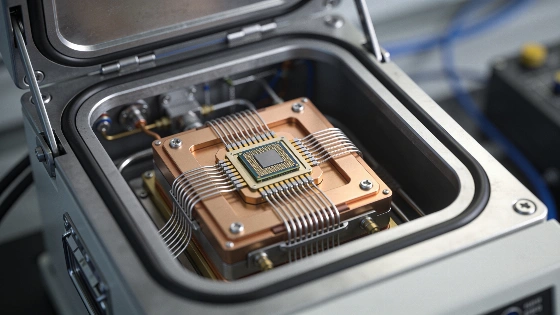
The study, Measuring higher-order bulk topology in a programmable quantum simulator, was posted as an arXiv preprint on October 12, 2026, and updated on October 15. The author team includes Pratik Sathe, affiliated with D-Wave Quantum and the New Mexico Consortium, as well as Niclas Heinsdorf and Andrew D. King. Experiments took place on a D-Wave Advantage2 processor in Burnaby, British Columbia. Across models spanning one to three dimensions, the team used up to 728 qubits in a superconducting analogue-digital quantum simulator. The three-dimensional BBH octupole model used 432 physical qubits to encode a 3×3×3 lattice of unit cells, each with eight orbitals. The arXiv preprint describes the models as effective tight-binding Hamiltonians.
The work examines higher-order topological insulators, where states can localize on boundaries of different dimensions, including surfaces and lower-dimensional features such as hinges or corners. The authors reconstruct complex propagators from real-space measurements, allowing them to examine boundary signals alongside bulk topological characteristics.
Dimerized qubits
The researchers paired physical qubits into strongly coupled dimers. Each pair acted as an effective two-level system, letting the team represent Benalcazar-Bernevig-Hughes (BBH) tight-binding models with denser connectivity than the processor graph directly provides. The reported dimer parameters were Jd = 2.5 GHz and Δ = 3.0 GHz.
Pulse-level control prepared the state, which then evolved under a static Hamiltonian. High-frequency time-series measurements supplied data to reconstruct the dynamics. The work covered one-dimensional and two-dimensional cases before extending the approach to a three-dimensional lattice.
In the measurement protocol, time-shifted σrx(t) data reconstructed a complex-valued propagator, Ψr(t) = σrx(t) + iσry(t). The reported time shift was 125 ps, with a temporal resolution of 62.5 ps. The experiment infers a complex quantity through a controlled measurement sequence, rather than directly reading out an entire wavefunction in one shot.
From signals to topology
The team used the reconstructed data to estimate occupied-band projectors, written {Pν(k)}. These projectors describe which states belong to occupied bands across momentum space. The researchers then calculated three successive nested Wilson loops, extracting a quantized three-dimensional electric octupole invariant of one-half.
That result is an inference drawn from measured dynamics and a model-based reconstruction. It is not a direct measurement of a bulk multipole moment as a single processor readout. The reported fractional charge deficits, approximately one-half, came from integrating real-space return amplitudes into local density of states (LDOS). They appeared at zero-dimensional corner modes, boundary features associated with higher-order topology.
For the three-dimensional BBH octupole insulator, the authors report that the LDOS resolved a hierarchy of states across the bulk and its boundaries. When γ>λ, the bulk and boundary regions were gapped; when γ<λ, corner states appeared inside the energy gap. The measured charge deficit at each corner approached one-half.
The study also reports that bootstrapping over physical lattice symmetries kept the bulk invariant close to one-half without imposing ideal spatial symmetries. This suggests the extracted value did not depend on enforcing a perfectly symmetric lattice in the analysis. The authors interpret the result as robustness to mild hardware disorder, but it does not establish immunity to arbitrary disorder or noise.
What the result establishes
The work presents a way to use quantum annealing hardware to study model systems and infer topological properties from measurements. Its scope covers higher-order phases across one to three dimensions, with the three-dimensional invariant as the central result. The reported maximum of 728 qubits spans the broader set of models; the specific three-dimensional BBH implementation encoded 432 physical qubits. The experiment demonstrates analogue-digital quantum simulation. It does not claim that the processor is a fault-tolerant universal quantum computer or has achieved quantum advantage.
The distinction between simulation and error-corrected computation also matters in other quantum hardware work. For comparison, modular QEC simulations examined logical-error overhead in circuit models, a different question from probing topological phases on an annealing processor.
Reading the boundary
Higher-order topology predicts boundary states concentrated on features with lower dimensionality than the system's surface: corners in a two-dimensional model, for example, or corner-like points in a three-dimensional construction. Here, localized charge deficits and the nested Wilson-loop calculation offer complementary characterizations, linking real-space boundary behavior to an inferred bulk invariant.
A topological invariant classifies certain global features of a band structure and can remain unchanged under some local perturbations. Here, measured signals feed a reconstruction of the occupied-band projectors, from which researchers calculate the invariant. The value near one-half so depends on both the experimental data and the model used to interpret them; it is not a direct count of protected qubits.