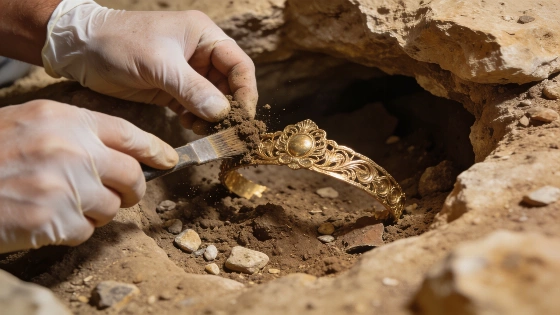
Archaeologists have analyzed a cache of 3,400-year-old gold ornaments from chamber tombs at Hala Sultan Tekke, Cyprus, uncovering evidence of local craftsmanship influenced by Egyptian, Mycenaean, Minoan, and Near Eastern traditions
A new study of gold ornaments excavated from Late Bronze Age tombs at Hala Sultan Tekke, near modern Larnaca in Cyprus, is providing detailed evidence for the complex cultural and economic networks that linked the eastern Mediterranean more than three millennia ago. The research, published in the Oxford Journal of Archaeology, focuses on a group of nine gold forehead bands and two thin gold mouthpieces recovered from chamber tombs dating to around 1400 BCE.
Excavation and Context
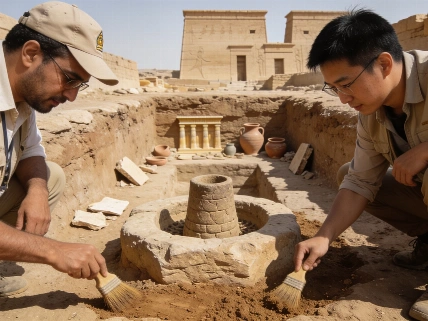
The gold ornaments were discovered during systematic excavations conducted between 2016 and 2024 at Hala Sultan Tekke, a major port city that flourished from approximately 1630 to 1150 BCE. The site, which covered at least 25 hectares at its peak, was a center for copper production and long-distance trade. The tombs containing the gold objects had collapsed in antiquity, which inadvertently protected their contents from later disturbance and looting. The burial assemblages included both robust and delicate gold bands, some showing clear signs of wear, suggesting a mix of personal use and items made specifically for funerary purposes.
In total, archaeologists recovered nine gold forehead bands-sometimes described as crowns-and two gold mouthpieces placed over the lips of the deceased. The tombs themselves were cut into clay and marked only discreetly, possibly to avoid attracting attention even in antiquity. The preservation of the gold objects was aided by the collapse of the tombs, which sealed the burials beneath layers of earth and stone.
Craftsmanship and Cultural Influence
Technical analysis indicates that the gold ornaments were produced by local Cypriot goldsmiths, despite their decorative motifs drawing on artistic traditions from Egypt, Mycenaean Greece, the Minoan world, and the Near East. One particularly notable forehead band features images of bulls with solar discs, palm branches, and rosettes-a combination that echoes Egyptian representations of the Apis bull but also incorporates Mycenaean stylistic elements. Rather than directly copying foreign designs, Cypriot artisans appear to have synthesized multiple influences into new forms.
The gold used in the ornaments may have originated from distant sources, including Nubia in Egypt or the ancient mines of Ada Tepe in present-day Bulgaria. The presence of imported materials at Hala Sultan Tekke is further supported by finds of lapis lazuli from Afghanistan, amber from the Baltic, and agate from India, demonstrating the city's integration into far-reaching trade networks. These routes not only transported goods but also facilitated the exchange of artistic styles and technological knowledge.
Mortuary Practice and Interpretation
Analysis of the burial contexts reveals that the gold ornaments were associated with both male and female individuals. In one case, a gold crown decorated with bull imagery was found with the remains of a woman estimated to have died between the ages of 35 and 40, based on skeletal analysis. This challenges assumptions that such symbols were exclusively linked to male authority and suggests a broader social or symbolic significance. Some of the heavier gold bands show evidence of prolonged use, while others are so fragile that they were likely crafted specifically for burial.
The function of the gold mouthpieces remains uncertain. Comparable objects have been found at other Mediterranean sites, but their precise role is still debated. They are generally interpreted as part of funerary rituals, possibly reflecting beliefs about the afterlife or the protection of the deceased. The tombs themselves were relatively plain, lacking elaborate architectural features, which may have been a deliberate strategy to reduce the risk of looting.
Trade, Exchange, and Ongoing Research
The discoveries at Hala Sultan Tekke highlight the city's role as a hub for both material and cultural exchange during the Late Bronze Age. The combination of local craftsmanship and imported materials illustrates how Cypriot artisans engaged with and adapted external influences. Only a small portion of the ancient city has been excavated to date, and researchers anticipate that further investigation will yield additional insights into the region's connections with neighboring societies.
These findings contribute to a growing body of evidence for the complexity of ancient Mediterranean networks. For example, research on high-status burials in Egypt has also revealed unexpected patterns of activity and cultural interaction, as seen in the analysis of royal women from Dahshur who displayed skeletal adaptations consistent with archery and hunting (see related research on Egyptian princesses and archery).
Archaeologists emphasize that while decorative motifs on the gold ornaments can be traced to distant regions, the objects themselves were locally produced. This distinction is important for understanding the mechanisms of cultural transmission and the agency of local craftspeople in shaping new forms of material culture.
In archaeological research, the concept of mortuary context is central to interpreting burial finds. Mortuary context refers to the specific circumstances in which human remains and associated objects are deposited, including the construction of the grave, the arrangement of the body, and the selection of grave goods. Careful analysis of mortuary context allows archaeologists to distinguish between objects used in daily life and those created or selected for funerary purposes, and to assess how social identity, status, and belief systems may be reflected in burial practices. However, interpretation is always limited by preservation, sampling, and the potential for post-depositional disturbance, making it essential to approach such evidence with caution and attention to context.