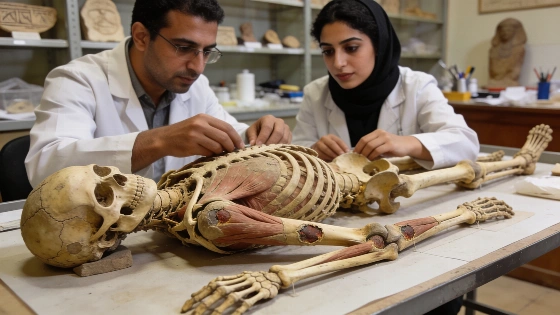
Bioarchaeological analysis of Middle Kingdom royal women from Dahshur reveals skeletal adaptations consistent with regular archery and hunting, challenging assumptions that weapons in their tombs were only symbolic
Recent research on the skeletal remains of royal women from Egypt's Middle Kingdom has provided new evidence that some princesses were not only buried with weapons but likely engaged in physically demanding activities such as archery and hunting. The study, published in a peer-reviewed journal, examined six individuals from the royal family of Pharaoh Amenemhat II, whose tombs were excavated at Dahshur in the late nineteenth century. The remains, including four daughters of the pharaoh, were rediscovered in the Egyptian Museum in 2020 after being thought lost for decades.
Reassessing Royal Burials
The burial chambers at Dahshur contained grave goods traditionally associated with elite male warriors, such as bows, arrows, maces, and daggers. Among the most notable finds was a finely crafted dagger interred with Princess Ita. While previous interpretations suggested these weapons were purely ceremonial, the new analysis focused on the preserved bones to assess activity patterns and health.
Researchers documented pronounced muscle attachment sites on the upper limbs of several individuals, particularly Princess Ita, who died between the ages of 28 and 34. These skeletal features are consistent with repetitive, high-intensity movements required for drawing bows and wielding weapons. Princess Khenmet, who lived into her late 30s or 40s, showed both age-related bone thinning and robust ligament attachments, suggesting continued physical activity into adulthood. Princess Itaweret, aged 20 to 34 at death, had survived multiple injuries, including rib and foot fractures, and displayed upper-body development typical of experienced archers.
Skeletal Evidence and Activity Patterns
The study's sample included six royal individuals, with four identified as daughters of Amenemhat II. Despite the loss of soft tissues and skulls, the preserved postcranial bones allowed for estimation of age, stature, and biological sex, as well as documentation of trauma, disease, and muscle development. The evidence of healed fractures, such as Itaweret's broken ribs, points to active lifestyles and access to advanced medical care for the period. Several skeletons also exhibited signs of infection and nutritional deficiency, highlighting the health challenges faced even by elite individuals.
Notably, all four sisters displayed rare spinal abnormalities, which the researchers linked to close familial relationships and intermarriage within the royal dynasty. The presence of similar upper-limb adaptations in the remains of Princess Noub-Hotep and King Hor suggests that archery and weapon use may have been common skills among Middle Kingdom royals, regardless of sex.
Context, Limitations, and Future Research
The pronounced muscle development observed in the upper limbs of these women supports the interpretation that archery and hunting were regular activities rather than symbolic associations. However, the absence of soft tissue and the incomplete preservation of some remains limit the precision of activity reconstruction. The study's conclusions are based on comparative analysis of muscle attachment sites and trauma patterns, which can suggest but not definitively prove specific behaviors.
Researchers plan to apply stable isotope analysis and advanced imaging to further investigate the diets, health, and kinship of the Dahshur royals. Digital preservation, including high-resolution 3D modeling, is also underway to support ongoing research and public engagement. The findings contribute to a growing body of evidence that challenges assumptions about gendered activity in ancient societies. For comparison, other studies have examined the social roles of individuals buried with weapons, such as the Iron Age child burial with a sword in Gaul, highlighting the need for careful interpretation of grave goods and skeletal evidence.
In bioarchaeology, muscle attachment sites-known as entheses-can provide clues about habitual activity patterns in past populations. Repetitive, forceful use of specific muscle groups can lead to more pronounced entheses, which are visible on well-preserved bones. However, interpreting these features requires caution, as genetic factors, age, and overall health also influence skeletal development. Entheses analysis is most informative when combined with other lines of evidence, such as trauma, pathology, and archaeological context, to reconstruct aspects of daily life and social roles in ancient communities.