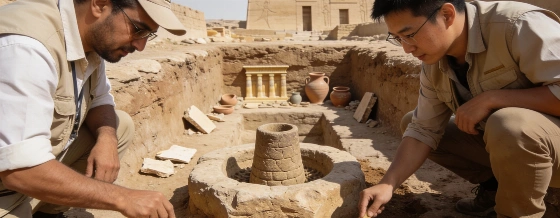
Archaeologists working at Mit Rahina near the Temple of Sekhmet have uncovered a residential complex, a possible wine press, and artifacts spanning multiple periods, offering new evidence for daily life in ancient Memphis
Archaeological work at Mit Rahina, the site of ancient Memphis in Egypt, has revealed the remains of a residential complex, a possible wine press, and a diverse assemblage of artifacts near the Temple of Sekhmet. The discoveries, made by a joint Egyptian-Chinese team, provide new evidence for how this area was used and inhabited across several historical periods.
Excavation Context and Methods
The project, a collaboration between Egypt's Supreme Council of Antiquities and the Shanghai Museum, began with cleaning and documenting the Temple of Sekhmet, which forms part of the larger Great Temple of Ptah complex. Excavations then extended into the surrounding area to investigate how the site developed over time. The team recovered stone architectural elements, statue fragments, and a range of domestic materials, all within stratified deposits that reflect changing use of the site.
Among the most notable finds is a stone installation east of the temple, interpreted as a possible wine press. The structure consists of an upper basin sloping toward a central opening and a lower basin likely used to collect liquid. Openings in the installation may have secured amphorae or other vessels. The presence of grape seeds within the structure supports the interpretation that it was used for winemaking, though alternative uses cannot be ruled out without further residue analysis.
Material Evidence and Chronology
The excavation yielded stone blocks and statue fragments, many attributed to the New Kingdom, especially the reign of Ramesses II (13th century BCE). These were found alongside pottery sherds, terracotta and stone figurines, and ostraca-inscribed pottery fragments-spanning a broad chronological range. The diversity of materials suggests continuous or repeated occupation from the Third Intermediate Period and Late Period through the Ptolemaic and Roman eras, with later adaptation of the area for residential purposes as the temple's religious significance declined.
In total, the team documented numerous architectural fragments and domestic artifacts, though the precise number of structures and objects remains under analysis. The stratigraphic relationships among these finds are being used to reconstruct the sequence of occupation and transformation at the site. Comparable approaches to reconstructing settlement history have been used at other sites, such as the investigation of long-term occupation layers on Montbellant hill in Burgundy, as described in recent research on settlement transformation in France.
Ongoing Research and Interpretation
The Egyptian-Chinese mission, led by specialists from both countries, plans to continue excavating and documenting the Temple of Sekhmet and its surroundings in future seasons. The team aims to clarify the architectural development of the temple, the nature of residential occupation, and the economic activities-such as food and drink production-evident in the archaeological record. The discovery of grape seeds and the possible wine press installation may contribute to broader discussions about agricultural production and consumption in later phases of Memphis's history.
While the finds offer valuable insight into daily life and site transformation, several uncertainties remain. The function of the stone installation, for example, is supported by the presence of grape seeds but awaits further residue and use-wear analysis. The full extent of residential occupation and the relationship between domestic and religious spaces will require additional excavation and stratigraphic study. The project's integration of architectural documentation and artifact analysis is expected to refine understanding of how this part of Memphis evolved over time.
Site History and Documentation
The Temple of Sekhmet was first identified in 1959 during construction work, with formal excavations following in the early 1960s. Subsequent documentation in 2015 focused on managing the ancient Memphis site and its community. The current project represents the first major new excavation at the temple and its environs in over half a century. Alongside excavation, the team is producing detailed architectural records to support future research and heritage management.
Understanding the transformation of ancient settlements like Memphis depends on integrating evidence from architecture, artifacts, and environmental remains. The ongoing work at Mit Rahina highlights the importance of multidisciplinary approaches and international collaboration in reconstructing the lived experience of past communities.
Stratigraphy is central to archaeological interpretation at complex sites like Mit Rahina. By analyzing the sequence of soil layers and the artifacts contained within them, archaeologists can reconstruct the order of occupation, construction, and abandonment events. Stratigraphic analysis helps distinguish between materials deposited during different periods and is essential for establishing the relative chronology of structures and artifacts. However, post-depositional processes such as construction, erosion, or later disturbance can complicate the sequence, requiring careful documentation and sometimes limiting the precision of historical reconstruction.