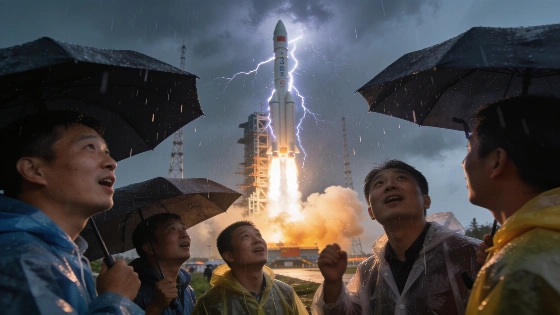
A Long March 3B rocket was hit by lightning seconds after liftoff from Xichang Satellite Launch Center, yet continued its ascent and successfully deployed a geostationary relay satellite to support China's Tiangong space station
On July 23, 2026, a Long March 3B rocket launched from the Xichang Satellite Launch Center in southwest China experienced a rare and hazardous event: a direct lightning strike less than a minute after liftoff. Despite the electrical discharge, the uncrewed vehicle maintained its trajectory and delivered its payload to orbit, demonstrating the resilience of modern launch systems under extreme atmospheric conditions.
Lightning Strike During Ascent
Eyewitnesses at the launch site observed a bolt of lightning arc through the rocket's fuselage and exhaust plume approximately 30 seconds after launch. The event was captured in photographs and video, showing the electrical current enveloping the vehicle as it climbed through stormy skies. The crowd, many equipped with umbrellas and raincoats, reacted audibly as the lightning struck, but the rocket continued its ascent without visible deviation.
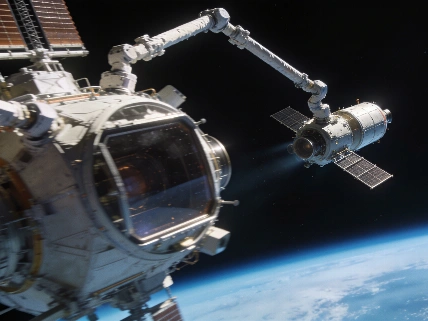
The Long March 3B is one of China's most frequently used heavy-lift launch vehicles, with over 100 missions since its introduction in 1996. On this occasion, the rocket was tasked with deploying the Tianlian-2 (06) satellite, a geostationary relay platform designed to enhance communications with the Tiangong space station. According to the China Aerospace Science and Technology Corporation, the mission achieved all planned objectives, although the official statement did not reference the lightning incident.
Engineering for Electrical Hazards
Spacecraft and launch vehicles are engineered to withstand electrical hazards, including lightning. The outer shell of the Long March 3B, like those of other modern rockets, is constructed to conduct high-voltage currents around sensitive internal systems, functioning similarly to a Faraday cage. This design principle is also applied in commercial aircraft, which are routinely struck by lightning without catastrophic consequences.
Despite these protections, launches are typically scheduled during favorable weather to minimize risk. The successful outcome in this case highlights the effectiveness of current engineering standards, but also underscores the unpredictable nature of atmospheric electricity. The Tianlian-2 (06) satellite was confirmed to have reached its intended geostationary orbit, where it will relay data between ground stations and the Tiangong space station.
Historical Precedents and Risks
Lightning strikes on rockets are rare but not unprecedented. Notably, NASA's Apollo 12 mission in 1969 experienced two lightning strikes during ascent, resulting in temporary instrument failures but no loss of mission. More recently, a Russian Soyuz rocket was struck by lightning in 2019, yet completed its deployment of a communications satellite. In contrast, an Atlas-Centaur rocket in 1987 was destroyed after a lightning-induced computer malfunction caused it to veer off course.
Lightning can also threaten rockets on the launchpad. For example, NASA's Artemis I vehicle was struck during a pre-launch test in 2022, but was protected by lightning towers designed to divert electrical discharges away from the rocket. These incidents illustrate both the effectiveness and the limits of current mitigation strategies. For further context on how rare atmospheric events can affect space missions, see this analysis of overlapping supernova remnants in the IC 443 region: evidence for twin supernova explosions in the Jellyfish Nebula.
Implications for Launch Safety
While the Long March 3B's survival of a direct lightning strike demonstrates robust engineering, it does not eliminate the risk posed by severe weather. Launch providers continue to rely on weather monitoring and lightning protection systems to reduce the likelihood of such events. The rarity of catastrophic outcomes is a testament to decades of incremental improvements in vehicle design and launch infrastructure, but the possibility of mission loss remains when atmospheric conditions deteriorate unexpectedly.
As launch rates increase worldwide, especially for missions supporting space stations and satellite constellations, the need for reliable weather forecasting and real-time risk assessment becomes more acute. The incident at Xichang serves as a reminder that even well-prepared missions can encounter unpredictable hazards, and that engineering margins must account for rare but consequential events.
Lightning protection for rockets relies on both vehicle design and ground infrastructure. The principle of the Faraday cage is central: a conductive shell routes electrical current around sensitive electronics, preventing internal damage. Launchpads are often equipped with tall towers and grounding wires to attract lightning away from rockets before liftoff. However, once airborne, a rocket is briefly exposed to atmospheric hazards until it clears storm-prone altitudes. Engineers must balance the need for launch schedule flexibility with the imperative to avoid unnecessary risk from severe weather.