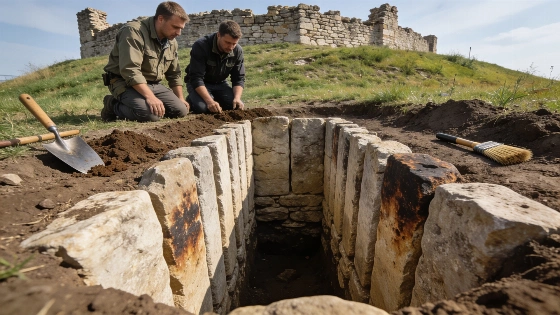
Excavations at Essegvár Castle in western Hungary have revealed a stone shaft marked by intense burning, constructed before the medieval walls. The absence of industrial byproducts leaves its original function unresolved.
Archaeologists at Essegvár Castle in western Hungary have uncovered a stone-lined shaft showing clear signs of intense heat. The structure sits beneath the medieval castle walls and appears to have been built before the fortress itself. Its purpose is still unknown, and the discovery has shifted the focus of this season's excavation. As of September 9, 2026, the shaft remains under investigation, with researchers gathering more evidence to understand its use.
Discovery and Signs of Burning
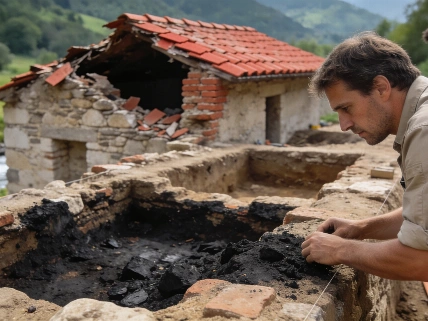
The shaft was found under the ruins of Essegvár Castle near Bánd in the Bakony region. It is small but carefully constructed, with large stones set upright to form its sides. Archaeologists from the Laczkó Dezső Museum, along with students and volunteers from Budapest, Debrecen, and other parts of Hungary, noted clear burn marks on the base and walls of the shaft, as well as in the fill. The heat was strong enough to discolor and alter the stone surfaces. Similar effects have been studied elsewhere by research teams using experimental archaeology to reconstruct ancient high-temperature processes.
Despite the evidence for burning, the shaft's function is unclear. Researchers considered whether it might have been used for metalworking or other industrial activities, but found no slag, melted metal, or typical kiln debris nearby. Its construction also differs from known medieval kilns or furnaces. Without industrial byproducts, and with no clear parallels, the shaft's original use remains open to question. Further residue analysis may help, but for now, the structure defies easy explanation.
Dating the Shaft and Castle
Coins found in the northern part of the site date to the reigns of Hungarian kings Béla III (1172-1196 CE) and Andrew II (1205-1235 CE). These coins are older than the castle walls, suggesting the shaft was in use before the main phase of fortification in the late 13th century. Archaeologist Dezső Laczkó notes that the combination of old coins and the layering of the site indicates the northern fortification could have been built as early as the second half of the 13th century.
The shaft lies beneath the earliest wall foundations, showing that activity at the site began before the medieval fortress was built. This suggests the location may have been important for settlement, industry, or another purpose before the castle's construction. Stratigraphic analysis-studying the layers and their order-is key to understanding the sequence of events at the site.
Artifacts and Changing Architecture
Excavations have turned up a range of artifacts from different periods. In the southern sector, a fortified wall built with cube-shaped red sandstone blocks was found, with material dating to the 15th century. Finds include ceramic sherds, animal bones, arrowheads, a wrought-iron knife, silver coins, and clothing ornaments, including one made of gilded silver. Decorative copper fittings from a Gothic door, two with six-pointed star motifs, and fragments of imported Italian glassware were also recovered.
The site's layout changed over time. A narrow doorway, later blocked with masonry, was found in the outer wall between a former brick tower and the stone palace building, pointing to remodeling during the later Middle Ages. The evidence shows a long sequence of building, occupation, and modification over several centuries.
Community involvement has been central to the project, with local and visiting participants joining the excavation. Many coins, weapons, ceramics, and architectural elements have been recovered, but the heat-scarred shaft remains the most puzzling feature. Similar interpretive challenges have been reported at other European sites, such as a prehistoric burial in Poland.
Unanswered Questions and Research Limits
The lack of industrial byproducts like slag or fused metal fragments makes it hard to assign a specific function to the shaft. Its unusual construction and position in the layers complicate comparison with known medieval industrial sites. While the evidence for deliberate burning is strong, the absence of diagnostic artifacts or residue analysis leaves its purpose unresolved. The ongoing fieldwork, involving museum staff, students, and volunteers, highlights the long-term and collaborative nature of the research.
Further excavation and lab analysis may eventually clarify whether the shaft was a rare industrial feature, a specialized domestic installation, or something not yet recognized in the region's archaeological record. Until more evidence is found, the structure remains an open question. Archaeological sites often preserve more ambiguity than certainty, especially when context is limited or parallels are lacking.
Stratigraphy-the study of layers and their sequence-is fundamental to archaeological interpretation. By analyzing the positions of features and artifacts within these layers, archaeologists can establish the order of events and separate earlier activity from later changes. At Essegvár Castle, the shaft's position beneath the earliest wall foundations shows it predates the medieval fortification. However, without direct dating of the shaft's fill or related materials, the exact timing and nature of its use remain uncertain. Careful excavation and documentation are essential to avoid misinterpretation, especially at complex sites with many phases of activity.