Archaeologists excavating a Mesolithic site in northwestern Russia have recovered thousands of stone tools and manufacturing debris, revealing a large-scale tool production center dating back up to 10,000 years and offering new insight into early postglacial lifeways
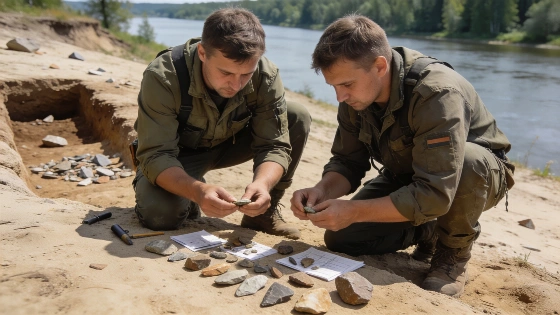
Archaeological excavations on a sandy terrace near the Peretna River in Russia's Novgorod region have revealed a dense concentration of stone tools, unfinished blanks, and manufacturing debris, providing evidence for a major Mesolithic toolmaking center active between the 10th and 6th millennia BCE. The site, investigated by a team from Novgorod State University, is situated in the Okulovsky District and dates to the period following the retreat of the Valdai Glacier, when human groups reoccupied the landscape.
Evidence for Specialized Production
Researchers have so far recovered nearly 15,000 lithic artifacts from only a fraction of the excavated area, including complete implements, partially worked blanks, and large quantities of flint flakes and fragments. The scale and diversity of the assemblage suggest that the site functioned as a specialized center for producing stone tools and weapons, rather than a location of casual or opportunistic toolmaking. The material allows archaeologists to reconstruct multiple stages of the manufacturing process, from initial preparation of raw flint to the shaping of finished implements.
Among the most notable finds is a pencil-shaped core of deep reddish-brown "chocolate" flint, a material not native to the immediate area. The core displays scars from the systematic removal of thin, sharp microblades, likely produced using controlled pressure with a bone implement. These microblades could be inserted into grooves in bone or wooden shafts to create composite tools such as spears, harpoons, or knives. The modular nature of these implements allowed for the replacement of individual blades when damaged, conserving valuable raw material and extending the use-life of tools.
Raw Materials and Technological Complexity
The presence of high-quality, nonlocal flint indicates that Mesolithic communities either transported raw material over considerable distances or participated in exchange networks. The deliberate preparation of cores and the use of controlled flaking techniques demonstrate a sophisticated understanding of lithic technology. Archaeologists interpret these practices as evidence of advanced planning and skill, requiring craftspeople to anticipate the final form of a tool and carefully manage the removal of each flake.
In addition to microblade cores, the assemblage includes large blanks intended for chopping tools such as axes or adzes, with characteristic bifacial flaking. Over ten cutting implements and numerous unfinished pieces have been documented, suggesting a focus on woodworking as the environment shifted from tundra-steppe to taiga forest. The ability to produce and maintain axes, adzes, and chisels would have been critical for constructing boats, shelters, and household objects as forest resources became increasingly important.
Settlement Patterns and Site Organization
The density and variety of woodworking tools imply that the site may have supported longer-term or repeated occupation, rather than serving as a temporary camp. Its location on a dry terrace overlooking the Peretna River would have provided access to fish and other resources, supporting a broad-spectrum subsistence strategy. Archaeologists are currently investigating a concentration of stones near the center of the excavation, which may represent a hearth or a deliberately prepared working area for tool production.
Comparative research on early settlement organization, such as the documentation of long-term occupation phases at Montbellant hill in Burgundy, helps contextualize the emergence of specialized activity areas in postglacial northern Eurasia. For example, the stratified remains at Montbellant illustrate how repeated use and industrial activity can be traced through archaeological deposits, offering a parallel for interpreting the Russian Mesolithic site.
Interpreting the Archaeological Record
The thousands of lithic artifacts, including manufacturing debris, finished tools, and rare raw materials, provide an unusually detailed record of Mesolithic technological practice in the Novgorod region. However, the absence of direct evidence for structures, burials, or organic remains limits interpretation of the site's social organization and duration of occupation. The ongoing analysis of the lithic assemblage, combined with environmental and spatial data, is expected to clarify the role of this workshop within broader patterns of settlement and resource use during the early Holocene.
Archaeologists emphasize that while the evidence supports the existence of a specialized toolmaking center, the precise scale of production, the extent of exchange networks, and the social context of craft specialization remain open questions. Further excavation and analysis will be required to determine whether the site served a local community or functioned as a regional hub for the distribution of tools and raw materials.
Understanding the significance of lithic workshops in the Mesolithic requires careful attention to the archaeological context in which artifacts are found. Lithic analysis involves the study of stone tool production debris, core preparation, and use-wear patterns to reconstruct manufacturing sequences and technological choices. Because organic materials rarely survive in open-air sites of this age, stone tools and their byproducts often provide the primary evidence for reconstructing ancient lifeways, but they cannot by themselves reveal the full range of social or economic relationships that shaped early postglacial communities.