

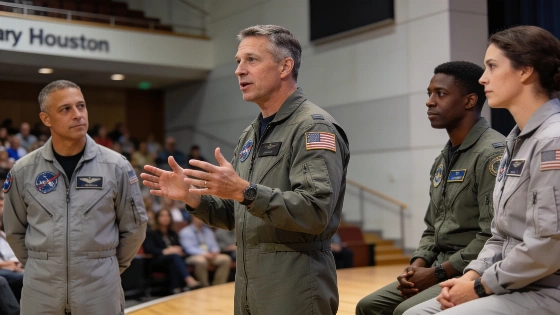
The Artemis II astronauts will meet the public at the University of Houston after traveling 406,771 kilometers from Earth during the first crewed lunar flyby in more than 50 years.
The Artemis II crew will bring its record-setting lunar mission to Houston on Wednesday, September 30, when the four astronauts appear at the University of Houston's Fertitta Center. Their public presentation will close the post-flight campaign and give audiences a direct account of their roughly 10-day journey around the Moon aboard Orion.
A record beyond Apollo
Reid Wiseman, Victor Glover, Christina Koch and Canadian Space Agency astronaut Jeremy Hansen traveled as far as 406,771 kilometers from Earth during Artemis II, equivalent to about 252,756 miles. The distance exceeded the human-spaceflight record associated with Apollo 13's 1970 flight, making it the farthest humans have traveled into space. The National Aeronautic Association is also expected to formally recognize the measurement during the Houston event.
The figure describes the crew's maximum distance from Earth during the mission, not a new destination reached by Orion. Its significance is comparative: Artemis II carried people farther from Earth than any previous crewed flight while testing the spacecraft and launch system planned for later Artemis missions. NASA's record-setting result is a historical benchmark and an operational test of deep-space transportation.
Artemis II launched on April 1, 2026, and splashed down in the Pacific Ocean on April 10 after a roughly 10-day mission. The flight was a crewed lunar flyby, not a Moon landing, and marked the first crewed trip around the Moon in more than 50 years. Wiseman, Glover, Koch and Hansen were the first astronauts to launch aboard NASA's Space Launch System rocket and flew inside the agency's Orion spacecraft.
The record makes the most sense in the context of the mission's trajectory. A spacecraft traveling around the Moon can reach a greater Earth-relative distance without touching the lunar surface. Its maximum separation also changes continuously along its planned path. The 406,771-kilometer value is a precise point-in-time distance, not the length of the entire route or a claim that Orion maintained that separation throughout the flight. Further background on the mission's verified record appears in BBC mission coverage.
The Houston event
The free public presentation is scheduled for 7 p.m. CDT at the Fertitta Center. It is the crew's first public event in Houston since the lunar mission earlier this year. Industry and community partners at the University of Houston are hosting it.
Media will have an earlier chance to question the astronauts during a session scheduled for 5:45 p.m. Attendance requires a reply to Kenna Pell at NASA by noon on September 30. The public presentation will focus on the crew's mission highlights, not a new flight or spacecraft test.
The University of Houston appearance follows NASA's public recognition of the crew at Johnson Space Center on August 28. President Donald Trump honored the astronauts at that ceremony, which also included the Congressional Space Medal of Honor. Trump said the crew had made history and praised the flight for breaking the distance record, reinforcing NASA's framing of Artemis II as a basic stage in human spaceflight.
For readers following the broader human-spaceflight record, the event also offers a useful contrast with an earlier report on a very different measurement problem. Both stories rely on precise quantitative comparisons, but involve different physical systems.
What Artemis II tested
Artemis II was not a surface-landing mission. The astronauts traveled around the Moon and returned to Earth aboard Orion. NASA used the flight to advance a crewed architecture built around the Space Launch System and Orion's deep-space operations. The spacecraft's performance matters for later mission planning: future Artemis flights will need reliable launch and navigation, along with communications, life-support and atmospheric reentry systems, over greater distances than those used in low Earth orbit.
That distinction matters. A distance record is a mission result and an engineering basic stage. By itself, it does not show that NASA has established a lasting lunar presence or is ready for a crewed Mars expedition. NASA describes Artemis as a sequence of increasingly difficult missions intended to support lunar exploration and scientific discovery, with economic benefits and preparation for future Mars missions among its goals.
No detailed instrument results, study sample size, statistical analysis or peer-reviewed scientific data release from Artemis II are provided. The strongest confirmed findings are operational and historical: the launch aboard SLS, the crewed Orion flight around the Moon, the April 10 splashdown and the 406,771-kilometer distance record. This distinction separates the mission's engineering accomplishments from scientific claims that would require formal datasets and independent analysis in journals such as Nature or Science.
Late-September reporting also indicates that Victor Glover and Reid Wiseman moved into emeritus roles at NASA's Johnson Space Center in Houston. The change signals that the post-mission personnel transition is underway, while the program continues to use Artemis II's results for later planning.
Why the record matters
Artemis II gives the program a concrete human-spaceflight benchmark before later missions grow more demanding. Its value lies in the crewed launch and deep-space journey, including the lunar flyby and safe return, not in a single dramatic image or isolated measurement. The mission also bridges Apollo-era experience with modern spacecraft systems designed for sustained exploration beyond Earth orbit.
The Houston appearance is more than a ceremonial stop. It puts the mission's verified accomplishments before the public and gives the astronauts a chance to explain what the Orion flight involved. The August recognition at Johnson Space Center and the September public presentation add context, but neither replaces the technical work still required for future Artemis objectives.
The most defensible reading of Artemis II is measured, not promotional: it completed a crewed lunar journey, set a new human-distance record and demonstrated SLS and Orion operating together. NASA's broader lunar and Mars ambitions remain a program of planned missions, so the Houston event should be judged as an account of what this flight achieved, not as proof that every later objective has already been secured.
Distance in human spaceflight is calculated relative to Earth along a changing spacecraft trajectory. It is not a straight-line separation maintained throughout the mission. That distinction helps explain how a flight around the Moon can set a record without landing there. Artemis II's 406,771-kilometer figure is a precise historical measure of maximum distance from Earth. The mission's broader scientific and engineering significance rests on how safely Orion and SLS carried people along that route. The event marks a completed step in NASA's lunar program, while future claims will depend on future missions.







