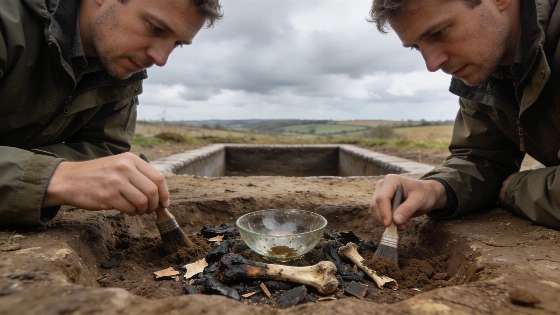
Archaeologists have excavated a first-century CE cemetery in eastern England containing over 100 cremation burials, including high-status graves with imported Roman artifacts, offering new evidence for pre-conquest links between Britain and the Roman Empire
An Iron Age cemetery recently excavated in eastern England is providing new insight into the complex interactions between local communities and the expanding Roman Empire in the decades before the Roman conquest of Britain. The site, investigated by a team led by Angus Forshaw of University College London Archaeology South-East, contains the cremated remains of more than 100 individuals, making it one of the larger mortuary assemblages from this period in the region.
High-Status Burials and Imported Roman Goods
The cemetery is square in plan and defined by a surrounding ditch, a layout consistent with Iron Age funerary traditions in Britain. Most of the burials consist of cremated bone placed in urns, but five graves stand out for their distinctive construction and contents. These high-status burials were found in large, square pits and include not only substantial piles of burnt bone but also a range of grave goods. Among the artifacts recovered are copper-alloy vessels, imported ceramic wine jars, a molded glass bowl, hobnails, and brooches. The presence of these imported objects, particularly the glass bowl and wine jars, suggests access to long-distance trade networks and possible diplomatic or economic ties with the Roman world prior to the formal conquest in 43 CE.
Archaeological dating of the cemetery places its primary use in the first century CE, a period marked by increasing contact between Iron Age societies in Britain and the Roman Empire. The imported artifacts provide a chronological anchor, as their styles and manufacturing techniques are consistent with goods circulating in the Roman provinces during this era. The cremation burials themselves reflect a local tradition, but the inclusion of Roman-style grave goods in select graves points to the adoption or adaptation of foreign material culture by certain individuals or groups within the community.
Evidence of Social Differences Within the Cemetery
In total, the cemetery contains the remains of more than 100 people, with the five high-status graves distinguished by both their construction and the quantity and quality of associated artifacts. The majority of burials are more modest, consisting of urned cremations with few or no grave goods. The differential treatment of the dead within the cemetery may reflect social hierarchy, personal connections, or other forms of status recognized by the community. The imported objects, while notable, do not by themselves establish the identities or roles of the individuals buried with them, and the interpretation of status must be approached with caution given the limitations of the archaeological record.
Pre-Conquest Contact With the Roman Empire
While the discovery of Roman imports in Iron Age burials is not unprecedented, the concentration and variety of such objects at this site provide valuable evidence for the nature and extent of pre-conquest interactions. The material assemblage supports the view that some communities in Britain were engaged in diplomatic or economic exchanges with the Roman Empire before the military invasion, but it remains unclear whether these contacts were widespread or limited to particular groups. The cemetery's context and the selective distribution of grave goods highlight the complexity of cultural change during this transitional period.
Understanding the significance of imported artifacts in Iron Age burials requires careful consideration of archaeological context. The presence of Roman goods does not necessarily indicate direct Roman presence or control, but may instead reflect local agency in adopting, adapting, or displaying foreign objects for social, political, or symbolic purposes. The interpretation of status, identity, and cultural affiliation in mortuary contexts is further complicated by the selective preservation of materials and the incomplete nature of the archaeological record.
Challenges of Studying Cremation Burials
In mortuary archaeology, the analysis of cremation burials presents particular challenges. Cremation often results in the fragmentation and reduction of skeletal material, making it difficult to estimate age, biological sex, or health status of the individuals. The minimum number of individuals is typically established by counting the most frequently represented skeletal element, but this method can underestimate the true number if remains are commingled or poorly preserved. The association of grave goods with specific individuals must also be interpreted cautiously, as post-depositional processes or later disturbance can alter the original arrangement. Despite these limitations, the combination of burial architecture, artifact assemblage, and contextual dating provides a robust framework for interpreting social and cultural dynamics at the site.