ETH Zurich's ANYmal-D completed three out of three attempts on a 4.6-kilogram Rubik's Cube, combining learned foot movements with a solver algorithm. The demonstration tests a specific manipulation task rather than broad industrial capability
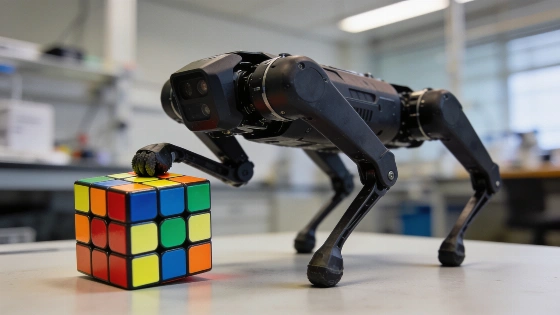
A 4.6-kilogram cube demands more than steady walking from a quadruped. To turn one face without shifting another, ANYmal-D had to brace itself, place its feet accurately and keep its balance as forces changed during contact. The oversized cube measured about 40 centimeters on each side.
ETH Zurich's Robotics Systems Lab demonstrated three successful solves in three attempts. The task is known as pedipulation: handling an object with a robot's feet rather than hands or arms. ANYmal-D balanced on its hind legs while using its front legs and feet to turn the cube's layers. Each solve took about eight to nine minutes and involved roughly 30 robotic actions.
The process began with the robot scanning the cube to identify its colored configuration. A conventional solver then calculated the sequence of turns, while learned control guided the robot's physical movements. Reporting by Heise describes the system's combination of sensing, planning and execution. Kociemba's algorithm generated the solution; reinforcement learning was used for the robot's movements, rather than to discover a Rubik's Cube solution from scratch.
The mechanical challenge was to rotate an individual layer without moving the rest of the 4.6-kilogram cube. As the required contact points changed, ANYmal-D repositioned its feet while maintaining balance on its rear legs. The task required coordinated control of posture and contact while keeping the cube's lower layer from shifting.
The control policy was trained in simulation and transferred using a teacher-student distillation approach. The Verge reported that the project involved reinforcement learning and this method of transferring learned behavior. Together, the components let a conventional planning algorithm specify what turns to make while learned control managed how the robot made them.
The project, titled "Solving a Giant Rubik's Cube with a Quadruped Robot," was published as an arXiv preprint. Its reported results concern a controlled laboratory task: three real-hardware solves, each completed in under ten minutes. The demonstration shows ANYmal-D manipulating a particular object with its feet; it does not establish broad industrial capability or performance across different objects and environments.
The work also illustrates a hardware choice in robot design. Instead of adding a specialized gripper, the researchers used the quadruped's legs for manipulation. A different hardware route is described in a report on Atlas's four-finger hand, designed for object handling and industrial tools. ANYmal-D's result concerns a specific foot-based task, not a direct comparison of the two systems.
The lab has presented foot manipulation as a potential approach for tasks such as opening doors or turning valves where installing a dedicated tool may be impractical. Those tasks were not part of the cube demonstration. Industrial inspection, maintenance and search-and-rescue work also involves varied objects and changing surroundings beyond the conditions of this controlled test.
Reinforcement learning trains a control policy through feedback tied to an objective. In robotics, training can take place in simulation before a policy is used on physical hardware, while teacher-student methods transfer behavior from one controller to another. In this demonstration, learned control handled the physical execution of a move sequence calculated by a cube-solving algorithm.