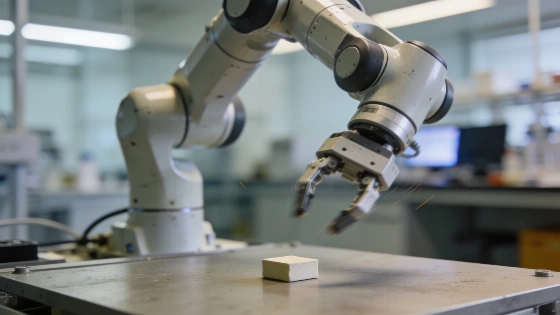
NVIDIA's VFlash predicts complete robot trajectories in one pass rather than decoding coordinates sequentially. Tests reported lower inference latency and fewer 3D prediction errors, though results remain tied to specific tasks and datasets
On Jetson Thor, robot-manipulation inference took 703.3 milliseconds with VFlash, down from 3,552.7 milliseconds using conventional autoregressive decoding. On DGX Spark, it fell from 3,356.5 milliseconds to 649.9 milliseconds. Those measurements correspond to roughly fivefold speedups on each system; separate reported inference configurations showed about a 3.6-fold gain on an H100. NVIDIA researchers say the method generates complete visual predictions in one pass.
Conventional vision-language models often produce spatial coordinates sequentially, so decoding can take longer as trajectories lengthen or include more detail. VFlash instead uses the known structure of the requested output to predict its coordinates jointly. The approach is designed for visual primitives including points, boxes and motion trajectories.
A bounding box has a fixed coordinate layout, while a trajectory may contain a variable number of two-dimensional or three-dimensional points. VFlash uses a lightweight, diffusion-based drafter to fill a masked coordinate block in a single non-causal forward pass. The researchers describe a method in which structurally valid predictions can be accepted without the token-by-token agreement required by conventional speculative decoding.
Across several trajectory-prediction tasks, VFlash lowered errors compared with the underlying autoregressive approach. In selected three-dimensional tests, average displacement error fell by as much as 61%, with results varying by dataset and training configuration. The paper also reports approximately 25 times faster generation for 3D point-motion forecasting in preliminary single-rollout measurements on an H100. That figure concerns one generated sequence, rather than repeated deployment operations.
Speed also translated into a higher score in a downstream manipulation evaluation, though the result came from a simulated benchmark rather than a reported field deployment. On MolmoSpaces, a world action model using VFlash-generated trajectories achieved a 70.2% average success rate across four task suites, compared with 62.6% for the autoregressive baseline. Success rose by 11.6 percentage points in pick-and-place tasks and by 12.8 points in object-closing tasks. A separate robotics evaluation report likewise distinguishes simulated results from physical demonstrations.
The researchers also tested autonomous-driving trajectories with NAVSIM and Waymo datasets, reporting competitive benchmark performance and further planning improvements with reinforcement learning. The study, titled "VFlash: Fast, Accurate Visual Planning via Flash Primitive Decoding," was posted to arXiv on November 5, 2026, and updated on November 6. Its abstract describes the method as Flash Primitive Decoding.