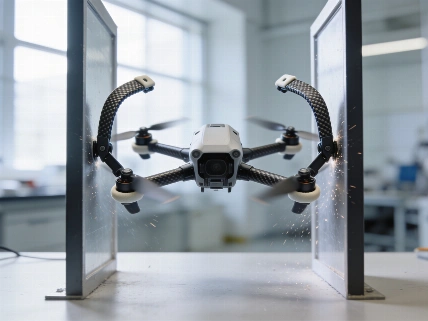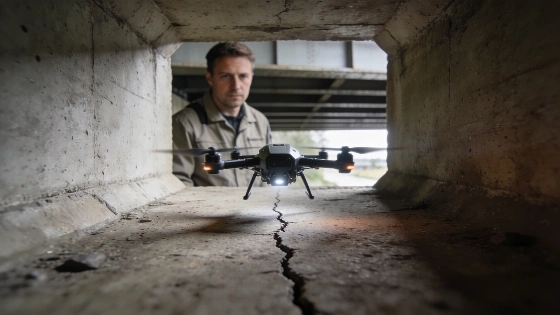
A Ruhr University Bochum team built a compact UAV that uses SLAM to navigate dim bridge cavities and AI to flag hairline cracks. The report describes laboratory tests and gives no result from a real-bridge trial
Thousands of bridges in Germany require inspections each year, and many were built between the 1960s and 1980s. Under the DIN 1076 inspection framework, bridges generally receive a major inspection every six years, a simpler inspection three years later and visual checks annually. Traffic and environmental conditions can damage concrete, making early crack detection important to structural safety.
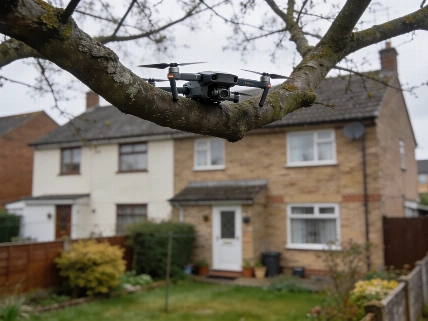
Ruhr University Bochum announced the project on November 12, 2026. The drone is designed for narrow, dark hollow box sections inside bridges, where conventional inspection can be laborious and costly. The research spans the university's Chair of Control Engineering and Systems Theory, Chair of Computing in Civil Engineering, and Chair of Artificial Intelligence and Formal Methods. David Müller and Dr. Raphael Dyrska work on flight control and hardware, while Patrick Herbers and Dr. Marcel Neuhausen work on the AI component.
The aircraft plans its own flight route and uses simultaneous localization and mapping (SLAM) to determine its position while building a map of unfamiliar surroundings without external positioning. Its AI scans concrete for cracks, and inspection results are stored on an SD card. Dyrska said the drone plans its route itself and saves the results directly to the card.
The researchers say the aircraft could reach areas that are difficult or hazardous for people to inspect. Human inspectors would still assess any damage: the drone is intended to collect data and flag areas for review, not replace them. No crack-detection accuracy rate, trial count or comparison with inspectors is reported. A separate robotics report described a moth-shaped prototype that formed a UV-sensitive material, a different laboratory task that provides no evidence about bridge-inspection performance.
As of the university's announcement, the drone was being tested in the flight laboratory run by the Chair of Control Engineering and Systems Theory at the Center for the Engineering of Smart Product-Service Systems (ZESS). Its next planned milestone was a test inside a real bridge. The announcement described the project as a way to digitize and automate data collection while keeping final assessments in the hands of human experts.
The account also identifies Dr. Marcel Neuhausen as a postdoctoral researcher in the university's Artificial Intelligence and Formal Methods work. He said the team wanted to demonstrate the system beyond the laboratory. The university describes the drone as a tool to support human inspectors, who remain responsible for assessing the findings.