UQ-DAAAM compares an object's descriptions across camera views and requests two extra captions when its uncertainty score crosses a threshold. Tests resolved ambiguities for about 92% of objects and raised description accuracy by 5%
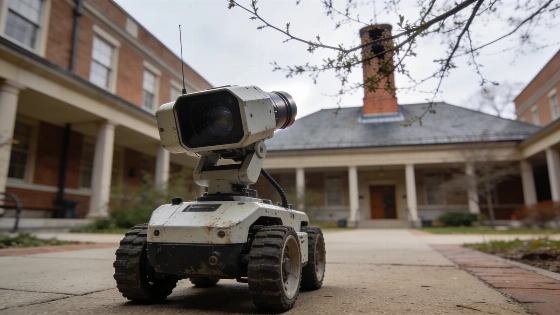
A robot could store a gray chimney as a squirrel after seeing a blurry rooftop image. UQ-DAAAM is designed to catch and revise that kind of unreliable object description before it remains in the machine's memory.
The system extends DAAAM, a robot-memory framework that stores vision-language-model descriptions of objects in a spatio-temporal representation of the environment. UQ-DAAAM checks both the model's confidence in its wording and how much captions for the same object disagree across different viewpoints. When the combined uncertainty exceeds a threshold, the system selects additional views for review.
MIT reported that the refinement process resolved ambiguities for about 92 percent of objects while requiring only two additional captions per object. On the OC-NaVQA description-question benchmark, UQ-DAAAM scored 76.1 percent, compared with 71.1 percent for the original DAAAM pipeline-a five-percentage-point gain. The comparison used GPT-5-mini as the reasoning model across the principal methods. MIT also reported improved answers about object identity, location and when an object was last observed.
The system selects useful images with a rule-based method under a fixed query budget, rather than running the vision-language model on every available view. A large language model then combines the selected captions into a revised description, giving greater weight to newer and less ambiguous observations. The updated description is returned to the robot's memory. The method is described in the paper "Remember with Confidence: Uncertainty Quantification for Spatio-temporal Memory with Probabilistic Guarantees," co-led by MIT graduate students Harry Zhang and Nicolas Gorlo, with Luca Carlone as senior author.
The benchmark measures question-answering performance, not real-world navigation, manipulation or safety. A paper example also showed that a bike-parking rack could remain mislabeled as a phone booth even after clearer images were added. The results therefore describe performance in the reported research setting; they do not mean that every revised label will be correct in every environment.
UQ-DAAAM was developed by researchers associated with MIT's Laboratory for Information and Decision Systems and SPARK Laboratory. The paper's first version was posted on June 6, 2026, and MIT published its account of the work on November 5. The research was planned for presentation at NeurIPS. Carlone, an associate professor in MIT's Department of Aeronautics and Astronautics, said that enabling robots to recognize what they do not know is essential for safe deployment and a positive social impact, as MIT News reported.
Robots encounter different perception challenges in hazardous environments, as illustrated by this Fukushima robotics report. UQ-DAAAM instead targets errors in remembered object descriptions. The researchers plan to extend the system to other platforms, including mobile robotic manipulators, and are exploring whether robots could revisit locations where uncertainty is high and gather better observations.