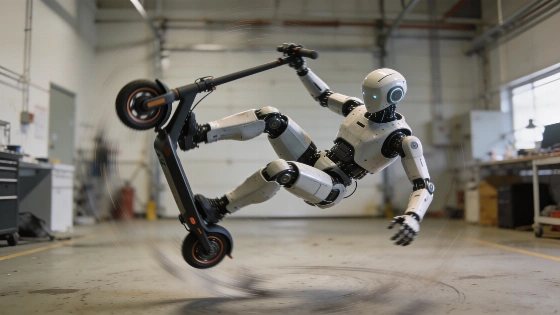
Boston Dynamics used a simple adapter to swap Atlas' feet for scooter wheels, then trained the humanoid to roll sideways and complete a 360-degree jump while refining simulated motor behavior
Before the jump, Atlas rolled its lower body into position for takeoff. The wheeled humanoid then completed a 360-degree turn in the air on its first physical attempt, tracking a trajectory derived from recorded human motion-capture data. Boston Dynamics described the maneuver as relatively low-risk because Atlas followed a predefined motion path.
Boston Dynamics published the demonstration, "Atlas On a Roll," on November 9, 2026, and characterized the wheeled machine as a research testbed, not a product. The experiment tested how a learned whole-body controller transfers from simulation to physical hardware, especially when actuators operate near the edge of their performance limits. The company said findings would inform development of the standard Atlas configuration.
A single custom adapter connected commercially available scooter rims to Atlas' existing ankle actuators. Boston Dynamics said the adapter was the only newly fabricated hardware component in the build. In the controller's model, each wheel was treated as an ankle capable of continuous rotation, allowing the researchers to retain Atlas' broader control architecture.
The focus was motor loading, rather than developing a wheeled transport product. During starts, stops, and turns, the actuators must deliver torque and maintain high rotational speed while supporting the robot. These repeated demands gave engineers a way to examine differences between simulated motor behavior and the physical hardware. Boston Dynamics described the project's goal as testing how faithfully learned whole-body control works with real actuators under demanding conditions.
Reinforcement learning in simulation helped Atlas adapt to the wheels. Engineers adjusted training elements such as reward functions, command ranges, and posture control so the system could use rolling traction. The robot steered its wheels into sideways dashes rather than sliding conventional feet across the floor, alongside rolling and sharp direction changes.
The jump followed a trajectory recorded from a human performance rather than a separately hand-coded jump routine. Atlas moved into its takeoff position, rotated 360 degrees, and landed on its wheels. The successful first attempt demonstrated the transfer of that motion-tracking behavior to hardware.
This work examined motor behavior and wheel-based movement; a ladder-focused humanoid study addressed obstacle courses instead. The demonstrations cover different tasks and test conditions.
Boston Dynamics said the wheeled Atlas will remain a research platform. The company expects the work to inform its standard configuration, particularly by improving actuator models and applying whole-body learning. The experiment follows the company's earlier wheeled robot, Handle, introduced nearly a decade before the Atlas test.
In its official announcement, Boston Dynamics summed up the project: "A wheeled Atlas isn't a product. It's a research testbed."