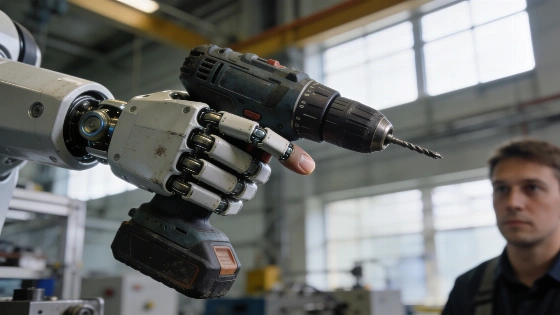
Boston Dynamics unveiled a four-finger, 13-degree-of-freedom hand for Atlas on October 1, 2026. The company says the directly actuated design can reorient objects, recover from slipping grasps and operate demanding industrial tools.
Boston Dynamics is betting that a useful robot hand does not need to copy the human hand exactly. On October 1, 2026, the company presented a new Atlas hand with four fingers and 13 degrees of freedom, designed for more precise manipulation of tools and objects in industrial environments. The specifications were also reported by Boston Dynamics engineers and independent technology outlets.
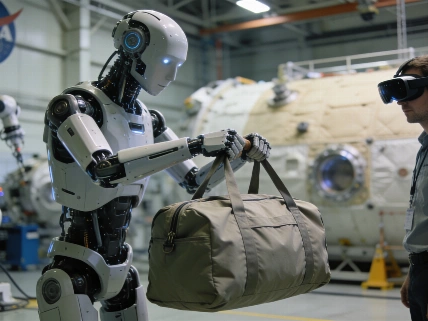
The change matters because Atlas is being developed for industrial environments built around human-scale equipment. The hand is roughly the size of a large human hand and is designed to combine dexterity with the strength required for physical work. Boston Dynamics says the wider Atlas platform is rated for an instantaneous payload of 110 pounds and a sustained payload of 66 pounds, while the new hand can hold a loaded mini-fridge weighing more than 100 pounds. Those figures describe reported capabilities, not a general guarantee of safe operation in every factory setting.
The four-finger configuration is a deliberate engineering compromise. The previous Atlas hand had seven degrees of freedom; the new version raises that number to 13 through four fingers: three degrees of freedom for each of the three non-thumb fingers and four for the opposable thumb. The fingers can also splay apart, which supports more stable pinch and tripod grasps. In robotics, degrees of freedom describe independently controllable motions, but a higher count alone does not guarantee better performance: sensing, mechanical compliance and control quality determine how those motions become useful contact.
The hand uses direct actuation and one actuator type throughout. Its actuators are enclosed rather than connected by cables crossing the joints, a choice intended to avoid a mechanically complicated transmission path. Backdrivable transmissions allow external forces to move the joints instead of being resisted by a rigid, high-friction mechanism. That property can improve physical compliance and give Atlas access to proprioception, the robot's ability to estimate its own joint positions and movement, while supporting recovery when contact does not go as planned.
There is no pinky. Boston Dynamics says its engineers tested whether a fifth finger was necessary for expected tasks and concluded that four could provide pinch grasps, tripod grasps, in-hand reorientation and recovery from a slipping grasp. The hand is also intended to operate tools, including pressing a trigger. A fifth finger would add three more degrees of freedom, along with extra actuators, size, cost and possible failure points. For an industrial machine that must be maintained and operated repeatedly, the omission is an engineering trade rather than an attempt to reproduce anatomy.
The hand's sensing system is as important as its joint count. Reports describing the company's design identify tactile sensors on the fingertips and palm that monitor contact forces and help the controller adapt a grasp to an object's shape and material. Dense contact information complements internal measurements of joint position and motion. In control theory, this combination is valuable because proprioception estimates the robot's configuration, while tactile feedback indicates what is happening at the interface between the hand and the object.
Boston Dynamics says its controls compensate for effects including friction and motor cogging so the hand can be represented with high dynamic fidelity in simulation. Friction can vary with surface material, contact pressure and wear, while cogging produces periodic torque variations in some motors. Accounting for such effects can make simulated behavior more representative, although it does not remove the gap between a model and a changing physical workplace. Research traditions associated with MIT and the broader robotics community commonly treat this sim-to-real gap as an experimental question requiring physical validation rather than as a problem solved by simulation alone.
That simulation focus connects the mechanical design to reinforcement learning. Policies can be trained in simulated environments with variations in motor behavior, surface friction, object geometry and external disturbances before being transferred to physical hardware. This approach can expose a controller to more conditions than a small set of physical trials, but the supplied material does not report a trial count, success rate, confidence interval or independent evaluation of the transfer. Simulation therefore supports the training method without establishing routine reliability in a factory. As in NASA robotic systems, the relevant standard is not only whether a behavior can be demonstrated once, but whether it remains repeatable under defined disturbances and operating limits.
The distinction between gripping and manipulating is central. A conventional industrial gripper can work extremely well when an object's position and orientation are controlled. Atlas is intended for less constrained, human-scale work, including handling drills, grinders, nail guns, torque drivers and welding torches. The company also describes thumb movements across the other fingers and several grasp types intended to keep tools stable while a trigger is pressed. These behaviors require coordinated force and motion: the hand must maintain enough normal force to prevent slip without crushing or destabilizing the object.
The reported specifications show a serious attempt to balance force, sensing, controllability and manufacturability. They do not show that Atlas can independently select tasks, judge workplace hazards or operate without human oversight. The supplied account describes a hand and a training strategy, not a fully autonomous industrial deployment, and it does not provide failure statistics, long-duration field results or evidence that every listed tool can be used reliably across changing conditions. A future peer-reviewed evaluation in a journal such as Nature would need to define task conditions, sample sizes, success criteria and intervention rates before broad reliability claims could be assessed.
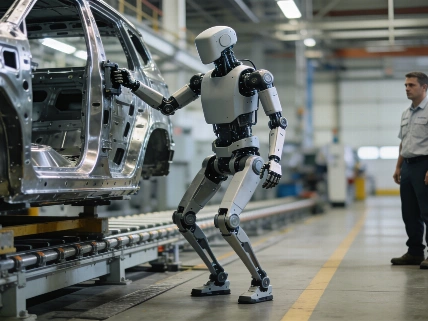
Boston Dynamics and Hyundai are training Atlas at a dedicated facility in Georgia on manufacturing and logistics tasks. Independent reporting has likewise placed the new hand in assembly-line and factory-use scenarios. That context places the hand inside an industrial development program rather than a consumer product release. A demonstration of dexterous movement can establish that the hardware supports a behavior; it cannot by itself establish that the robot will perform the behavior safely around workers, damaged tools, unexpected objects or mechanical wear.
The design also fits a wider robotics problem: hardware and learning systems must be developed together. A hand that is easy to model but too weak is useless for industrial work. One that is strong but difficult to sense or control can create unpredictable contact forces. The four-finger layout is a defensible choice because it targets the tasks Boston Dynamics reports while limiting mechanical complexity, but its practical value will depend on repeated physical testing rather than on anatomy alone. The same systems-engineering logic appears in CERN instrumentation, where mechanical precision, sensing and control must be evaluated as one measurement chain rather than as isolated specifications.
That principle separates Atlas from other attempts to make robots look human. The strongest claim here is not that the machine has acquired a human hand or human judgment. It is that Boston Dynamics has designed a specialized manipulator around measurable control requirements and industrial constraints. Until the company reports systematic physical evaluations and failure behavior, the new hand should be treated as promising engineering infrastructure for robot learning rather than proof of dependable autonomous labor. The connection between hardware design and learned control is also visible in earlier robot research focused on transferring task knowledge across changing manipulators.
Sim-to-real transfer means moving a control policy trained in a virtual environment onto physical hardware. The transfer can fail when real friction, sensor noise, object surfaces or mechanical wear differ from the simulation. Tactile sensing and backdrivability can give the controller more information and physical compliance, but they do not remove those differences. For Atlas, the decisive evidence will be repeatable performance under varied industrial conditions with documented human intervention and failure recovery, not the number of fingers alone.