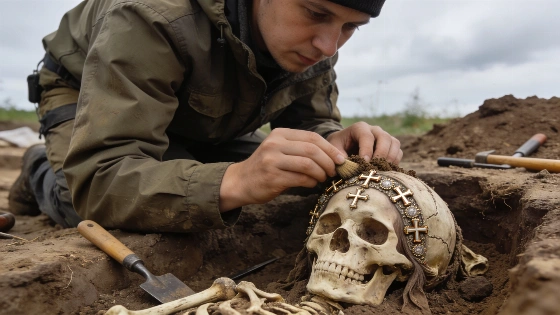
Excavations at the Zvyaginsky II cemetery in Russia's Nizhny Novgorod Region have revealed some of the earliest Murom burials, including a rare high-status female grave with a ceremonial headdress, offering new insight into early medieval populations
Archaeological work at the Zvyaginsky II burial ground in the Nizhny Novgorod Region of Russia has uncovered a series of burials attributed to the Murom culture, with evidence suggesting these may be among the earliest known Murom graves on the right bank of the Oka River. The site, excavated by a joint team from the Institute of Archaeology of the Russian Academy of Sciences and the Nizhny Novgorod Museum-Reserve, provides new data on the origins and development of one of the Volga-Oka region's least understood early medieval populations.
Excavation and Burial Evidence
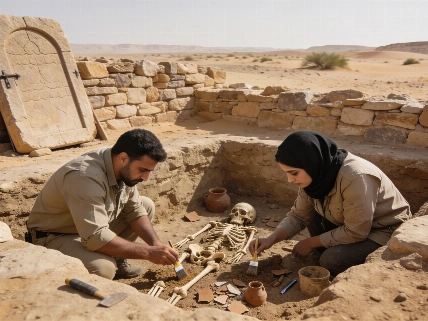
During the 2026 field season, archaeologists investigated approximately 1,000 square meters of the Zvyaginsky II cemetery, documenting 43 burials. The sample included 37 inhumations, one cremation, and six horse burials, with two horses interred in a single grave pit. The focus of this season's work shifted to the cemetery's oldest section, allowing researchers to examine the emergence of Murom cultural practices. Stratigraphic context and associated artifacts indicate that some graves date to the late 6th and early 7th centuries CE, predating the previously accepted timeline for Murom settlement in the area.
Material recovered from the site includes weapons, belt fittings, and personal ornaments. Male graves contained spearheads, darts, axes, and celts, with one burial preserving a complete set of warrior equipment. Several distinctive belt types were identified, including iron-fitted belts typical of Volga-Finnic groups and so-called "eastern belts" believed to have originated in Central Asia and spread into the region during the 7th and 8th centuries. Notably, one female burial included an eastern-style belt and a rare tin-lead clasp with a "winged needle" motif, a form previously found in both male and female graves at nearby sites.
Ceremonial Headdress and Cultural Connections
Among the most significant discoveries was the burial of a high-status female individual, identified by the presence of an elaborate ceremonial headdress. The headdress was decorated with eight cross-shaped brooches: seven small brooches arranged in a halo-like pattern around the skull and a larger two-plate brooch positioned behind the head. The absence of fastening pins and the presence of tin-lead beads suggest these ornaments were sewn onto a textile headdress, rather than serving a functional fastening role. Traces of leather cords bound with bronze rings were also preserved, providing rare evidence for the construction of elite Murom headwear.
Comparative analysis indicates that similar headdress designs have been found at other 5th- to 7th-century cemeteries across the Volga-Oka interfluve, including the Bezvodninsky, Akhmylovsky, and Zheltukhinsky burial grounds. The consistency of these elements across multiple sites points to a shared cultural tradition extending over a broad geographic area. This pattern of material culture is echoed in other regional discoveries, such as the long-term use of communal tombs in the UAE, as seen in the excavation of the Qattarah Necropolis, where burial practices and artifact styles provide evidence for cultural continuity and change.
Chronology and Cultural Development
Jewelry and grave goods from Zvyaginsky II, including boat-clasp torcs, syulgams, glass beads, and decorated breast ornaments, have been used to date many of the burials to the late 7th and early 8th centuries CE. However, several children's graves contained artifacts-such as a necklace of opaque red glass beads and distinctive syulgams-that suggest some burials may date to the late 6th or early 7th century. These findings indicate that Murom communities established themselves along the high banks of the Oka River earlier than previously recognized.
The new evidence strengthens the archaeological link between the Murom culture and the earlier Bezvodninsky-Akhmylovsky cultural tradition, which is represented by sites across the Volga-Oka interfluve. Ongoing comparisons with material from other burial grounds, such as Podbolotevsky and Malyshevsky, are beginning to clarify the broader cultural processes that shaped the region during the third quarter of the first millennium CE. The expansion of Murom culture across the Lower Oka basin appears to have involved both continuity and adaptation, with the population remaining established for nearly five centuries despite the river's role as a geographic boundary.
Research Methods and Limitations
The Zvyaginsky II burial ground is now considered one of the most thoroughly studied Murom archaeological sites. Modern excavation techniques, including advanced digital recording and scientific analysis, have enabled a more detailed reconstruction of burial practices, costume traditions, and social organization than was possible in earlier investigations. Nevertheless, the interpretation of early Murom origins remains limited by the available sample size, preservation conditions, and the absence of direct radiocarbon dates for some contexts. Further research, including ancient DNA and isotope analysis, may help clarify population relationships and mobility patterns in the region.
Understanding the dating of archaeological burials often relies on a combination of stratigraphic context, typological analysis of associated artifacts, and, when preservation allows, direct radiocarbon dating of organic material. In cases where direct dating is not possible, researchers must use comparative artifact typologies and regional parallels to estimate chronological placement. This approach can introduce uncertainty, especially when artifact styles persist over long periods or are shared across different cultural groups. As a result, chronological frameworks for early medieval populations like the Murom are subject to ongoing revision as new evidence emerges.