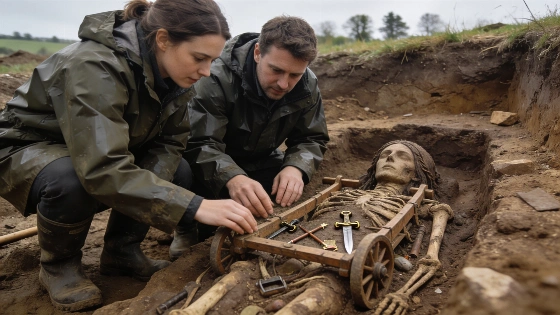
Archaeologists have uncovered weapons in some female burials across Iron Age Europe, raising questions about the roles of women in Celtic warfare. Recent genetic and osteological studies provide new insights but leave key uncertainties unresolved
Archaeological discoveries across Iron Age Europe have long established the Celts as a population with a strong martial reputation. While historical accounts often focus on male warriors, recent research has challenged assumptions about gender roles in Celtic societies by examining burial evidence, ancient DNA, and osteological remains.
Weapons in Female Burials
Excavations at Iron Age cemeteries from France to Britain have identified a small but significant number of female individuals interred with weapons such as daggers, spears, and, in some cases, chariots. For example, a 2,500-year-old cemetery in eastern France yielded several female burials with daggers, while sites in northern Britain have produced graves of women buried alongside chariots. In Britain, osteological analysis from at least three hillforts has identified skeletal trauma consistent with participation in combat among some female individuals.
On the Isles of Scilly, off the southwest coast of Britain, a burial containing a woman and weapons has been interpreted as evidence that women may have engaged in battle. However, the presence of weapons in a grave does not automatically confirm a warrior identity, as grave goods can reflect a range of social, symbolic, or familial meanings. The interpretation of these finds remains debated, with some researchers emphasizing the need to distinguish between occasional participation in violence and formal warrior status.
Genetic and Textual Evidence
Recent ancient DNA studies have added complexity to the picture of gender and power among Iron Age Celts. A 2024 study of burials in Germany reported matrilineal inheritance patterns among elite individuals, while a 2025 analysis of Iron Age English burials suggested that men sometimes married into powerful local female lineages. These genetic findings align with some ancient textual sources that describe Celtic women as having greater autonomy and influence than their contemporaries in Greek and Roman societies.
Classical writers, including Ammianus Marcellinus, described Celtic women as formidable in physical confrontations, though such accounts often blur the line between observation and stereotype. While these texts provide context for the social perception of women, they do not directly document female participation in organized warfare. The strongest archaeological evidence for women in battle remains concentrated in Britain, where both textual and material sources reference figures such as Boudica and Cartimandua, though the cultural classification of these individuals as 'Celtic' is itself debated.
Defining Celtic Identity
The question of whether ancient Britons, including the Iceni led by Boudica, should be considered Celts is unresolved among scholars. Ancient authors such as Strabo distinguished Britons from continental Celts, and the terms 'Celt' and 'Gaul' were not consistently applied to the populations of the British Isles. However, linguistic and cultural similarities have led some researchers to include Britain within the broader Celtic world for comparative purposes.
Archaeological evidence for female combatants is strongest in Britain, where Iron Age chariot burials and historical accounts document women in leadership and military roles. On the European continent, evidence for women fighting in battle is less frequent and often more ambiguous. The interpretation of these finds is complicated by the diversity of burial practices, regional variation, and the limitations of both skeletal and genetic sex estimation.
Limits of the Evidence
Across Iron Age Europe, the number of securely identified female burials with weapons remains small relative to the total number of graves. For example, in a cemetery with hundreds of burials, only a handful may include women with martial grave goods. Osteological evidence for combat trauma in female skeletons is rare and often complicated by preservation issues and the difficulty of distinguishing perimortem injuries from postmortem damage.
While genetic studies have revealed patterns of matrilineal inheritance and social power among some Celtic groups, these findings do not directly establish participation in warfare. The archaeological record supports the possibility that some women fought in battle, particularly in Britain, but does not indicate that female warriors were common or that all women with weapons were combatants. Interpretations remain provisional, shaped by the available evidence, preservation bias, and ongoing debates about gender, identity, and status in the Iron Age past.
Estimating biological sex in archaeological remains typically relies on pelvic and cranial morphology, but preservation and population-specific variation can limit accuracy. Ancient DNA analysis can supplement osteological methods, especially when skeletal indicators are ambiguous or incomplete. However, genetic sex estimation does not reveal social gender or the roles individuals held in life. As a result, interpretations of gendered activity, including participation in warfare, must integrate multiple lines of evidence and remain open to revision as new discoveries emerge.