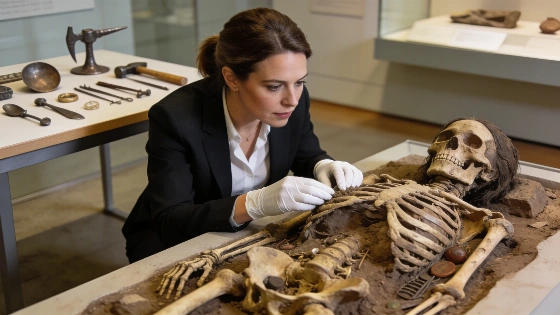
A 4,000-year-old burial near Stonehenge, long thought to contain a male shaman, has been re-examined using ancient DNA analysis, revealing the individual was biologically female and challenging assumptions about gender roles in Early Bronze Age Britain
New genetic analysis of a well-known Early Bronze Age burial near Stonehenge has overturned two centuries of assumptions about the individual's identity. The remains, excavated in 1801 from a barrow near Upton Lovell in Wiltshire, England, were long interpreted as those of a male shaman or metalworker based on the grave's rich assemblage of tools and the perceived robustness of the skeleton. However, recent ancient DNA testing conducted by researchers at the Francis Crick Institute has established that the individual was biologically female, prompting a re-evaluation of gendered interpretations of craft and ritual in prehistoric Britain.
The Upton Lovell Burial
The Upton Lovell burial, located approximately 16 kilometers west of Stonehenge, contained a single individual interred with an unusually elaborate toolkit. The grave goods included stone axes, metalworking implements bearing traces of gold, a touchstone for testing metal purity, and pierced animal bones likely used as garment decorations. Four hollowed fossil sponges, possibly used as cups, were also present. The combination of high-status tools and objects interpreted as having ritual significance led to the longstanding interpretation of the individual as a shamanic figure, sometimes referred to as the "Upton Lovell Shaman."
At the time of excavation, the English antiquarian William Cunnington described the skeleton as that of a "stout man" based on bone size, and museum displays subsequently depicted the individual as male. This assumption persisted for over 200 years, shaping both scholarly and public perceptions of gendered roles in Early Bronze Age society.
Ancient DNA and Osteological Evidence
The recent study aimed to clarify the individual's ancestry using ancient DNA extracted from a tooth and a toe bone. Instead, the analysis revealed two X chromosomes, confirming the biological sex as female. The result was replicated across multiple samples, and no evidence was found for the presence of more than one individual in the grave. Osteological analysis indicated the person was approximately 165 centimeters tall-unusually tall for a Bronze Age woman-and died at around 45 years of age. Skeletal markers, including arthritis in the right wrist, are consistent with repetitive manual activity, possibly related to metalworking.
Previous research had suggested the individual was a skilled goldsmith, based on the presence of gold traces on tools and the technical complexity of the grave goods. In the Early Bronze Age, the ability to work precious metals was rare and may have been associated with ritual or symbolic authority. The new genetic evidence demonstrates that women could occupy such specialized roles, challenging the assumption that metalworking and ritual leadership were exclusively male domains.
Reconsidering Gender and Craft
The reinterpretation of the Upton Lovell burial adds to a growing body of evidence that challenges binary assumptions about gendered labor and status in prehistoric Europe. Comparable cases, such as the identification of a high-status female burial with weapons in Viking Age Sweden and a Copper Age elite woman in Spain, have similarly relied on ancient DNA to correct earlier misclassifications based on grave goods or skeletal robustness. These findings highlight the limitations of inferring gendered social roles solely from material culture or skeletal morphology.
The Upton Lovell case also underscores the importance of integrating multiple lines of evidence-archaeological context, osteology, and biomolecular analysis-when reconstructing past lives. As new analytical methods become available, previously accepted interpretations are subject to revision, revealing a more complex picture of social organization and identity in the past. For readers interested in how archaeologists use systematic survey and contextual analysis to investigate ritual traditions, the documentation of rock art sites in central Mexico provides another example of how field methods can reshape our understanding of ancient societies (see this report).
Material Evidence and Limitations
The Upton Lovell burial is notable for both its early excavation and the preservation of a diverse assemblage of artifacts. The toolkit includes at least two stone axes, several metalworking tools with visible gold residues, a touchstone, and decorative animal bones. The presence of these items, combined with the individual's robust skeletal features, initially led to the interpretation of a male craft specialist. However, the reliance on bone size and grave goods as proxies for gender has proven unreliable in the absence of direct genetic evidence.
Despite the new findings, some uncertainties remain. The precise social role of the individual-whether primarily a craft specialist, ritual practitioner, or both-cannot be established solely from the burial context. The association of metalworking with ritual or symbolic authority is plausible but not directly observable. The interpretation of the burial as that of a "shaman" remains a hypothesis based on the combination of tools and decorative objects, rather than direct evidence of ritual activity.
Ancient DNA analysis has become a transformative tool in archaeology, allowing researchers to estimate biological sex, ancestry, and kinship with greater accuracy than osteological methods alone. DNA is typically extracted from dense bone or tooth samples, and successful analysis depends on preservation conditions and contamination control. While genetic sex estimation is highly reliable when DNA preservation is sufficient, it does not provide information about social gender or identity, which must be inferred from broader archaeological and cultural context.