Archaeologists have documented eight previously unknown rock art sites in the Valdecañas range, central Mexico, using systematic survey methods to investigate the ceremonial landscape and artistic traditions of hunter-gatherer groups from 600 to 1,200 years ago
Eight previously undocumented rock art sites have been identified in the Valdecañas mountain range near Fresnillo, Zacatecas, expanding the known extent of prehistoric ceremonial landscapes in central Mexico. The discoveries, made by researchers from Mexico's National Institute of Anthropology and History (INAH), bring the total number of recorded rock art sites in this area to nine. The findings provide new evidence for the ritual and artistic practices of hunter-gatherer communities who occupied the region between approximately 600 and 1,200 years ago, according to a report from HeritageDaily.
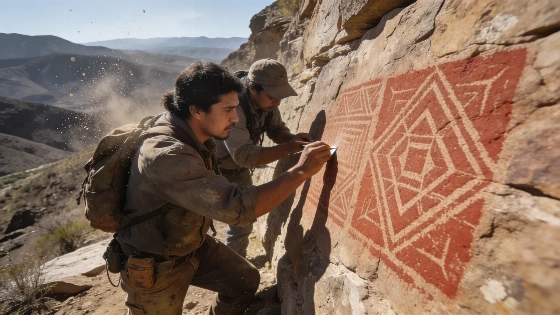
The newly recorded sites are distributed across a five-kilometer stretch of rugged terrain. Several feature painted panels that extend up to 20 meters across rock walls and ceilings. The majority of motifs are geometric, including straight, zigzag, and wavy lines, triangles, circles, and series of dots. A smaller number of animal and human figures have also been documented. One site, located within the center of a stream, has been interpreted as a possible ritual gallery, potentially associated with fertility or hunting ceremonies, though direct evidence for specific ritual use remains limited.
Survey and Documentation
The fieldwork was conducted in 2026 by archaeologists Paola Moulinie Córdova and Jorge Rafael Quiroz Martínez, under the direction of Carlos Alberto Torreblanca Padilla. The project was initiated following reports from local residents of additional rock art beyond the previously known Cañada de Linares site. Systematic surveys were carried out in collaboration with Fresnillo plc, the mining company that owns land in the region. The research forms part of the ongoing Images on Rocks: Rock Art Manifestations in the State of Zacatecas project, launched by INAH in 2021 to document and interpret the state's rock art heritage.
Across all nine sites, the predominant pigment is red, applied using both outlining and flat painting techniques. The consistency in style and technique suggests a long-established regional tradition of rock painting. However, researchers have identified at least two distinct artistic traditions in the area. The Valdecañas style is characterized almost exclusively by geometric motifs, while a second style, documented at the nearby El Capulín (El Dominguejo) site, includes depictions of animals such as goats and a small number of human figures.
Chronology and Context
The rock art is attributed to hunter-gatherer groups who inhabited central Mexico between 600 and 1,200 years ago, based on stylistic comparison and regional archaeological context. No direct dating of the pigments has yet been reported, and the chronological assignment relies on association with known occupation periods and comparative analysis with other regional sites. The absence of direct radiocarbon or other absolute dating methods means that the proposed time range remains provisional.
Archaeologists have also identified circular dwelling structures near Cañada de Linares, but it is not yet clear whether these settlements were directly associated with the creators of the rock art. The relationship between habitation sites and painted panels remains an open question, and further excavation and analysis will be required to clarify the social and ritual context of the artwork.
Preservation and Protection
Of the 480 archaeological sites currently recorded in Zacatecas, only 61 contain rock art, making the Valdecañas range a significant concentration of such evidence. The newly discovered sites are at risk from recreational rock climbing, with climbing hooks and other traces already observed at several locations. INAH is working with Fresnillo plc to establish protection zones around each site to prevent further damage. The need for conservation is underscored by visible footprints and climbing equipment left by visitors, which threaten the preservation of the painted surfaces.
Despite the new discoveries, many questions remain. The ethnic identity of the groups responsible for the rock art is unknown, and the function of the geometric motifs is still debated. The evidence supports the existence of a sustained artistic tradition, but the specific meanings and social roles of the paintings are not yet established. Ongoing research aims to address these gaps through further survey, excavation, and analytical work.
Rock art is a form of material culture that can provide insight into the symbolic and ritual lives of past communities. However, interpretation is often limited by the absence of direct dating, incomplete archaeological context, and the challenges of linking motifs to specific cultural practices. In the case of the Valdecañas sites, the geometric designs and their spatial distribution suggest repeated use of the landscape for ceremonial purposes, but the precise meanings and social significance of the paintings remain open to interpretation. As with many forms of prehistoric art, careful contextual analysis and comparison with other archaeological evidence are essential for building a robust understanding of their place in the ancient world.